I’m just curious and probably a “numbers nerd.” I’m simply interested in watching what changes in lactate readings relative to ventilation, relative to nutrition before or during a workout, how “dehydration” changes lactate readings, for example — even though intensity doesn’t change. Lots of curious stuff. In short, I’m that same lab rat for myself.
More practical — if lactate at a fixed intensity shows a steady downward trend, that means I’m progressing metabolically. That’s clearer to me than trying to pin down “dynamic” progress via ventilation.
Yes, the warm-up clearly plays a significant role. I studied VO2 kinetics research and it was extremely useful. For easy long rides there’s no need for it, but when it comes to high intensity or relatively short races (say up to 60 minutes), my warm-up is very intense — but, as correctly noted, it also includes a fairly long recovery before the start (~20 minutes) or before key intervals ~6-10 minutes. The point is simple — the body mobilizes and stays that way for up to 40 minutes, but thanks to the rest, it fully recovers. This helps me both in key sessions and at races.
Funny, but you still don’t trust the ventilation readings. Your anchor is pace, while ventilation is the variable. For me it’s the opposite — my anchor is ventilation, and pace (power) is the variable. ))
Hehe. . Learning to trust the process. But for the record. I don’t run on pace. Mostly on feel when doing a normal easy Z2 run. And then I check pace, hr. But just for info. And now when I see VE rising, I back of a little. . But I have to admit backing off and slow down is not easy.
I’m wondering whether I do something similar.
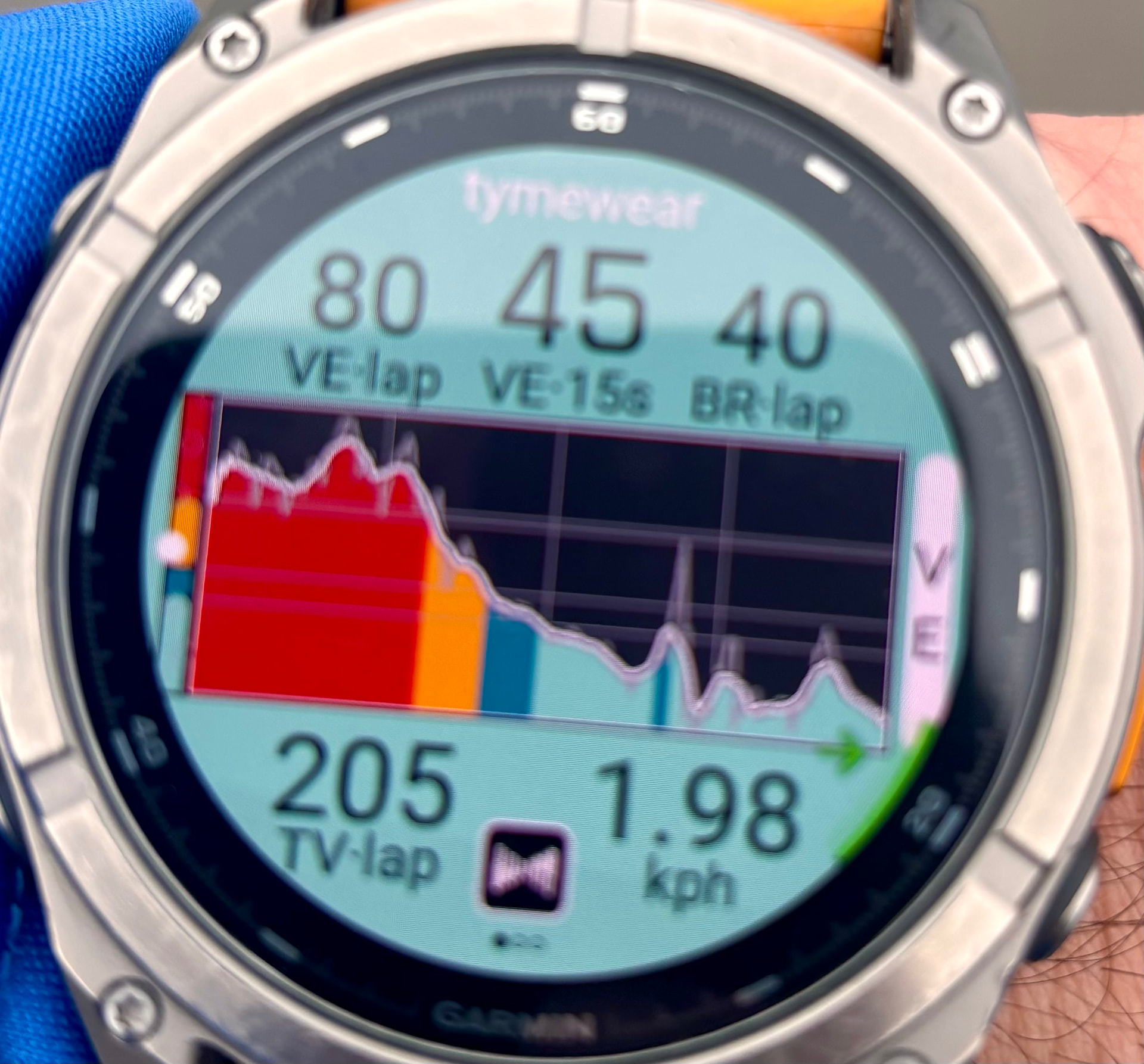
When I’m doing a workout, my running pace is my starting point, but I pay more attention to VE. So if I’m doing a workout in zone 1 or 2, the VE zone color matters more to me. Even if I’m keeping to the pace prescribed in the workout, I slow down if my watch shows I’m already in the yellow VE zone. I’m wondering whether this is a good approach to training with Tymewear and to running “by feel of my breathing” in general.
Here the data of the first 30min with 2 30sec short stops. Two times a drop in TidalVolume causing VE to get lower. No specific change in speed, and if it changed it was slightly faster, but not much…
Yes, the colors on the watch are implemented really well, I use colors constantly. More often at low intensity. Only on structured target intervals, where the goal is to hold an exact VE, do I look at the number. Otherwise, 90% of the time one glance at the color tells me how to adjust intensity. A really cool thing.
There’s a small chance it’s clothing and movement. There’s an even smaller chance it’s sensor failure.
And the first and most common thing — ask yourself what’s been going on with you in the last 48 hours. What load and workouts you had, what your sleep was like — its duration, but more importantly its quality — and what your nutrition was like. That’s key.
And a little life hack: if I see abnormally high ventilation in the moment that I can’t explain by intensity, I can switch to nasal breathing for about 30 seconds. It noticeably and deliberately lowers VE, but then it returns to a normal level.
But once again I’d point out that a rise in VE or a drop in pace in most cases reflects your current state.
I’ll add. 30 seconds isn’t a very significant deviation, especially at low intensity. But for drawing conclusions — use one metric as a constant/anchor. VE or pace. Then changes in the others will tell you more than “a soup of them.” For example, VE always 90 — how does your pace, breathing rate, heart rate change? Or if pace is always 5:45 — higher VE means your movement is more expensive (metabolically). VE stable but BR high — your CNS is probably suppressed by external (accumulated) stress.
Thx. But morning metrics HRV, Sleep, RestHR all were in place at good level. And did not feel tired. Maybe not fully fueled but not empty or disastrous. And if it there are underlying issues, would my heartrate also give some indications? Because when I went really slow today, HR was 109 for 5min and that is very low. So, HR, pace, RPE felt like super easy, only VE did not respond.
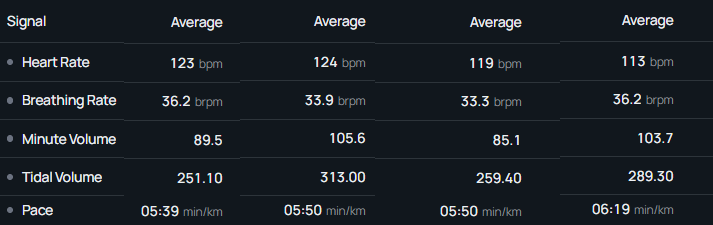
At comparable easy running intensity, heart rate and breathing rate, my measured tidal volume can differ by roughly 20–30% between sessions (e.g. ~240 vs ~300–320), causing VE to differ by a similar amount. I have also observed VT changing from ~304 to ~240 after a brief stop within the same activity without repositioning the strap. Is this expected physiological variability, or can strap tension/baseline calibration affect absolute tidal-volume and minute-volume measurements?
Of course, strap fit, its tension, and changing clothes can have an influence. But in my experience it doesn’t have a dramatically significant effect. What does have a significant effect is a change in movement pattern — cycling, running, skiing. And within one sport there’s almost no effect. My strap is always in the same position on the 3rd notch. So I almost rule out (for myself) the influence of external factors.
Tidal volume depends on breathing rate too: higher rate — lower depth. You can see this clearly.
First run: pace 5:39, HR 123.
Last run: pace 6:19, HR 113.
A classic pattern of accumulated fatigue. (I’ve pointed out before that for me a low heart rate is actually not a very good sign.)
At the same time, in workout 4 the VE is 104 — like in workout 2 (106), but pace dropped from 5:50 to 6:19 — meaning breathing economy got worse. You’re running slower at the same “oxygen cost.”
Yes, this is all visual — without accounting for terrain and wind.
True, but the low HR was because I tried to run verrry slow so that my VE would get lower. But even then my VE would not drop. It is very normal that at 113 heartrate I run at 6:15 or lower. In my first run I ran on feel, last run I tried to run based on VE value.
In this video, the relationship of VE/TV/BR vs power/pace/RPE is explained in simple and clear terms. Which confirms my empirical observations that VE is intensity and BR/TV is stress. TW for coaching
This is an exclusive offer from the TW developers
I don’t know — it’s a Connect IQ app. On the watch I selected the TW field — a single field that by default includes the graph. And the values are chosen in the app settings. They (TW) updated it, and now you can trim the ventilation “peaks” on the graph so it looks visually smoothed. It’s gotten really cool. Honestly, this one field is enough for me overall.
 . Learning to trust the process. But for the record. I don’t run on pace. Mostly on feel when doing a normal easy Z2 run. And then I check pace, hr. But just for info. And now when I see VE rising, I back of a little.
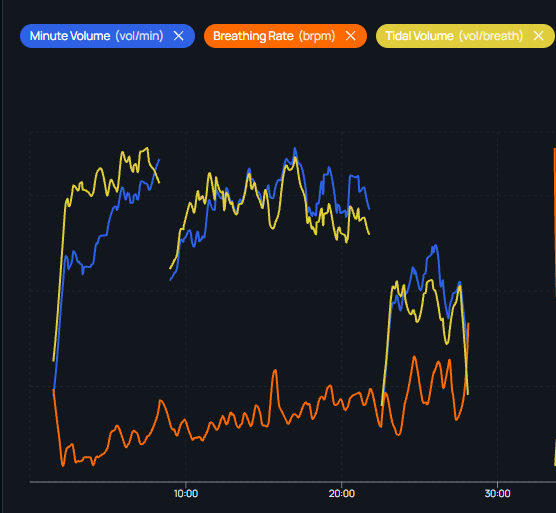
 . So goal was to run around VE 90 like a few days ago when that went perfect, but this was horrible.