I was curious about anybody who has a time where chest strap and app if they feel like they’ve been able to get some really valid information that they weren’t getting through heart rate power meter, and possibly even lactate testing?
Looking to get one in considering whether or not it’s worth the investment and giving me any useful training advice.
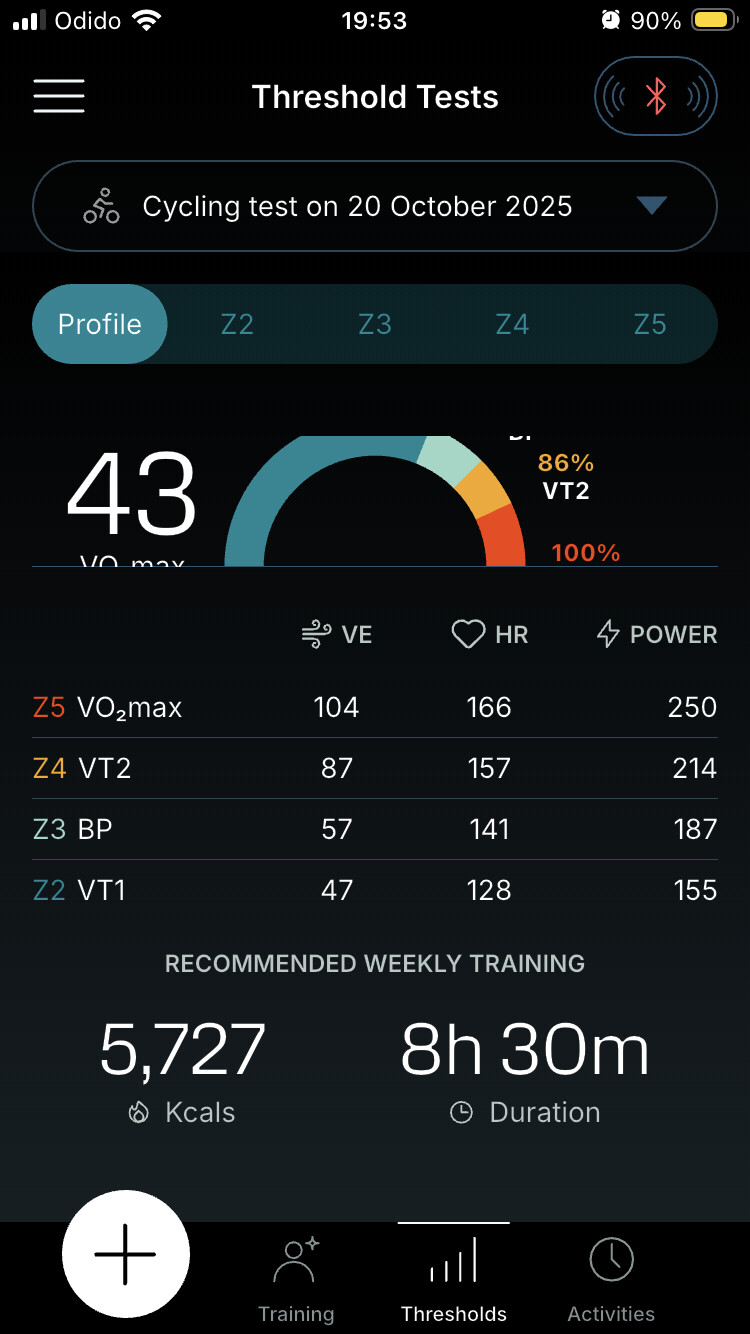
Hi, I have Tymewear for a month now. Since I started training with it, I no longer look at my heart rate and power output because they vary from day to day. Tymewear offers a whole new dimension. Simplicity itself. Just train in the zone you’re supposed to train based on your tests. The most important thing is your VE, which is derived from your breathing rate x your tidal volume. If you’re tired, you’ll ride with low wattage afterward to stay below your VT1. This way, you always stay in the right zone, whether you’re tired or fresh. Riding with wattage burns you out because it doesn’t take your internal workload into account. I’ve thrown everything away. Estimated values from Xert, Garmin, etc. You also learn a lot from your breathing. Breathing more calmly during higher exertion reduces acidification. You can see this from your VT BR and VE. It’s really worth the money. Of course, you do have to delve a bit deeper into the subject, but that’s precisely what makes it interesting. You learn a lot about your body. And yes it match very well with lactate testing. Only now you have it live.
They’re addressing their growing pains quite quickly. It’s in an early phase, but I agree with Pabo01 that the technology is worth it. Given the invervals.icu integration I’m excited to see how people work this into their data. With custom fields I can imagine making the Zones for VE/color coding them to see changes during efforts.
IMHO this is a really game changer. They are a small business company so maybe they’ve not too much budget to spend on advertising but they should have.
Given the accuracy of the strap and their algorithm, it’s more reliable than a continuous lactate monitor (still not released).
It calculates also the vo2max with 3%
error (much lower than some metabolic cart)
For 299€ it’s a must buy
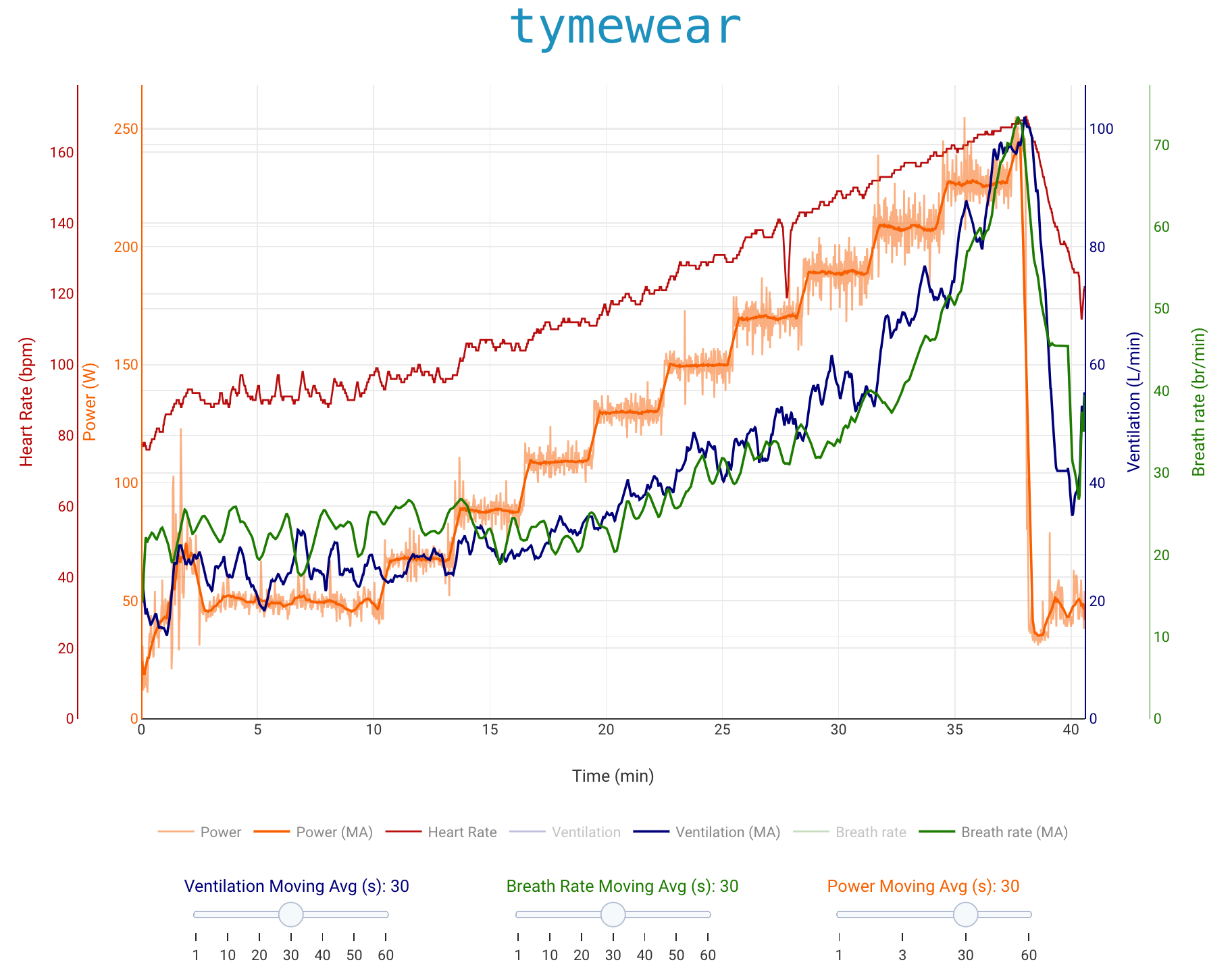
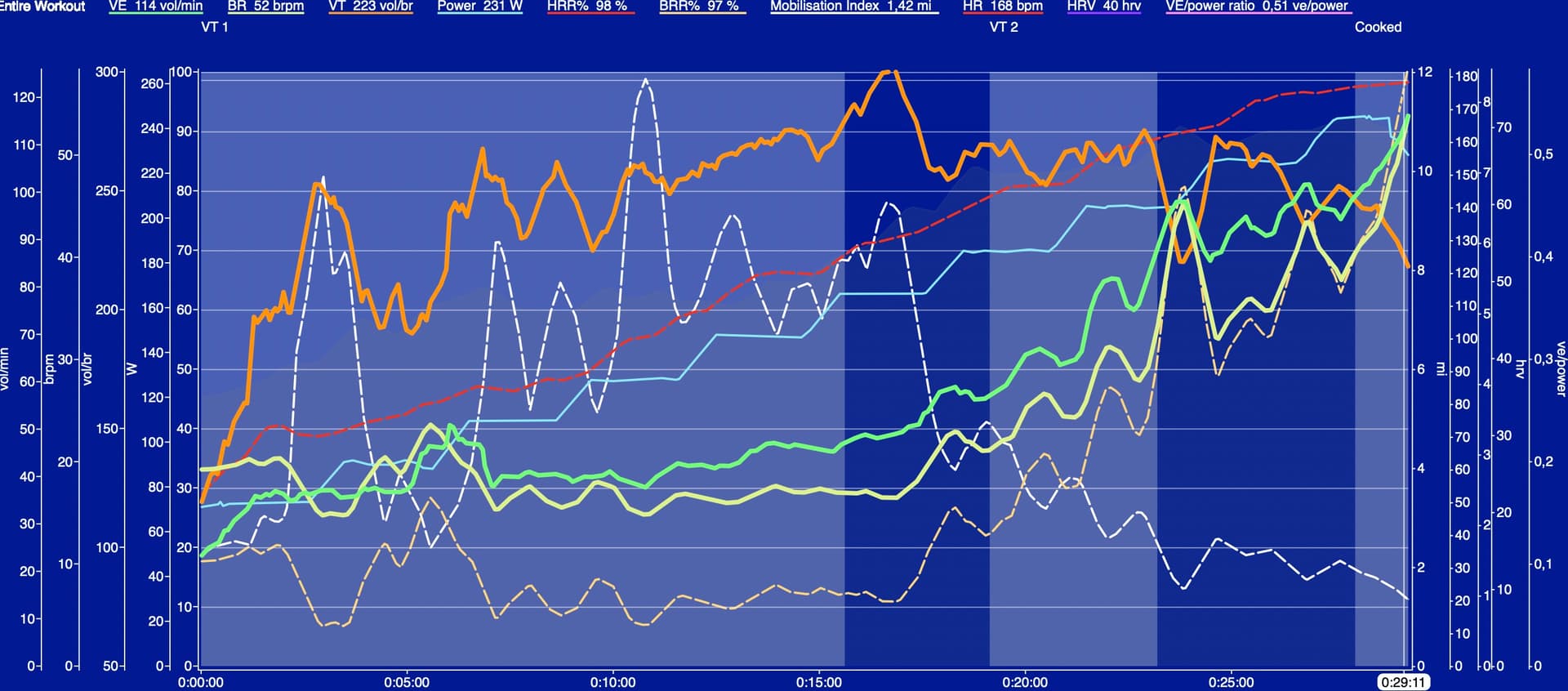
Have you used the graphs on Intervals.icu ? If so do you have one of the step test you could post on here showing the deflection points.? I’ve got one on order and am curious to see one.
What you said is exactly why I ordered one.
Thanks
I’ve been riding with power for 10 years and it hasn’t burned me out.
Suppose that measuring VE does actually tell you precisely which internal workload zone you’re in. How do you know that that is more important than which output zone you’re in (ie power)? How do you know which zone you should be in anyway? How do you know that staying below VT1, say as opposed to slightly above VT1, is important when you’re tired?
No, I have not used graphs from ICU intervals. These are actually a bit too simple and you cannot do much with them. You cannot get breakpoints from them either. I use WKO 5. But when you do a test with the Tymewear app. they will send you within 24 hours the results, with your zones analysed.
I took a look at the paper that is cited on the tymewear website a few times.
“Apparently healthy, but sedentary men and women (n = 42) were randomized to a non-exercise control group or one of two exercise training groups. Exercise training was performed 30 min/day on 5 days/week for 12weeks according to one of two exercise intensity regimens:”
I would be interested to see studies involving people already engaged in persistent and consistent endurance training.
The accurate measuring of “breathing” could be useful and usable data.
If tymewear is the device that delivers that accurate measuring capability, then there should be some very interesting developments, as more people start to work with that data.
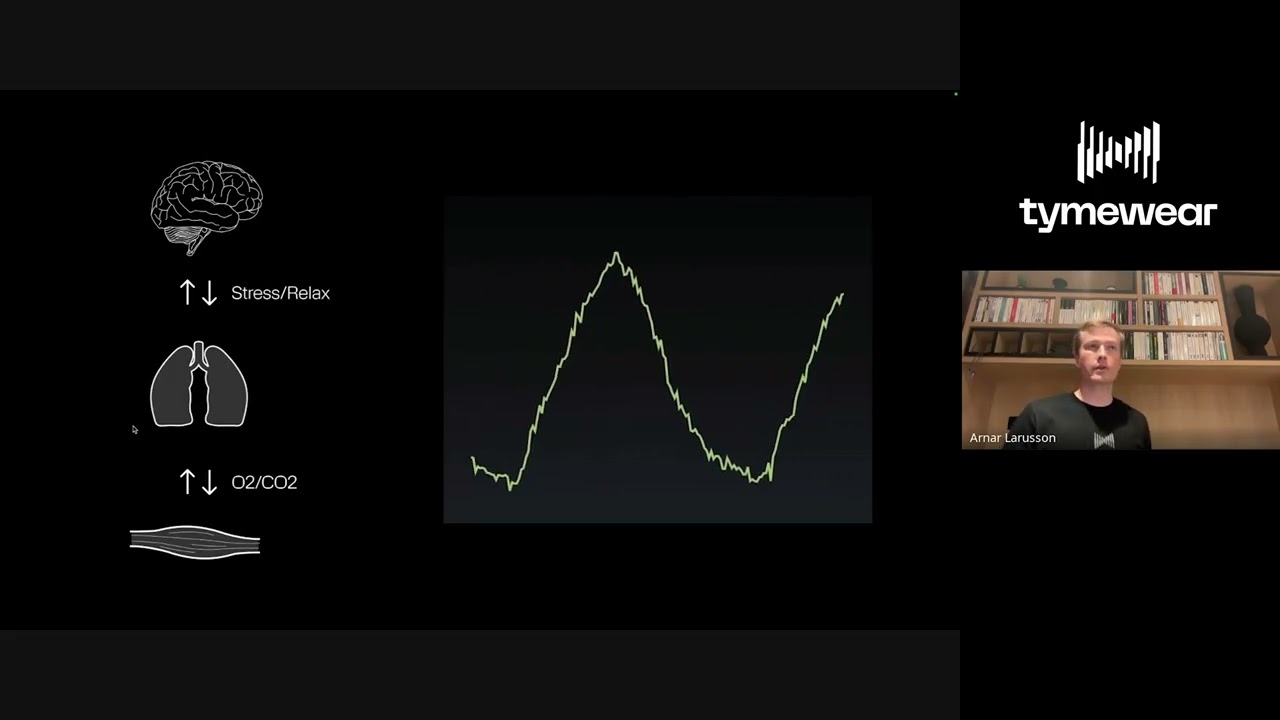
I watched this video by a co-founder of tymewear too
I’m not enough of an early adopter to buy one right now. But I wouldn’t rule out buying one sometime.
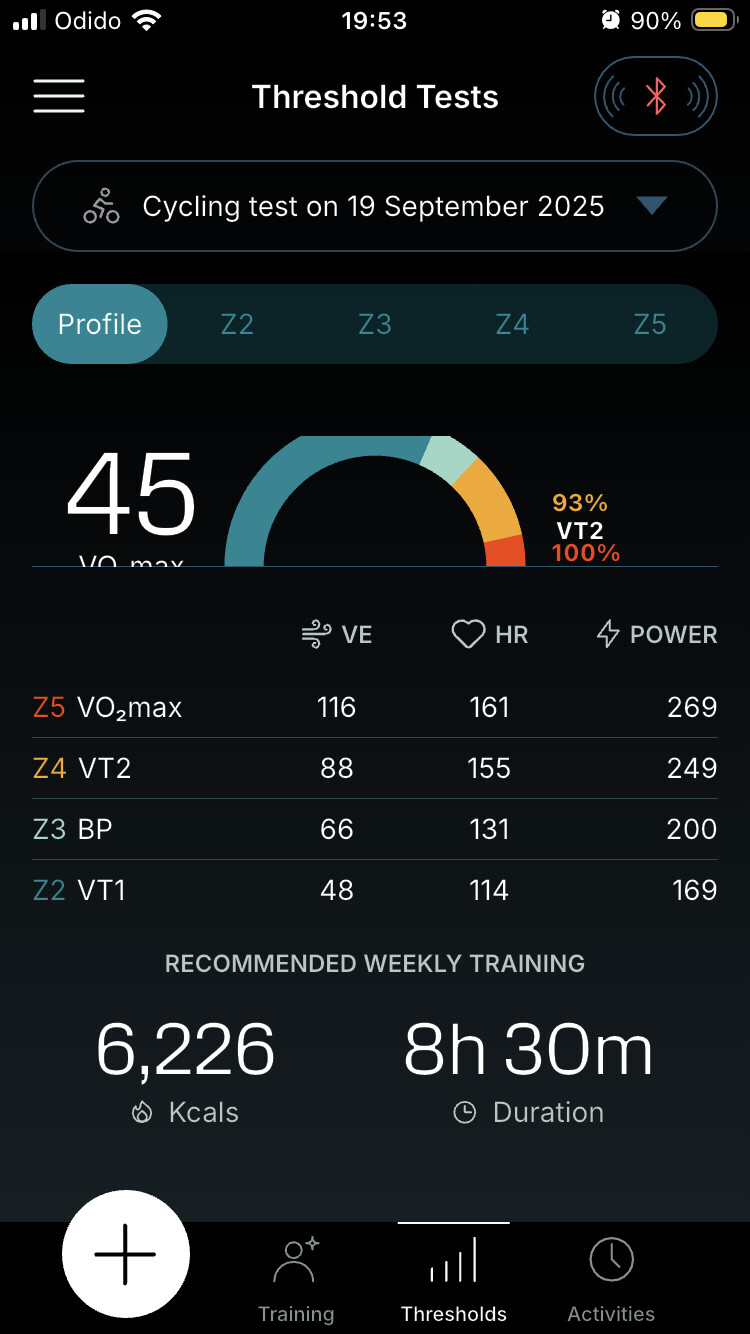
These are the final data from yesterday’s test. The VE minute ventilation values are fairly consistent with the previous month’s test, but the wattages are significantly lower. This is clearly a case of one day being different with power and heart rate. Therefore, in my opinion, riding at VE is the way to go for me.
Are the intervals graphics too simple? It seems to me that you haven’t evaluated the possibilities of programming them with JavaScript. It’s much more powerful than the pseudo scripting of wko5. Apart from how poorly it’s done, it’s not even programmed for 64 bits. Check out the documentation at intervals.icu and you’ll see how powerful it is.
No, I barely managed 6 hours a week. And only in the last two weeks did I start Z5 training, half the recommended amount of 36 minutes per week. I mainly trained on breathing more calmly during different zones because my tidal volume remained the same during the first test. This is a sign that my CO2 tolerance is lagging, resulting in insufficient oxygen delivery to the muscles. This could very well be true, because my breathing always increases rapidly, but I don’t breathe deeply, so I quickly plateau. So my goal this month was to increase my tidal volume from 1.75 liters to 2 liters to make my breathing more efficient.
I’ve found it interesting so far, but also wonder why my VE zones are often (very) different from the W/bpm ones. Is that real or is that a measurement issue? Is it because I breathed more consciously during the test than during random rides? Or was I in much better shape during my test than during almost all my subsequent rides? (I surely doubt it.)
Test results are interesting and the differences you cite are worth thinking about.
But I am interested to see the results achieved by following the recommended training plan.
Ideally from someone with a track record of successfully completing training plans based on HR or power.
The hypothesis to test is that for cyclists consistently training, properly completed plans of comparable volume, aimed at the same goal, will deliver pretty much the same outcome, whether they are based on HR, power or VE.
That said, whatever it takes to get more people doing more exercise is a high priority. If using tymewear is what it takes to motivate someone to train (more), then I am all for it.