Yes, another AI Coach... Coach Watts

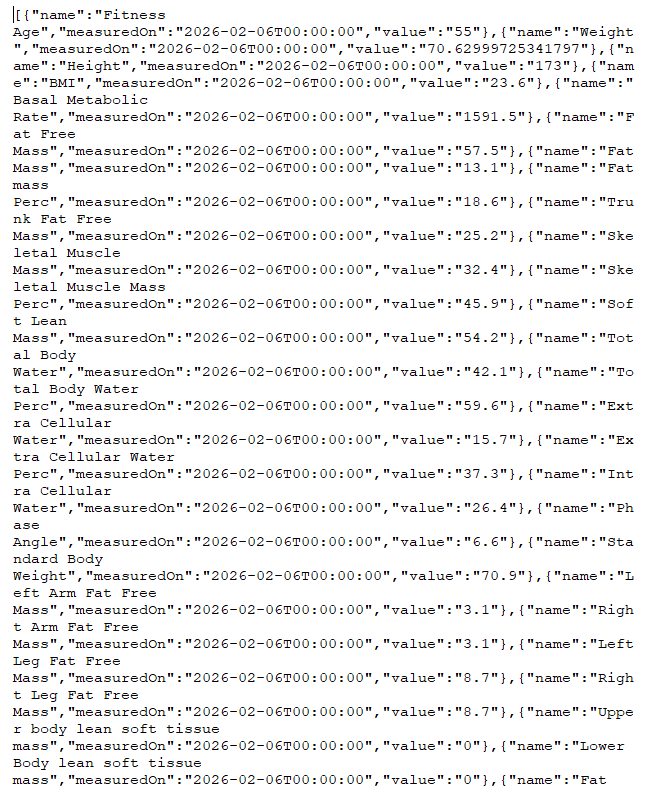
I noticed that the Vital Signs section has a JSON file download. If CW can handle JSON files, is there any chance of CW being able to import a JSON file from Technogym’s Mywellness Biometric Analyser? I have screenshotted what the file looks like in Wordpad below. I have tried to convert & then reformat the file into a CSV that Intervals will import into its Wellness file but have failed miserably even with the power of Gemini Flash guiding me as to using Pivot Tables. But even with it pivotted I cannot even get past the first column not being recognised as a date despite reformatting it as such.

Even if there was not a specific wellness screen where the values could be viewed (there are a lot in the JSON file that are largely irrelevant, at least CW would be able to include the JSON metrics into any advice e.g. nutrition, caloric deficits, hydration leverls, hypertrophy monitoring (trunk, arm & leg muscle/fat mass) etc. It seems a shame me collecting this info but not being able to incorporate it into other analyses.

@Giuseppe_Leccese

Is this directed to me or @hdkiller? If me then see below.

I use/import only HRV4 metrics as I prefer them to Garmin. Marco Altini is very open about how his metrics are calculated & demonstrates through quality research their validity; whereas Garmin keeps a lot of their calculations as proprietary & so validity, though perhaps equal to Marco’s, is not easy to check. Marco, in fairness has said that Garmin reading & the HRV4 app one tend to be much the same & so consistency in using one OR the other is the main point. Garmin’s is certainly easier to use but then edge case athletes e.g. with arrhythmias (see below) might prefer HRV4’s better transparency of what is happening? So it is up to you which you import into Intervals & therefore Coach Watts depending on your own choice & situation. If you import both then they are not necessarily compatible (edge cases) & so could confuse the Wellness analysis picture.

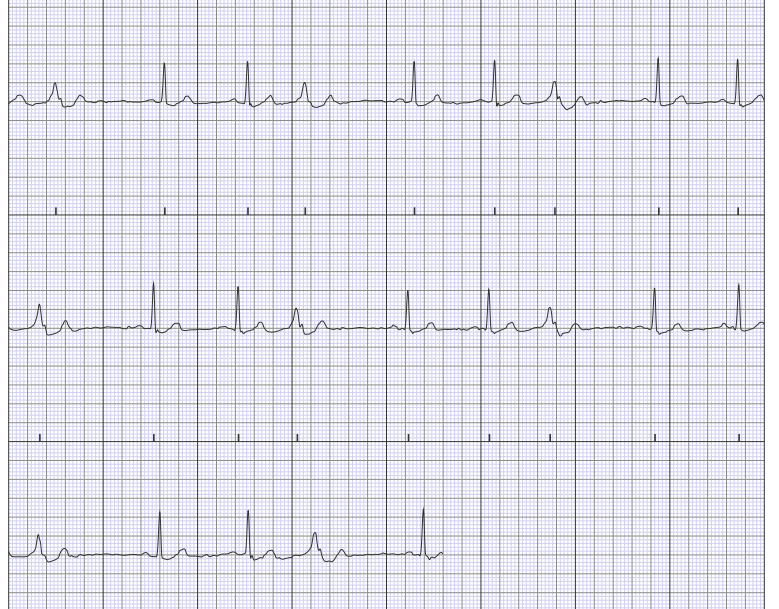
Garmin’s Overnight HRV as I said before is hit or miss for me as I can get an arrhythmia that would render the value meaningless. An arrhtymia will change the RR value & if you are getting thrity every minute as can happen for me then the value is nonesense. See my ECG below. Fortunately, I do not have to worry about other stressors e.g. recent exercise, caffeine, alcohol etc affecting the obernight HRV reading. But also when taking the HRV4 measurement I can monitor the signal quality visually & so confirm if the HRV value is likely reliable. If, for example, I cough slightly during the reading then I can see if it affected the HRV4 app’s reading whwereas I cannot not with the Garmin one. And as I said before if your are one the endurance atlhetes who unfortunately is affected by an arrhythmia this will likely be evident with the HRV4’s graph, even if quite subtle. Not so with Garmin’s overnight HRV reading or their Morning Snapshot unless you palpate a vein during the reading & it is quite a significant arrhythmia.

However one drawback with seeing/watching the tracing is that I somethiomes perhaps unconsciously affect the reading by changing my breathing. For example if I want a higher reading then I can consciously breathe a bit deeper or hold my out breathe (before breathing in again) for longer (that is the low part of the HRV cycle) than I realistically would normally be able to sustain for long. That is where the breathing guide with the CameraHRV is good as it does maintain consistency of breathing if followed. HRV4 app could do with that perhaps.

@MedTechCD is far more knoweldgable about HRV recording etc than I am & so could perhaps help advise.

1 Like

My advise has always been to use morning measurements and I myself use Kubios with the Polar H10 strap.
If you use HRV4, ppg (camera measurements), are validated and equally good. But I would never trust ppg HRV measurements from a wearable, worn during the night.
When it comes to morning measurements, the rules are to discard and restart a new measurement whenever you had to cough, swallow, burp, whatever. All these are creating misplaced RR intervals/artefacts. ‘Normal’ artefacts are filtered out by the HRV app but the above create multiple sequential artefacts and the number of usefull RR intervals becomes too small. You’re better of with a short (30sec) quality measurement then with a 3min low quality one.
For you specifically, the number of arrythmia’s in the screenshot is up to 1 out of 3, which is a lot. A 60sec morning measurement is probably a better advice in that case, especially if you have low HR. I guess you do consult a cardiologist?
Furthermore, you should just relax and close your eyes, breathing naturally and try to keep your mind free. Any thought of something that could irritate you, any noise, movement, etc will influence the results.
To avoid any misunderstanding, ppg (camera) wil not give you an ECG trace, you need a chest strap with ECG possibilities, like Polar H10 for that. Ppg only detects the r-peaks, not the entire trace. Polar H10 records 130Hz ECG.

1 Like

@MedTechCD

I did try using the HRV4 with a Polar H10 but I think that the act of cosnsciously putting the chest HRM on possibly could have affected the “naturalness”/spontaneity of taking the reading (as to just holding a phone) & so perhaps distorted it a bit at times. As you say I could have allowed even more time to forget that I was wearing it (if the tightness of it is ignorable) but I am happy with Marco saying that the PPG is accurate enough where care, consistency & common sense are followed. I did discuss the arrhythmia with him years ago & he warned about the effect of the PVCs on HRV. My HR sometimes shows as low (30bpm as the long QRS is ignored) but actually the cardiac output seems OK even when the PVCs are 1:1. Perhaps doing lots of Z1-2 for many years, my heart is large enough to compensate for (relative) ejection fraction drop from the compromised QRS beats?

I am aware that the PPG is the optical signal strength & not an electrical signal as with an ECG. The ECG (taken with a Kardia) was just to illustrate my paroxysmal PVCs for Giuseppe & what effect it would have on the RR intervals. To my surprise, my cardiologist, a marathon runner himself, was pretty chilled about my arrhythmia as I was not feeling any palpitations. Also I was a nurse who looked after some of his patients & so he knew me (& my knowledge level) fairly well which probably helped. His echocardiographer was not so relaxed though as she took an age to record my Echo & eventually called in a senior. Needless to say, that did not really help my arrhythmia at the time.

The arrythmia in itself is usually benigne, but the high number of them could be worrying. If your cardiologist had a look at it, he surely knows if follow-up is required or not.

Now regarding HRV: in the above image are 23 beats, but only 7 valid RR’s. If your resting HR ( artefacted beats included) is 46, then a one minute measurement only has 14 RR intervals to calculate a HRV from. Without arrythmia, that number would be 45 RR intervals. That is a significant difference (factor 1 third) and I doubt that in your case, HRV will ever return a usable result. The artefact number is surely different from day to day and HRV is to be followed as a trend. Seems impossible with those variations.

Luckily that significant arrhythmia has settled mostly now. But yes at that time the HRV was indeed nonsense. I am still very wary of believing my HRV at times even now though.

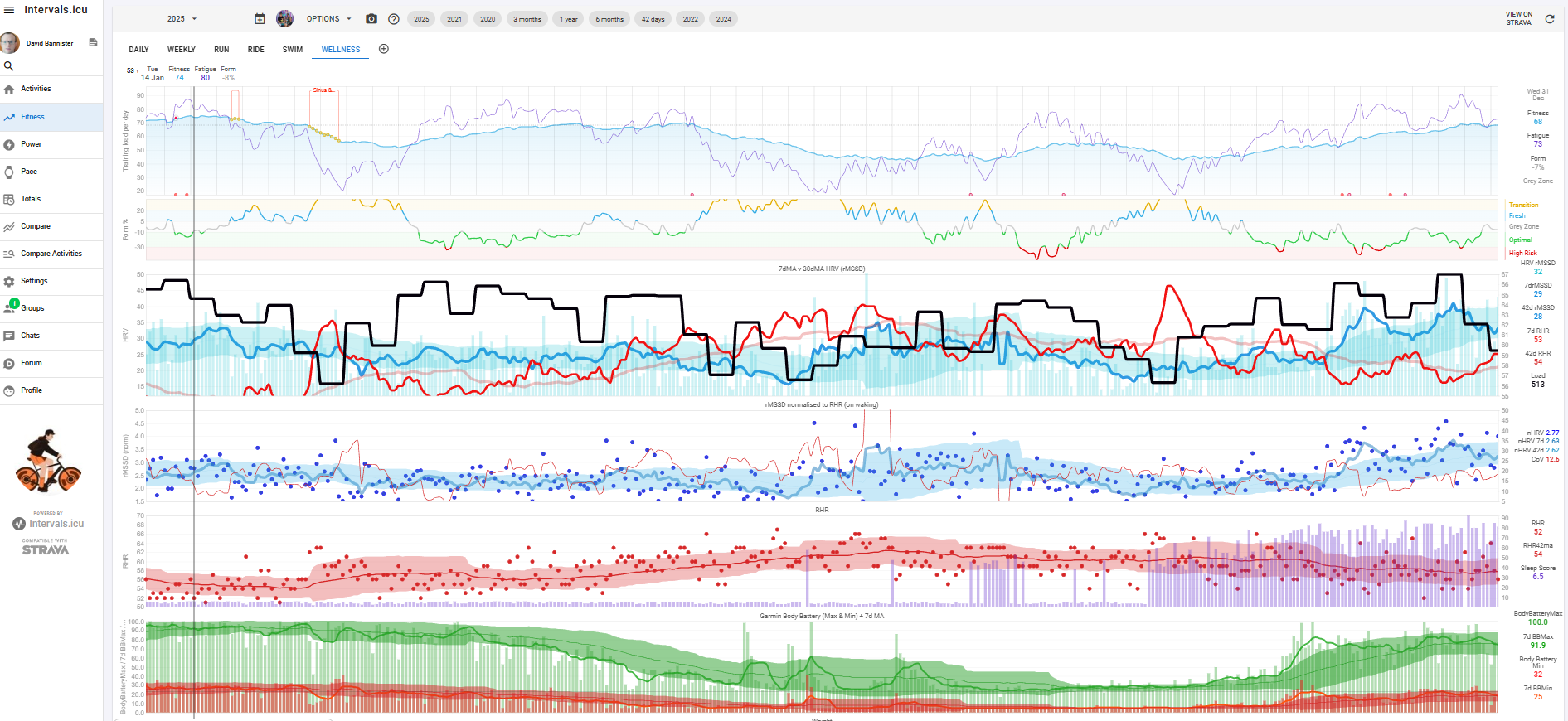
Below is my Wellness screen from 2025 which shows hoe erratic & uncorrelated RHR, HRV & Load has been. So I cannot really trust HRV in isolation. That is one of the issues that I am having with Athletica & Coach Watts as most AI coaches are a bit too reliant on a decent HRV in terms of their advice. CW’s chatbot “New Chat” (v the automated analysis agents on the platforms) is better because at least I can have the discussion about my arrhythmia v reliability of HRV there.

@Giuseppe_Leccese

I’m not sure if my comment will help you any further at this point. In addition, the coach is developing very quickly at the moment, and I don’t know if Laszlo has already made any changes here.

I created a plan about 10 days ago and also had the problem that my personal instructions were not implemented 100%. Basically, the structure of the plan was fine, but the details within the weeks were not correct.
When I then activated the “Generate Plan with AI” button within a training week, my prompts were implemented 100% for that week.

1 Like

@David_Bannister And how do you enter the HRV4TRAINING values? Do you import them manually? I noticed that Garmin “morning check” varies by 10/15 points more than HRV4TRAINING BUT IN THE END IT MAINTAINS the same trend… if one increases the other also increases and considering that it automatically loads on intervals I think I will use that one

@David_Bannister, as I see you know well HRV4Training and its dynamic, do you know how is determined the HRV4T readiness score pass to intervals? I find it kind of unreliable, as it is really stable, also in the days that I am feeling off … thanks in advance for your input!

Yes, another AI Coach... Coach Watts - #302 by hdkiller.

I import them from HRV4 app into Intervals using the method in the above link as I explained previously. It is semi-automatic as you will have to select the “Data Export” from the HRV4 app’s menu options though. If using HRV4 app’s metrics you will need to remove those from the Gamrin wellness sync or one will overwrite the other normally.

Garmin has its own proprietary/secret algorithms to calculate rMSSD & so that might explain any differences in the rMSSD reading perhaps but difficult to prove. Also comparing beyond Gamrin & HRV4, watch out for if the measurement is rMSSD or SDNN (usually Apple) that is being measured as they differ significantly. I find comparing both useful as it can hint at the qwuality of the reading that I am getting. If they go off in different directions for example I will usually repeat the measurement just in case.

But as you say it is the trend that matters & not the raw figure anyway. I think that Garmin is “internally” consistent which is the important aspect sp long as the user that is taking the reading is equally consistent. But there in lies the issue with many things. People do not always follow precisely the same process/situation when taking meausrments & that is often the cause of differences.

Biometric scales are a prime example of this where people do not follow a process and then blame the equipment for inconsistency. They might be right in many cases where the equipment manufacturer/marketeer over promises, but not following the same process each time can also introduce variables which skew the results That is why lab testing is fastidious & expensive. so for biometric scales ideally you need to do it first thing in the morning having emptied both bowel & bladder (could be 1kg or more difference) & drank/not drunk the same amount of fluid (perhaps another 0.5kg) . Boith of those will also potentially affect interna hydration levels which affects cellualr conductivity. Your skin needs to be much the same level of dampness (electrical conductivity again for gauging fat v muscle) & the room temperature probably much the same (level of dehydration) , so could vary season by season. I also see people standing on them in socks which again will reduce conductivity & skew results.

Fortunately HRV is not quite so fickle but care & consistency is still important to make the result more reliable/reproducible. So even Garmin’s more automatic & convenient method is not infallible. With HRV4, at least you have a better chance at controlling the variables.

1 Like

@Marco_Saraceno

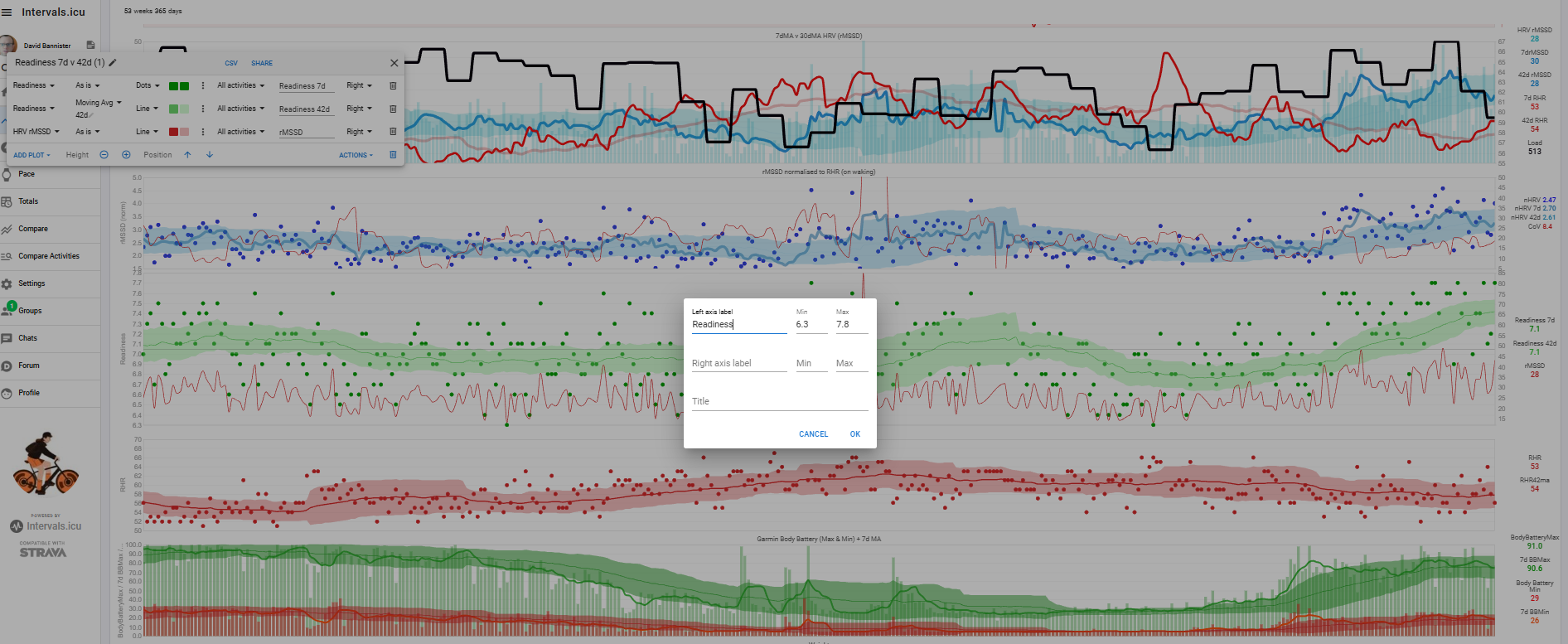
From what I have read from Marco Altini the Readiness Score takes in a wider view than just the rMSSD. But this is Marco’s secret sauce as Garmin has theirs. So the tags & age also influence it for example. I am a boring retired teetoller, no kids with a very regular routine yet my HRV4 Readiness Score looks like a map of the Himalayas. So whilst the Readiness Score might not seem to change much, if you narrow the scale of the graph you will (probably) see that the daily figure can go above & below the 1SD band quite regularly to indicate a significant variance. If that is not the case for you then you are either a black belt equivalent in Transcendental Meditation or perhaps not varying your training intensity enough? If you look at my graphs then you will see that the Readiness does follow the rMSSD (red line) pretty well. As you can see it is about setting the scale (& height also) of the graph appropriately.

From Perplexity

what metrics does the HRV4 app to calculate its readiness score

HRV4Training does not fully publish the exact algorithm or weightings behind its readiness score, but the company has shared the main inputs it uses and the logic behind them.hrv4training+2

Main physiological metrics

HRV4Training relies primarily on morning resting HRV, especially time‑domain metrics such as rMSSD, taken under consistent conditions upon waking.[aiendurance]​
It interprets this HRV value relative to your own rolling baseline, flagging when today’s reading is substantially higher or lower than your normal range.marcoaltini.substack+1

It also considers resting heart rate in the same “deviation from your baseline” way, since elevated resting HR with suppressed HRV can indicate higher stress or incomplete recovery.[aiendurance]​

Subjective metrics

The app combines your physiology with your self‑reported “subjective feel” each day (e.g., how fatigued or sore you feel, sleep quality, stress, muscle soreness, motivation).[hrv4training]​
Daily color‑coded advice and readiness‑type outputs come from merging these subjective scores with HRV/HR deviations, rather than from physiology alone.[hrv4training]​

What it does not use

HRV4Training makes a point of not building in your recent training load or behavior (e.g., distance or TSS) into the readiness calculation itself, unlike many wearables that mix inputs and outputs into a single score.marcoaltini.substack+1
Instead, it treats training load as context you interpret alongside the physiological and subjective data, rather than a direct ingredient in the readiness metric.marcoaltini.substack+1

Practical takeaway

In practice, your readiness/advice in HRV4Training is driven by:

  • Morning HRV vs your baseline.
  • Resting HR vs your baseline.
  • Your daily subjective scores (fatigue, sleep, soreness, stress, etc.).aiendurance+2

If you want the precise numerical formula (exact weights or thresholds) HRV4Training uses, that information is not publicly disclosed and appears to be proprietary; only the high‑level components and principles are documented.hrv4training+1
2 Likes

@David_Bannister Thank you so much for your reply. Looking carefully on the graph with the proper Y scale, my readiness score as fluctuate significantly as well!

@hdkiller you should take this information into account:
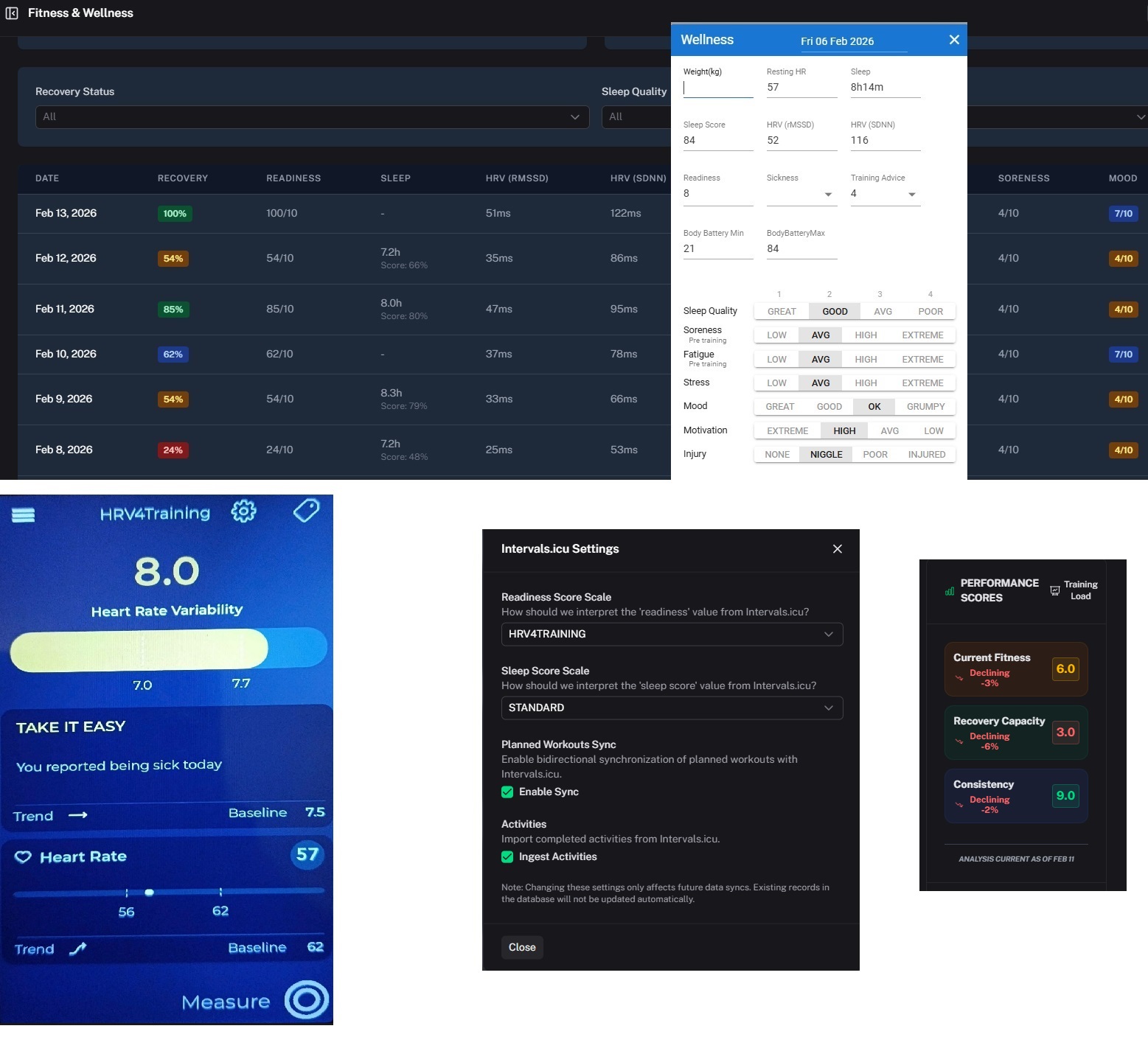
HRV4Training provides a readiness score as an absolute value derived from a proprietary model. The scale is not standardized across users and does not naturally map to a 1–100 percentage range. In practice, each athlete’s score floats within a relatively narrow and individual band (e.g., 6.8–8.0 in my case).

Coach Watt, however, interprets readiness as a percentage (1–100), implicitly assuming that the input is already normalized and comparable across users.

The issue is that feeding the raw HRV4Training value directly into CW creates a semantic mismatch. A score of 7.6 has no intrinsic meaning in a 1–100 framework unless it is first normalized relative to that athlete’s historical distribution.

To make the metric usable for CW, the HRV readiness score should be normalized at the athlete level before being treated as a percentage.


2 Likes

Thanks, but I think this data is useless in the sense that… what we’re interested in is entering the RMSSD data, then letting the Coachwatts app read the planned workout, HR sleep data, and RMSSD and advise us accordingly. I often wake up feeling tired but with a good RMSSD. After a coffee and a hearty breakfast, I can train great, whereas if I entered my morning sensations, I would have a low readiness.

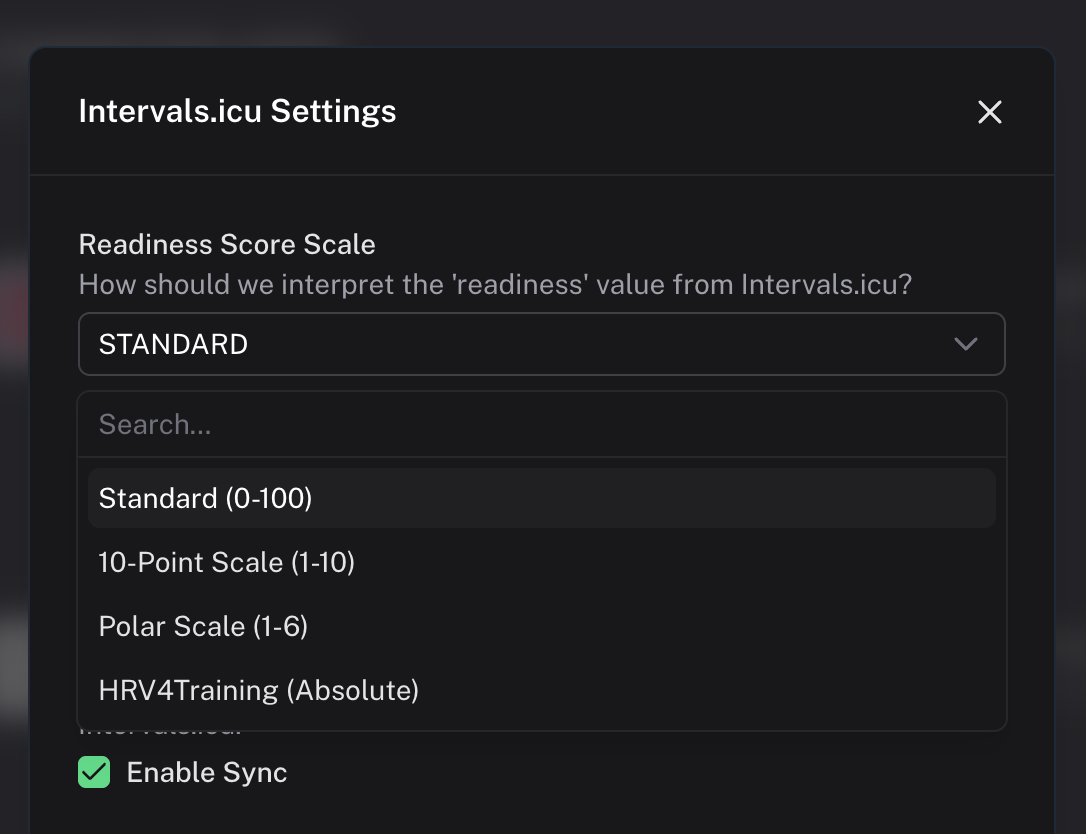
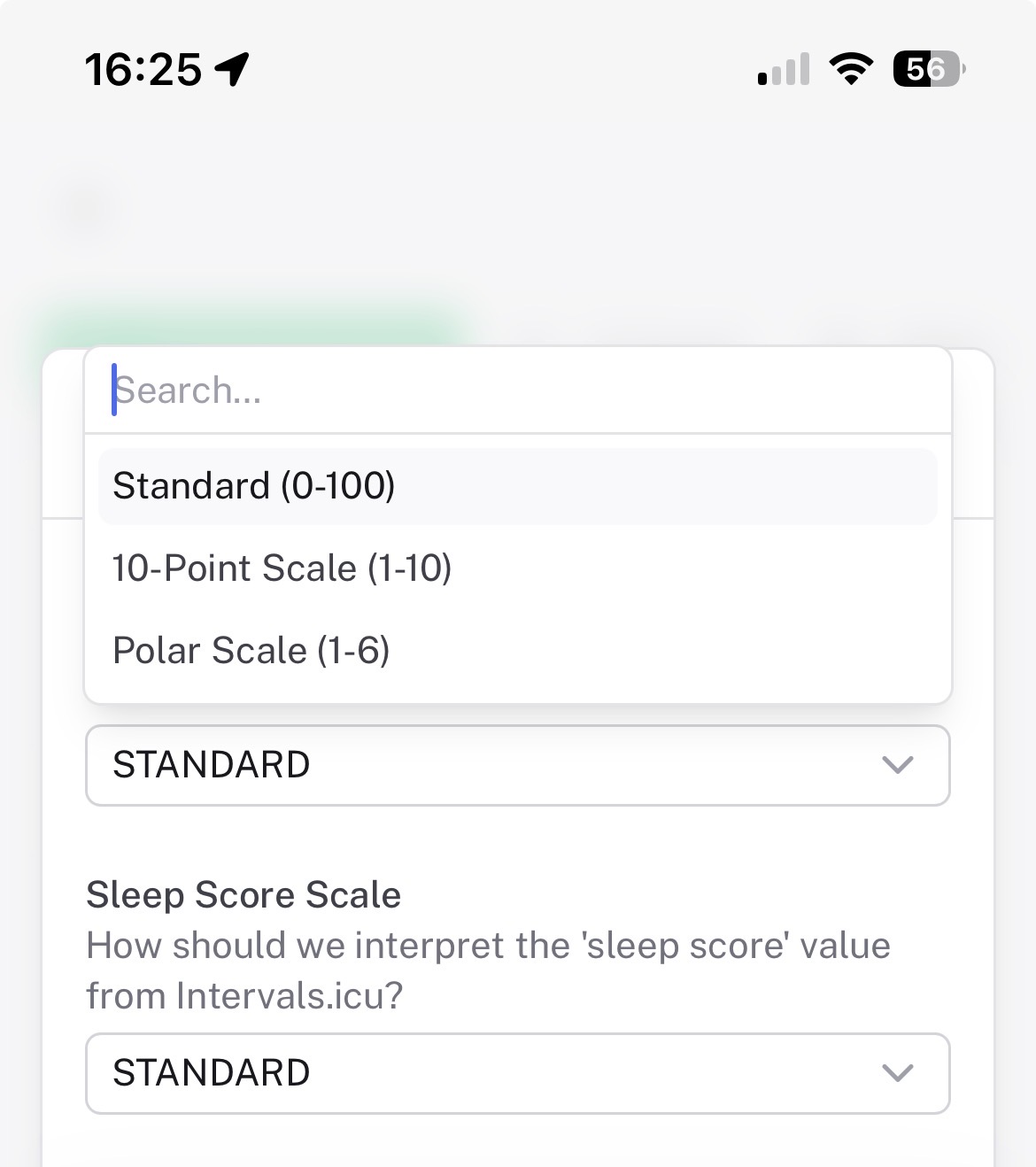
I’ve added HRV4Training as a Readiness Scale, which I normalize to a 1–100 scale as mentioned before. I’m also feeding the min/max values into the context for the AI.

I hope it works!

Laszlo

1 Like

I am afraid the fix has not been push in production

@Giuseppe_Leccese

You can sync both Readiness and/or rMSSD into Intervals via Dropbox & then CW can see both. You can then direct CW which you prefer used. Some might want Readiness, others/you, rMSSD. For Apple Watch they have to use SDNN to my understanding. Marco Altini has tested the reliability of SDNN to rMSSD & found the trends consistent though the raw value varies markedly. He prefers rMSSD for the reason outlined in this link but HRV4 does still measure both. On his platform (free or padi) he provides all of the combinations & then lets users choose which they use. So ideally Intervals & Coach Watts would be fair to do likewise & that is what @hdkiller seems to be trying to facilitate rather than forcing users to use one over the others.

To be honest it matters little as you are/should be looking at the trends rather than the individual metric. So as long as each method is internally consistent (which Readiness & rMSSD both are according to Marco’s research) then the trends should be informative whichever is used. The key issue is more about users ensuring that they are measuring correctly & consistently as that is the far bigger problem usually. ANAL is in analysis for a reason. Apologies for the crudeness but the point is important.

In terms of on-waking sensations then I am like you pretty poor almost every morning when I enter the HRV4 Tags, namely often groggy (even if Garmin says that I slept like a log) & with backache until I have fed the birds (i.e. usually 20-25 min fresh air, currently about 2C in UK with/without driving rain etc & a bit of healthy stretching). I have uploaded my personal wellness data above in a reply to Marco Saraceno & so you can see how my Readiness score compares to the raw rMSSD. Fundamentally the trend is a near exact match & so it appears to make little difference. As it is Marco “secret sauce” I cannot comment on what effect, if any, the Tags have on his Readiness Score. But you should not use just that metric alone to guide training anyway. It is a indication to possibly confirm how you are feeling (alongside your subjective feelings, RHR, Sleep Score, Body Battery etc; or give cause to examine deeper what might be going on if those do not all align. For example a high rMSSD reading does not necessarily mean that you are more ready for HIT as many think, but instead could mean that your ANS is struggling & whether actually high or low, you need to rest or reduce intensity. That is where the Coefficient of Variability (CoV) can also help,which is available in Intervals & you will see in my rMSSD graph. If you have a rMSSD reading above the 1SD zone, you feel good & your CoV is low then go for it. If any of those do not line up then it is a warning sign from my understanding & indicates that your ANS is struggling.

But these are single metrics in a very complicated human system of health v load v recovery. It is not the same as plugging a car into a diagnostics machine unfortunately. Eventhough AI can analyse far more information far quicker than we can, whatever Coach Watts or others advise you still need to consider it as advice that could be potentially incorrect & so take responsilibity if you choose to act on it. It is like an autonomous car, great until it crashes due to something that is outside of its training/understanding/abilities. For now we still need to hold onto the steering wheel with eyes forward or be willing to accept the consequences.

Try now!

1 Like

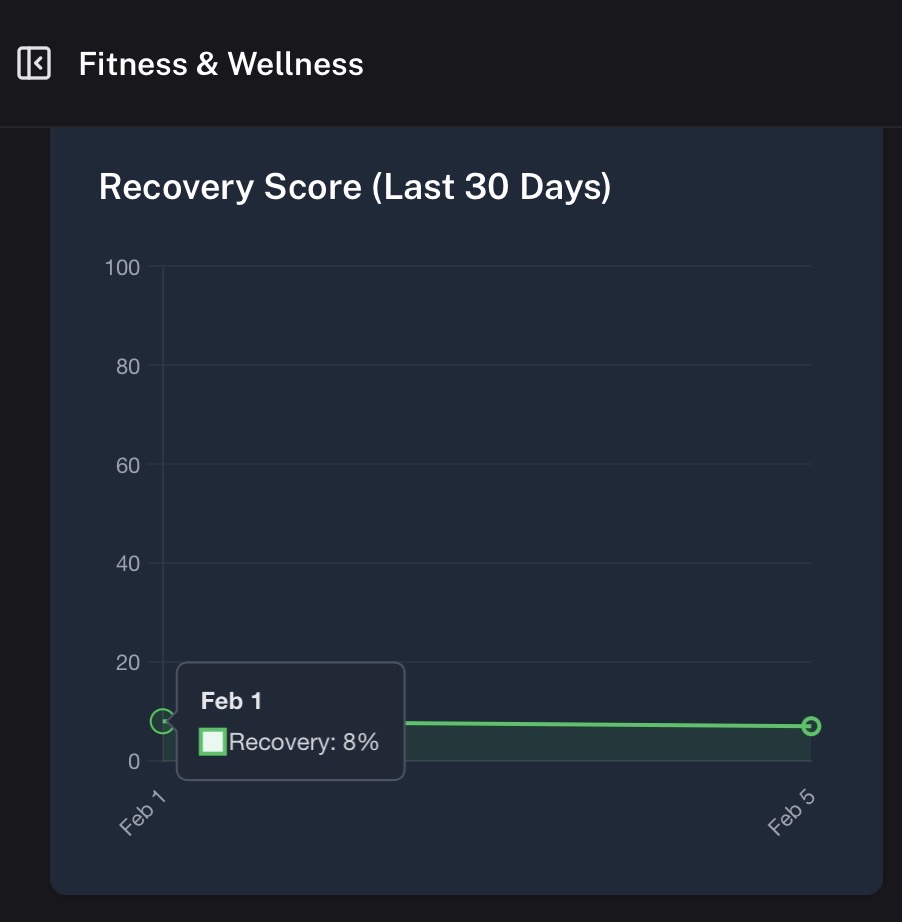
@hdkiller @Marco_Saraceno My Readiness Score has not carried across when I sync’d a few minutes ago. It is saying 100% which I can understand if it is thinking that my Readiness Score in Intervals is above my normal range of 7.0-7.7. i.e. being above my normal range would imply good/great readiness & so 100% is probably a realistic conversion. Is that how you are meaning for it work?

1 Like

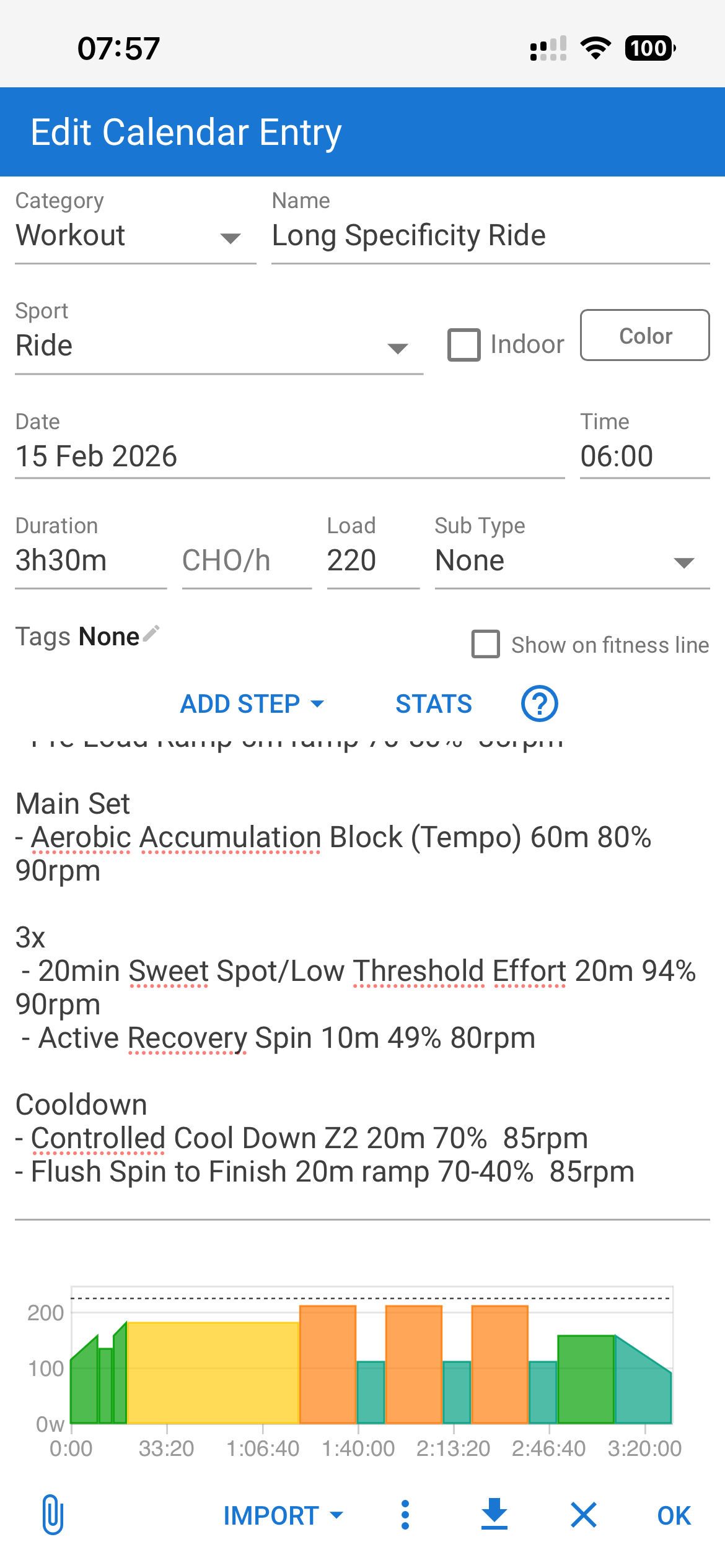
I noted few issues in workouts creation:

  • CW missed a space line prior to start a rep (see the 3x)
  • CW improper interpreted Tempo and Sweetspot (it set at 50% Ftp instead of between 85-95%) power target
  • Recovery spin is missing the power target

I modified manually as such:

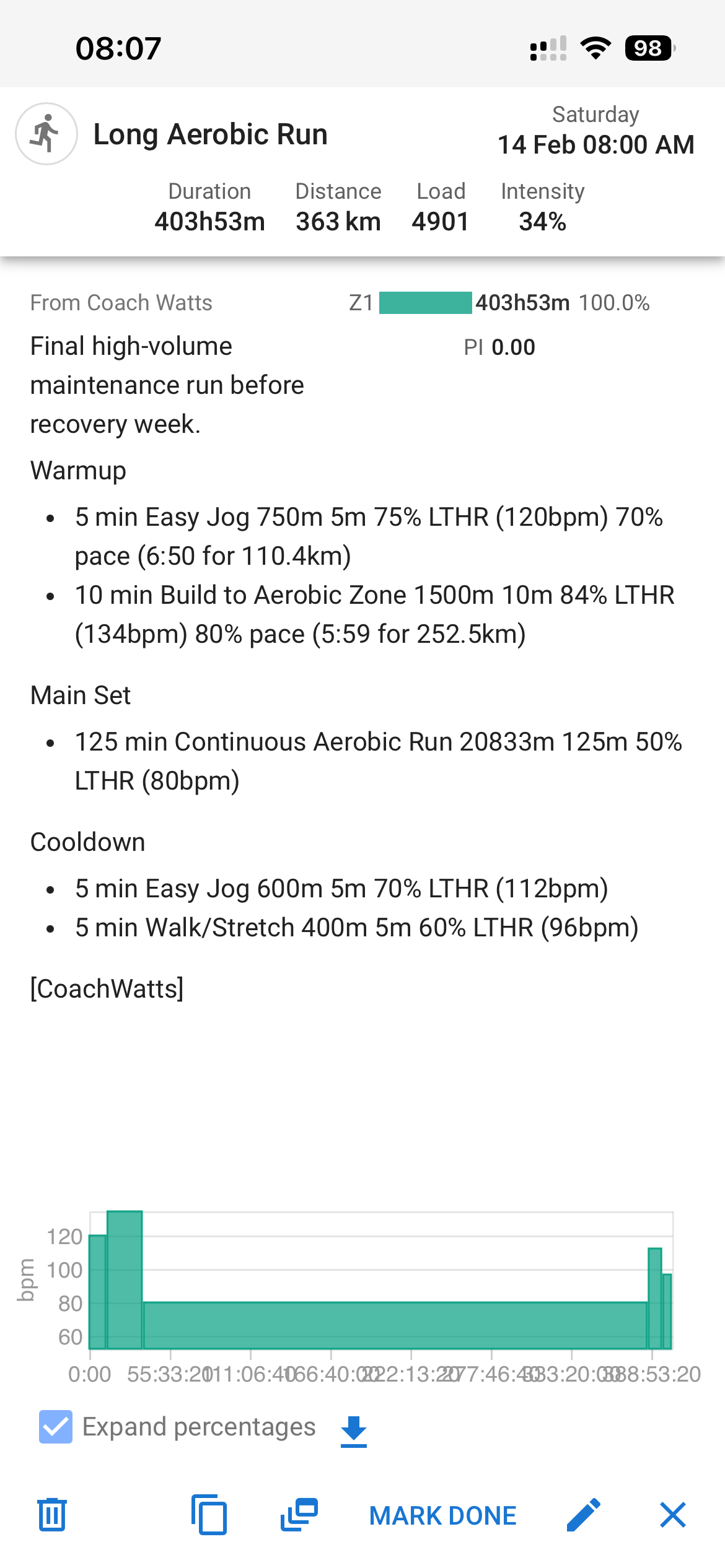
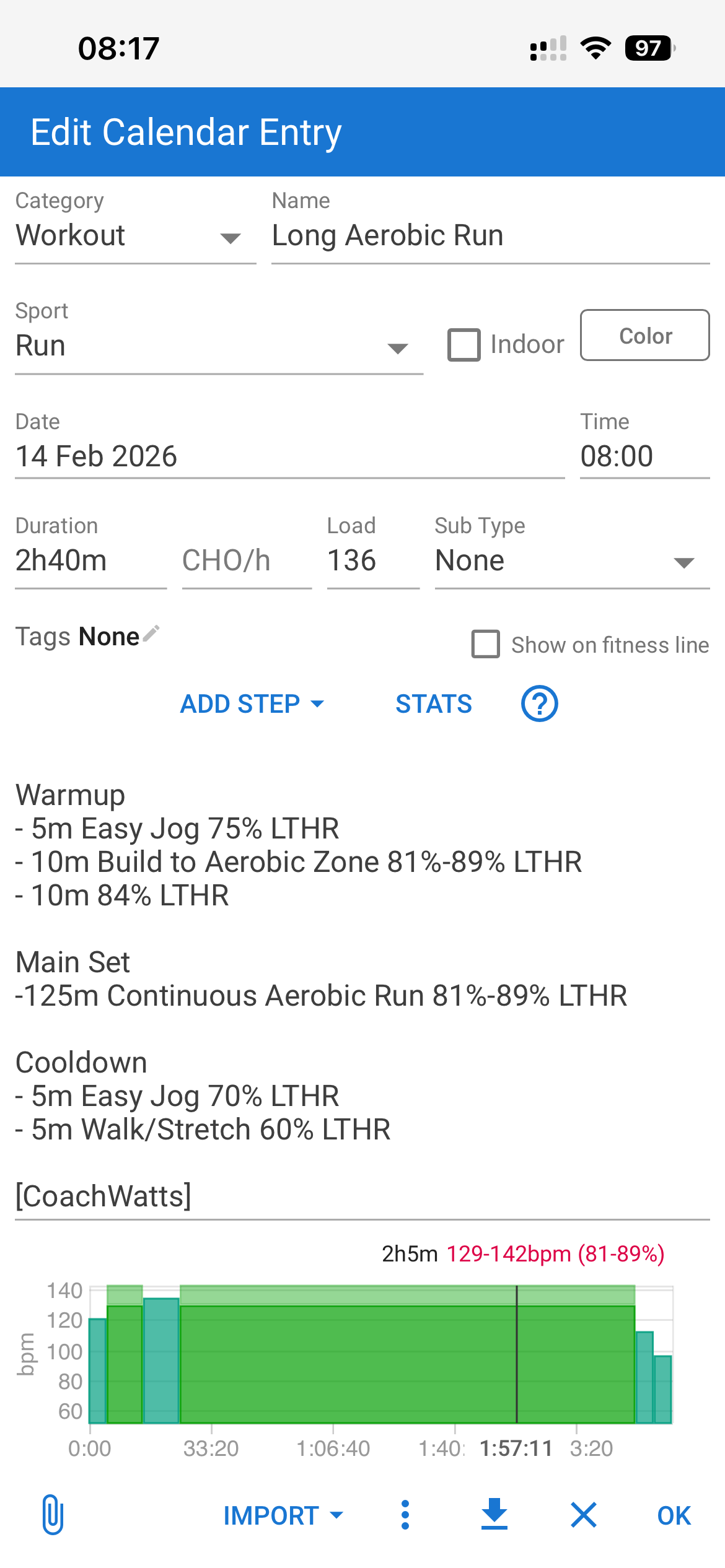
Also the run workout need some tweaks:

  • the main set is waaaay too long, as it mixed minutes and meters and multiple target (a big mess)
  • the target for the aerobic run is off…

This should be corrected:

1 Like