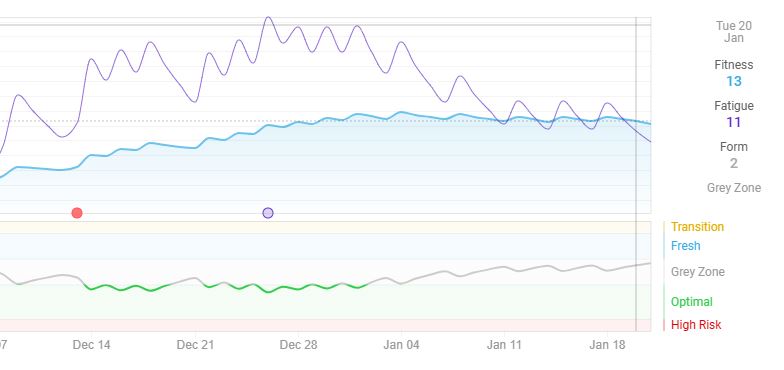
My 11 year old daughter loves Zwift and does rides/workouts a few times a week, averaging probably 2.5 hours a week.
I recently uploaded her workouts to intervals.icu and notice that she sometimes trends in the grey zone. I am fairly new to this so was wondering how much weight I should put on that.
She does at least 6 hours of gymnastics training a week as well which isn’t captured by intervals.icu, and I’m wondering if I should be worried about her being in the grey zone according to intervals when it’s not capturing that.
I know at 11 years old it’s not that important, it’s more about riding and enjoying it, but I’m OCD so just thought I’d ask.
For your 11yo child, I wouldn’t worry too much about the metrics. Let them ride and have fun, as 2.5 hours is adequate. Once they start obsessing with more, and more, then you can start worrying about the metrics.
Maybe try looking at form as percentage? You get a completely different view then.
And from my experience with an 11 year old, don’t impose OCD by proxy, it doesn’t end well!
As @Gerald says, the best result will be of she’s having fun and not worrying about statistics.
Also, if it makes you feel calmer, you could estimate the load from a gymnastics session and add it to the activities manually.
It’s just a mathematical model. Being in the Grey is not associated with a problem - it is not like it is useless or even dangerous to train there.
The most important bit is the red zone. Athletes often tend to overdo it, and consistently hitting the red is a signal to think about that.
Grey is mostly interesting because it means you could do more, to get into the green. Great for professionals whose livelihood depends on it.
But that is not relevant to your 11 years old. At that age, the absolute number 1 prio is to avoid them losing fun and motivation. That happens very quickly, often unforseen, and has zero correlation with the chart.
Echoing what others have said. No, you do not need to worry.
I would say the key thing is that she enjoys her time on the bike.
Have a look at what she is doing on Zwift and find ways of amplifying the bits that she enjoys. The gamification in Zwift will do that already to a large extent, but you can share and celebrate her satisfaction at earning XP, winning a new virtual jersey, or a bike upgrade etc.
The grey zone also happens when the available time to train has been maximised, as well as any room for intensity. It will eventually happen to everyone, as there is a finite amount of time each week.
Absolutely. I wonder if there would be a different name and color for the Grey zone which is less psychologically depressing. I for sure remember when starting out with the fitness chart that there was a distinctive negative feeling simply based on the color/name.
When you get stuck in the grey zone, isn’t the theory that you should reduce training for awhile and then pick it up again? So you creating a bit of stress, impulse? Can’t think of the word. A sort of periodization based on the fitness chart? @gerald will know.
Could be… probably.
But isn’t that Banister’s theory, that you have to create a stimulus by training a smidge harder than you usually do? But at some point that becomes impossible and you have to back off. And doesn’t the science show that active rest for a bit actually increases fitness, that’s why olympic athletes taper wayyyy before the event?
Those aren’t smart arse rhetorical questions… I’m trying to remember and being a bit lazy because I know you know the answer and I can’t be bothered looking it up.
It all depends… on the goals and objectives for training, and where the time spent in the grey zone fits in relative to the rest of the plan and desired outcome. There’s really no single answer.
The drop in load to allow space for that stimulus is usually done in a mid season break and end of season.
Not a silly question at all. Intervals.icu really isn’t designed with kids in mind, and since it’s not capturing her gymnastics load, the grey zone doesn’t mean much on its own. At 11, HR and fatigue can fluctuate a lot, so I wouldn’t stress unless she looks tired or stops enjoying it. Data can be interesting, but with kids it’s very rough guidance at best. I recently read an article about zero-calorie drinks and how easily people overthink metrics like fasting or training data, and it kind of reminded me of this situation — sometimes the tools make things seem more serious than they are: 7 Zero Calorie Drinks for Intermittent Fasting (And a Few More to Avoid) - BetterMe