Polarized training principles have been discussed over and over again. Mostly by people who don’t believe in the underlying message that you need to do a lot less intensity and a lot more low intensity volume. All kinds of interpretations were made, one more correct then the other, to the point that Seiler himself apologizes for the fuss that was created.
One important thing, in my opinion, is that Seiler‘s work is the result of statistical research on several decades of data from mostly pro-athletes. Some of that data dates from a time period where Power meters were not yet used regularly and thus only contains HR data. More recent data has both Power and HR in it.
The conclusion from that statistical analysis was that pro’s, do way less high intensity then what was generally thought. This was very different from what was on the menu for amateurs and recreational athletes, who in general had less training time filled with higher intensity.
I’m not gone go through all the details on how things turned out but I will give my interpretation of how I see it. I may be wrong on some details but am pretty sure that the main message is correct.
The very short version:
Consistency is key! Anything comprising consistency must be avoided as much as possible. Meaning that the workout you do today, must be tailored in intensity and duration in such a way that you will be able to do your next planned workout with the highest quality possible. If you train 5 or more times a week, you must, for every single session, be sufficiently recovered to do that session with high quality. If you are to fatigued to do that session as intended, you loose the benefit of it. We all know that lower intensity sessions can build quite a bit of load/fitness while they are relatively easy to recover from. Higher intensity sessions require much more recovery time.
Working out while not sufficiently recovered on regular bases, will dig a hole and performance will plateau or even diminish. A nice way of explaining this, is with the ‘supercompensation’ theory.
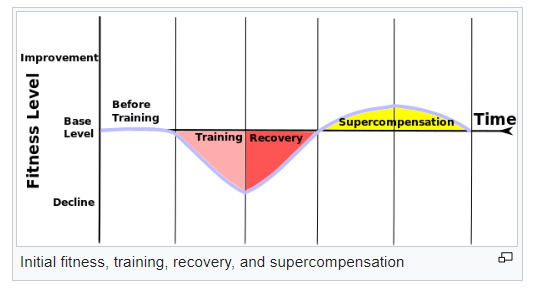
Look at this chart and you will see three basic situations:
- If no training follows before the end of the supercompensation phase, you return to base level. No progress is made, there’s no consistency
- If you train too soon, before the recovery made it back to at least base level, your base level diminishes. You are digging a hole, overreaching, overtraining…
- The ideal situation is to have your next session as close to the top of the supercompensation period as possible. The person who finds a way to pinpoint that timing, will be rich in no time
 . The result is an ever increasing base-level.
All timings on the x axis and all amplitudes on the y axis are dependent on the intensity and the duration (time) of the former workout. The purpose of planning to get better is to maximize the outcome of this chain by also finding the right frequency of sessions. And then you have the three letters of FIT (Frequency-Intensity-Time/duration), unfortunately not in the best order, because building fitness is best done by first increasing Frequency, then Time (duration) and last Intensity.
I could go on for a couple more hours on this subject, but I lack the time to get in to detail. I just hope that the above gives some more insight into the subject of planning for performance improvements. It’s a very difficult subject because the number of variables is huge and every individual responds differently. So please, give your coach huge respect if his plan is making you perform better year after year.