This is my writing, but I used AI to proofread and tighten it up for clarity.
I’ve been experimenting with a very simple progression model over the last ~5 weeks, and the results have been more stable than anything I’ve done before.
The core idea is:
Fix heart rate (~135 bpm cap)
Increase total work by +10 kJ per day
Split into two rides (roughly equal KJ)
Let power float naturally under the HR constraint
That’s it.
No intervals. No forced intensity. Just a slow, controlled expansion of total work.
What’s interesting
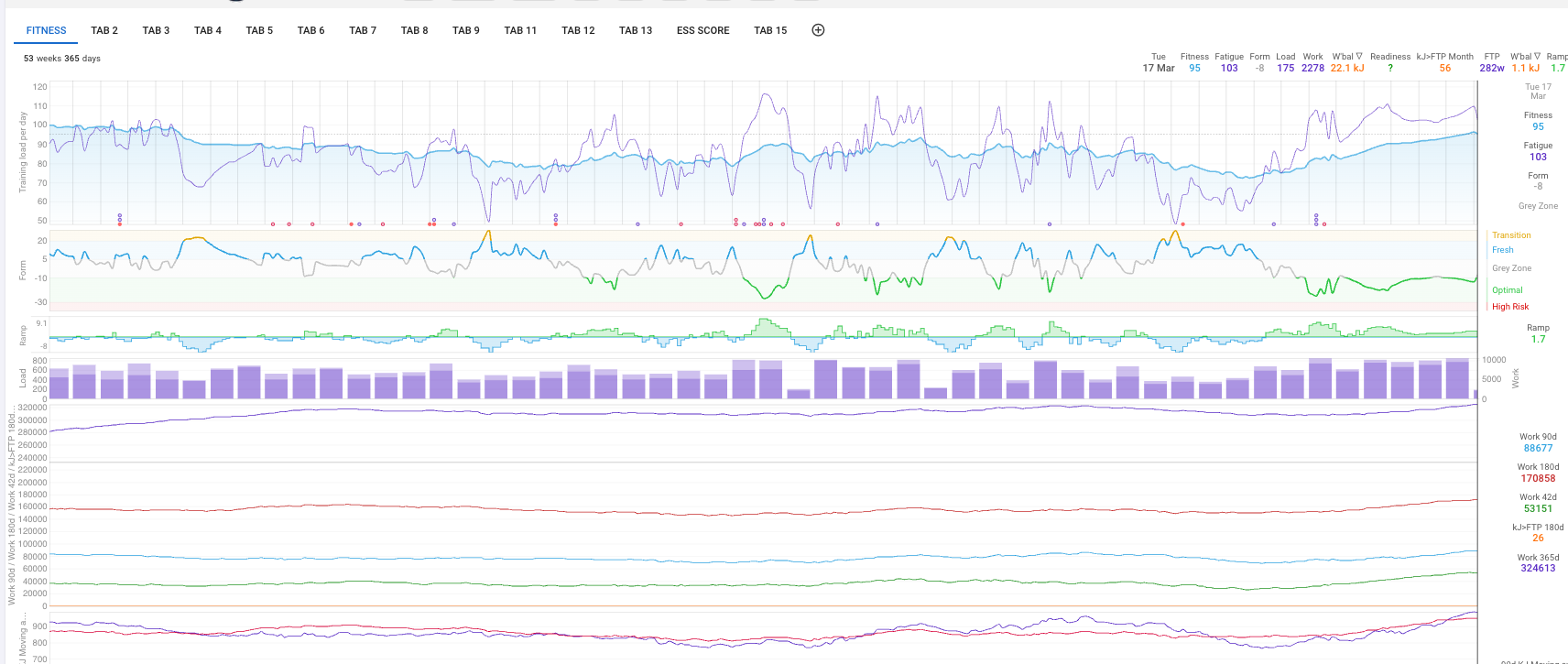
On Intervals, this has kept me in the “green zone” (form/fatigue balance) longer than I’ve ever managed before.
Normally, when I try to push load, I end up oscillating:
Build → fatigue spike → back off → repeat
This time:
Load is rising steadily
Fatigue is contained
Form isn’t collapsing
It feels almost too easy, but the metrics say otherwise.
Some data points
Here’s a simplified slice of the progression:
Day 1: 1200 kJ total → ~1.50 W/HR
Day 18: 1340 kJ total → ~1.53 W/HR
Day 27: 1430 kJ total → ~1.55 W/HR
Day 36: 1520 kJ total → ~1.58 W/HR
Heart rate is basically pinned ~130–135 bpm.
Power is drifting upward slowly as a consequence, not as a target.
Observations
Efficiency is trending up
W/HR rising from ~1.50 → ~1.58 over ~5 weeks
Session-to-session variability is shrinking
Early on, morning vs afternoon W/HR deltas were large
Now they’re much tighter
Fatigue is “absorbed” instead of accumulating
Even as KJ increases, I’m not seeing the usual breakdown
The constraint seems to matter more than the load
The HR cap is what prevents this from turning into junk fatigue
What I think is happening
This feels like a durability-first model:
Peripheral adaptations (mitochondria, capillaries) are being pushed
Central stress is capped by HR
The system is being forced to become more efficient to handle the extra work
It’s basically:
controlled volume progression under a strict autonomic ceiling
Open questions
How long can this continue before plateau?
At what point does adding intensity become necessary?
Is there a predictable ceiling for W/HR at a fixed HR like this?
Has anyone else tried something similar with a strict HR cap + linear KJ ramp?
What I’m watching next
Pa:HR / decoupling at 135 bpm
Whether W/HR continues trending up or flattens
When (if) fatigue finally starts to outpace fitness
Curious if others have run something like this, or if there’s an obvious failure mode I’m not seeing yet.
Expect to see those gains in W//HR for 3 - 6 months. The rate of improvement slowing / stopping is usually taken as the signal to incorporate some speed work (high HR stuff like VO2).
The ceiling is around 75 (maybe 80%) VO2max - not sure what that is W/HR, probably a specific number to you.
Plateau will occur either at the above, and/or when you can no longer increase the workload.
Intensity - a/ if you need it to achieve you cycling goals b/ if it becomes a constrainer eg need to increase VO2max so that you can increase power at 135 bpm (as a percentage of VO2max).
Haven’t done this exactly the same, but it’s a well used model to increase load whilst maintaining an intensity threshold around Z2/LT1/‘endurance’ pace etc. Unusually for all rides to be like this, even in a base phase you’d have some work above this threshold, whether it is strength on the bike, short VO2max intervals or ad-hoc racing.
I suppose for me that will be at around 255w. Im at around 218 now. So should I start doing one vo2 and maybe 1 threshold workout per week once I hit that?
In the first two months of my first ever use of Maffetone training I completed 25x 2hr workouts at the MAF HR.
I increased my power at that HR by 18%
1.18 x 218 = 257
So it is not unreasonable to expect that the gap can be closed by @Steve_Balboni
Although this link relates to running, it is Mark Allen talking about the intervals he did as part of his Maffetone training.
extract
“Keep your interval sessions to around15-30 minutes of hard high heart rate effort total. This means that if you are going to the track to do intervals do about 5k worth of speed during the entire workout. Less than that and the physiological effect is not as great. More than that and you just can’t maintain a high enough effort during the workout to maximize our benefit. You want to push your interval making each one a higher level of intensity and effort than the previous one. If you reach a point where you cannot maintain your form any longer, back off the effort or even call it a day. That is all your body has to give.”
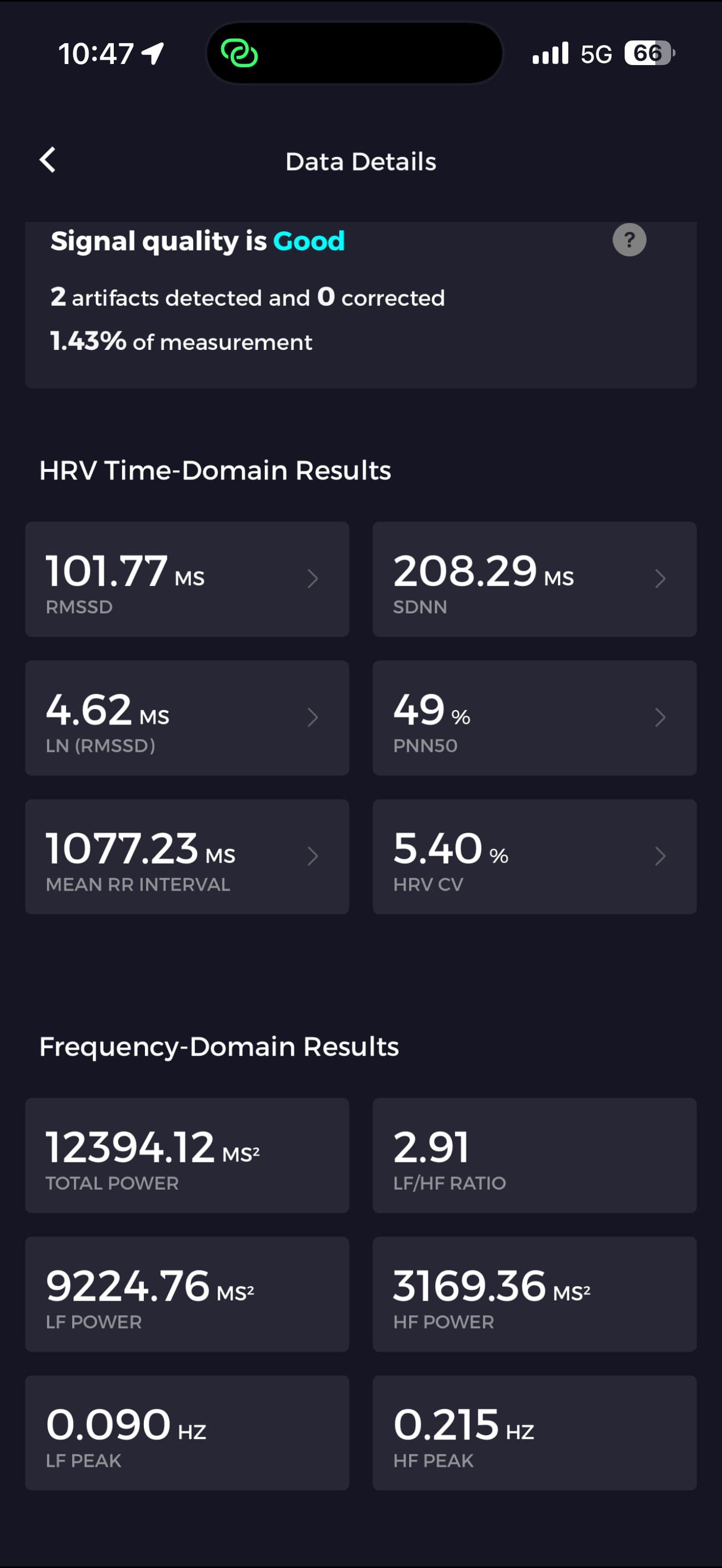
Bumping my own thread here. This training plan is working comically well. HRV this morning was over 100 and I’m caring the biggest training stimulus i’ve done.
FWIW my field tested first ventilatory threshold (roughly LT1) is 124bpm so I keep it mostly under that except for short 5-12 second sprints (and full recovery between). Built a lot of fitness that way.
Bumped my cycling ftp by 40 watts just by walking easy for 6 hours a week. And twice a week doing 6 short uphill sprints. Without any riding.
Alan Couzens runs the madcrew forum. He is a decades long advocate of easy training under LT1/VT1, because it’s easy to ramp volume and build a huge aerobic base.
Why did you pick the 135bpm HR cap? Using breathing field test my “zone2” is 124-134bpm. Under this “zone2” I can train a lot more volume without any impact on recovery. And still build a huge aerobic base and get faster.
I made an app that is a bike computer running on my laptop and connected to my power meter. The app lets me create allocations for kj in certain watt ranges.
Intensity is just daily threshold, vo2, and anerobic. 120, 100, 30
I am tempted to say that lag and noise makes that unusable but I think it could be a valid strategy as well. The problem with training with power is that the “map becomes the territory”
We start optimizing for watts based off the assumption that it’s the best truth.
But are we training our power meter or are we training our biological system?
It was actually that first principle thinking that lead me to make my own PC based Bike Computer. It’s like the bike computer is another example of the map becoming territory.
Today I made a feature in this app to control effort (trainer target watts) based on maximum breaths per minute.