Linear KJ ramp + HR cap: unexpected stability in the green zone

A good case can be made for training by power, or by HR, and certainly for combining both.

I agree that lag and other factors does affect HR. I say that does not make it wholly unusable.

I like HR caps and I like HR targets for intervals where the target remains the same for >3 minutes.

I use the trainerday HR+ (controls trainer watts based on HR targets) feature in combination with intervals that start with an ERG period to get up to a target HR quickly.

It works well for 30 minute tempo intervals at 80% HR max. Also for 10 minute threshold intervals at 87% HR max. I keep looking at a VO2 workout that has 4 minute intervals at 95% HR max, but I am not ready to tackle it yet.

For shorter efforts and sprints, HR is interesting to look at it afterwards, but I don’t see how it can be used to manage intensity in such efforts.

Breathing rate is an interesting metric too. I have done nothing more than try to manually count mine from time to time. I expect that, when the technology becomes more common, I will try a sensor of some sort.

It would be interesting to read your feedback on the new breathing controlled power when you have used it a few times.

In the context of using high intensity work to support the growth of aerobic capacity, maybe aligning the nature of the intensity work for the riding we are training for makes sense? Or just mixing up the high intensity work based on anything, or nothing.

It could be different for different people and at different times. For example, 30/15 VO2 intervals could be suitable right now and, later in the year, 15 minute threshold intervals might be more suitable. More suitable because the nature of the riding being trained for changes, or more suitable just because that is what the rider wants to do.

As long as the aerobic conditioning work continues without the high intensity work being too hard / too much to negatively affect it, it should work out OK… shouldn’t it?

A couple more thoughts. When the W/HR curve starts to flatten and one decides to introduce intensity work. 1) Is the intensity work done as a block (say 4 weeks) before returning to low HR only work, or is it on the schedule “forever”? 2) Is the intensity work structured to be progressive (e.g. by intervals getting longer, or intensity getting higher)?
Again, I am just experimenting but the way I plan to introduce this is through precisely controlled KJ buckets. Multiple intensity “buckets” like 400-500w, 360-399w, 320-359w, and 275-319 (which is just threshold region).

Take each block and grow them at a ramp rate per day in KJ. For example, add 1kj per day into 320-360 range, 2Kj per day into 275-319 range.

Now these aren’t traditional methods, not at all. Im not claiming its correct. But the issue is that from a first principles point of view, the current methods in training all converge around certain assumptions. I’m trying to break those fundamental assumptions.

My inspiration for this plan is the work in Simulacra and Simulation as well as DARPA’s Gamebreaker

I also realize a lot of readers of this post wont grasp these ideas and thats ok. So they’ll probably go for ad hominem instead lol.

1 Like

I can see the sense in the idea and I am all for experimentation.

How long that linear increase can be sustained, before something gives, is an interesting thing to explore.

I am familiar with some of Baudrillard’s work, but had not heard of the DARPA Gamebreaker program before - I will look at that, thanks.

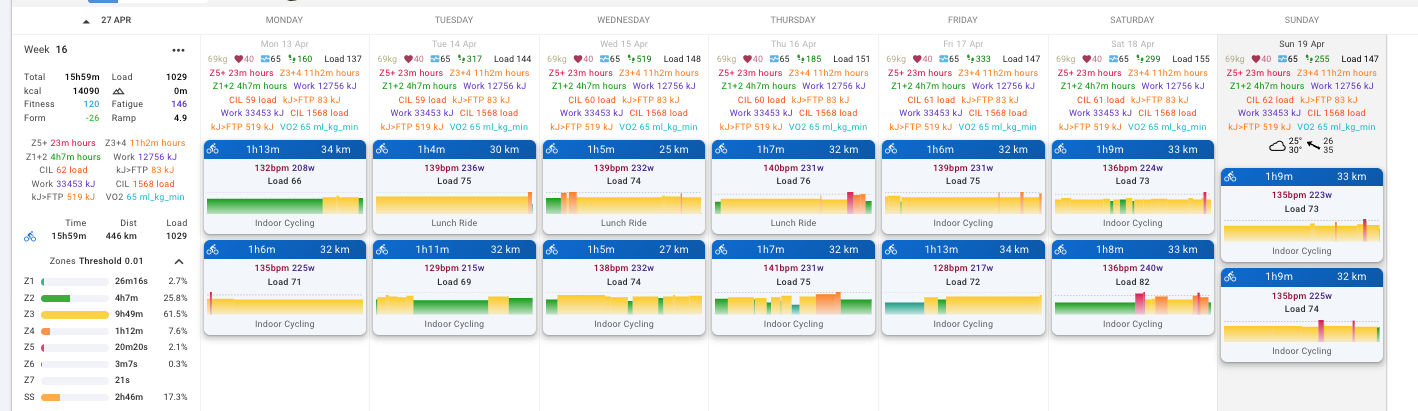
Here is the data so far from my experiment.

I want to see if this can get to pro levels of volume — approximately 25,000 kJ per week. But doing that for 3 consecutive weeks will be interesting. Who knows.

Date Morning KJ Afternoon KJ Morning Watts Morning HR Afternoon Watts Afternoon HR
2/10/26600600210138191144
2/11/26600600227142213144
2/12/26600600198140169132
2/13/26600600178131162123
2/14/26600600181130186131
2/15/26605605217140187130
2/16/26610610179130203135
2/17/26615615204137180130
2/18/26620620207131176128
2/19/26625625215138189131
2/20/26635635195130211135
2/21/26640640214140214140
2/22/26645645198127215144
2/23/26650650166117206130
2/24/26655655210129208134
2/25/26660660207132198134
2/26/26665665207134202135
2/27/26670670203133208134
2/28/26675675198135205135
3/1/26680680216134213129
3/2/26685685208131202134
3/3/26690690209134211134
3/4/26695695208133169121
3/5/26700700210135184125
3/6/26705705193131194129
3/7/26710710197130200130
3/8/26715715210135208134
3/9/26720720204128212135
3/10/26725725201132210135
3/11/26730730210135201134
3/12/26735735215135215135
3/13/26740740205135216135
3/14/26745745209135222134
3/15/26750750219135209135
3/16/26755755217135218135
3/17/26760760214135208135
3/18/26765765207135224135
3/19/26770770220135205135
3/20/26775775205135212135
3/21/26780780246151256156
3/22/26785785215135221135
3/23/26790790220135208130
3/24/26795795207.36135.54213.46135.14
3/25/26800800214.66135.51205.01135.75
3/26/26805805208.41135.88211.05135.22
3/27/26810810219.81135.39219.96135.99
3/28/26815815218.49135.83220.2136.27
3/29/26820820194132193133
3/30/26825825220.11140.182222.45137.425
3/31/26830830221136216.72135.771
4/1/26835835218.17144.901207.88140.38
4/2/26840840220.5141.38252.95151.82
4/3/26845845210.46135.63216.09135.35
4/4/26850850223.25135.38216.02135.555
4/5/26855855209.74133.35209.74133.35
4/6/26860860230.62135.48219.2135.505
4/7/26865865211137211.01135.58
4/8/26870870212.4137.418222.07136.903
4/9/26875875210.39137.85216.7136.66
4/10/26880880214.52137.05216.32135.3
4/11/26885885223.25137.878224.84137.85

Actually it is, according to your core idea:

The HR cap is essentially a metabolic state, whether thats above or below LT1. There are studies showing long periods (years) of increased volume (increased kJ) is possible when majority of work is below LT1 (as it greatly reduces sympathetic nervous system stress). That training concept has been around for a long time. I’ve got a book from 22 years ago with lactate testing to establish the HR cap, and then progressively ramping volume which is essentially implementing a linear kJ ramp.

Back in 2022 my experiments were capped around 139bpm and as older dude was able to sustain 8 hours/week for about 9 months before I started breaking down. Then I really dropped HR below 128bpm for a final volume push. Early 2023 saw very nice gains across power curve, including my best ever 20 minute effort.

Regarding adding intensity, you need it to generate aerobic adaptations in type 2 muscle fibers, assuming your 136bpm is mainly generating type 1 muscle fiber adaptations.

Good work.

3 Likes

You are almost half way there!

1785 kJ per session, twice per day.

If you carry on as you are, you will be there in 180 days.

Mark the calendar: 8 October

Are you ai?

No, I am an actual real live human that rides bikes.

Although if I was AI, I would say something like that, wouldn’t I?

1 Like

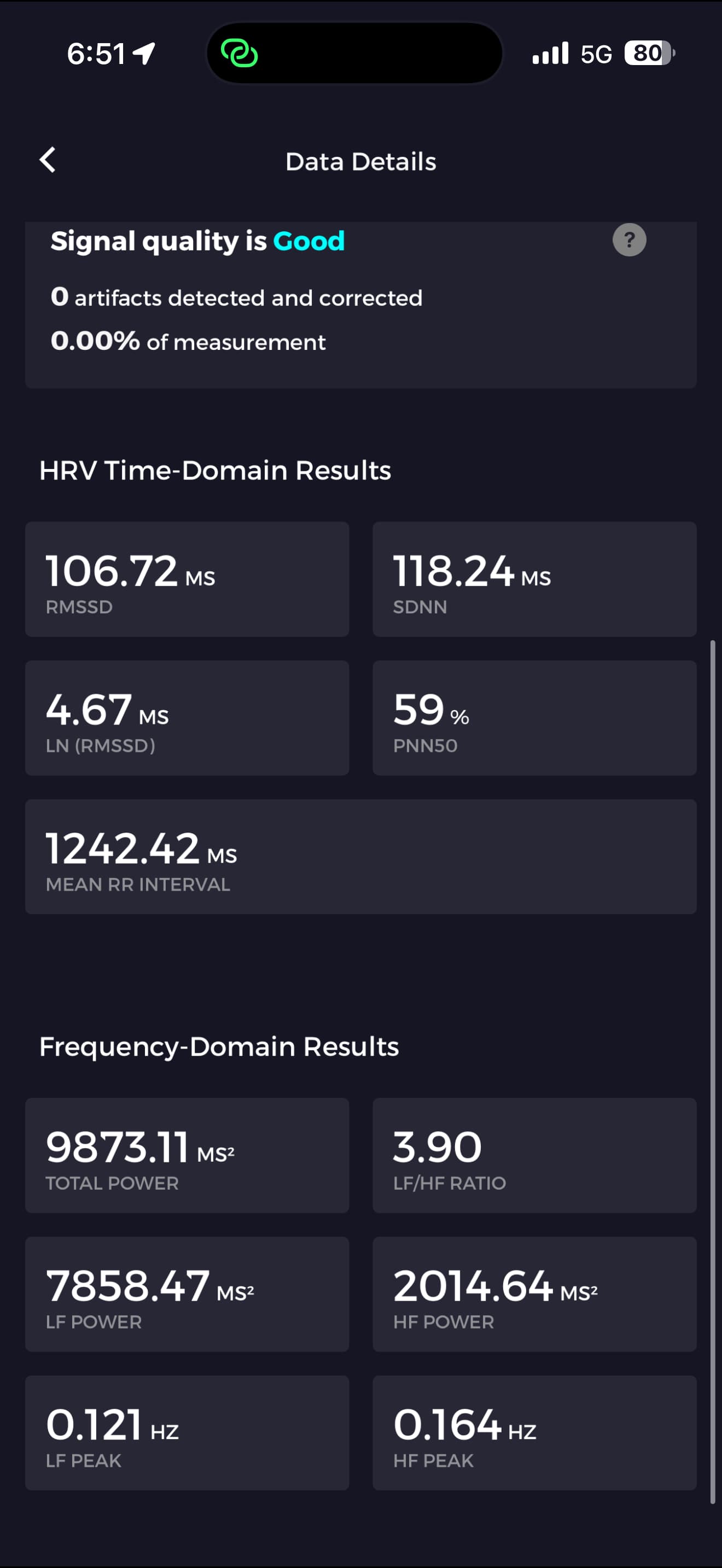
This was a few hours after ride 1 on tuesday. Every metric says back off but HRV is holding strong day to day.

1 Like

FWIW I know more than a few guys putting down 15-25 hours/week. One was in his late 30s, and two Cat3s that quickly became Cat1s that were in mid 20s. The guy in late 30s had a 1 hour usable FTP over 350W (maybe 375???) and was doing most of his endurance at 100-120W. Something like 12-14 hours below 120W. And then going out on Wed Worlds and Sat throw downs and absolutely killing it.

The guys in 20s were coached by former Conti pros (different coaches), and they had a hard cap of 150W and told to ride lower (IIRC they both had HR below 125bpm). The mid 20-somethings did that year after year after year, and now late 20s are P1 and killing it. Despite riding most endurance below 150W and have usable (race and practice race) 1-hour FTPs over 350W.

Also a guy down the street in late 60s, has a CA state champion jersey, and same thing even now. Just lots and lots of really really easy time in saddle.

Go look at the X or other feeds of Alan Couzens and Gordo Byrn (World Champion Ultra Distance Triathlon) and Inaka de la Parra (Ultraman World Champion). It’s really easy to overcook low intensity and do it too hard.

I’m not even remotely in their leagues and eventually overcooked myself doing low intensity at 136-139bpm (/ 180-210W) on 8 hours/week at a 275W ftp.

FWIW.

1 Like

Could it still satisfy your definition of linear kJ ramp if you introduced a rest day into the structure at any point?

Be that a one off rest day as and when you decided it was appropriate, or if it was a regular feature - say one day every XX days?

Second hand anecdote of a summary of a story is pretty useless

Anything can be anything if you change the defintion

Highest volume
highest back to back TSS
Highest CTL

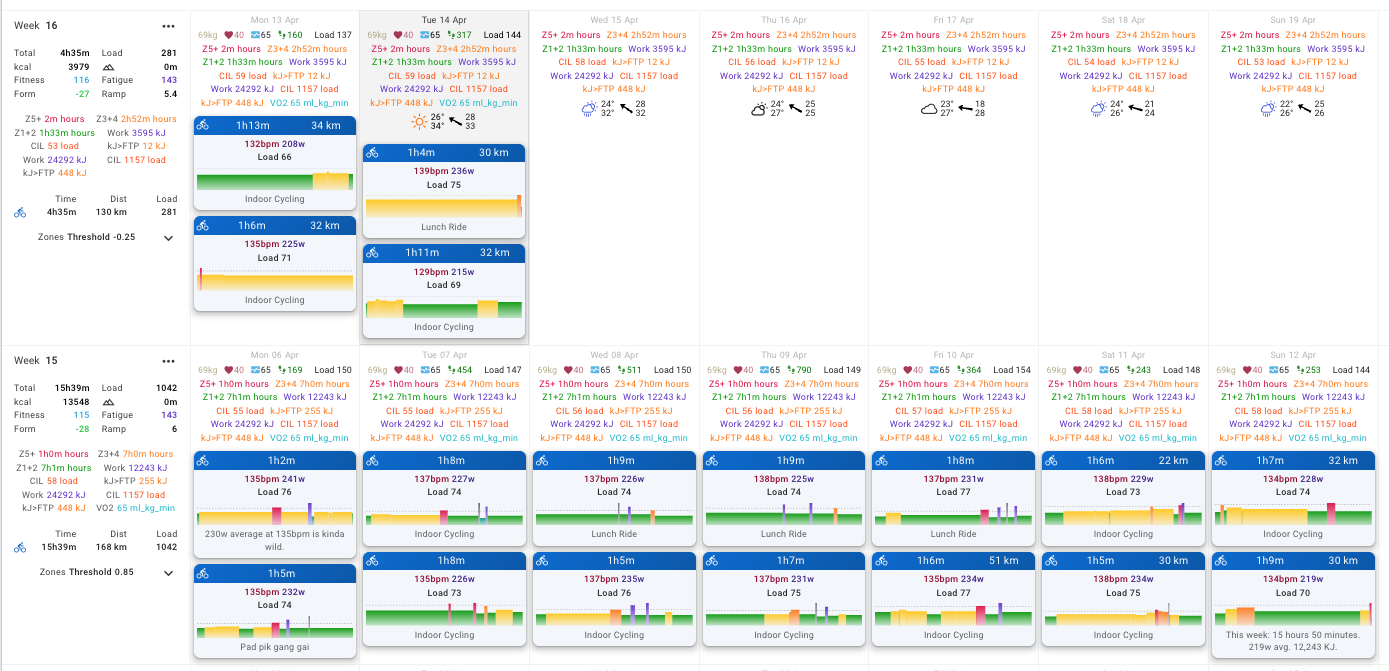
Week I’ve ever done. All from controlling KJ at 10-12kj ramp per day.

1 Like

Great work.

How are you feeling? How are W/HR and HRV looking?

The daily / weekly load increase is becoming a smaller percentage of the overall daily / weekly load. I wonder if that is noticeable already, or if it becomes significant in any way at any point?

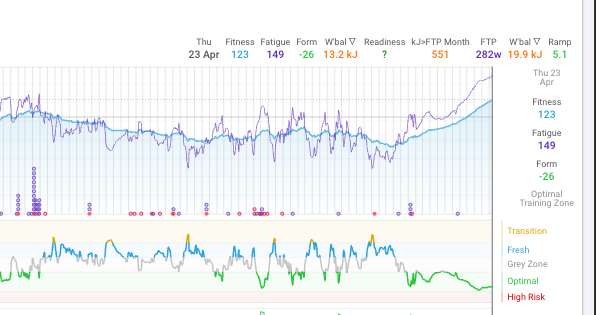
CTL and ATL continue to reach all time highs.

1 Like

A question: I’m impressed it’s “just one hour.” I see you don’t set any HR cap like WindWarrior mentioned. Are you basing it only on kJ? I was doing something similar, trying to beat my kJ, or at least maintain a rolling monthly kJ target to exceed each week. But I also give myself a kind of “recovery score” to avoid overloading any single discipline.

So please continue sharing your experiments—it would be great to see new approaches.

Taking advantage of what we’re discussing, I’d like your opinion.

Consequently, in, for example, VO2 max or SIIT phases, my KJ drops – meaning I train harder, but the sessions tend to be shorter or I have more rest days.

How do you deal with this? Even in phases where you exert more effort and need rest days, would you try to beat the KJ from the previous week/month? In other words, would the VO2 max session add more time even if it’s low enough to beat the KJ?

Intensity distribution was touched on in these previous posts

There are no rest days.

There is no try to beat the kJ from the previous month / week: the primary structure of the plan is that today’s work is more kJ than yesterday’s.

1 Like

As the other commented mentioned it is simply 5KJ more than the day before. I recently changed that number to 6 per day as an experiment. Yesterday I completed 2 * 952KJ rides for 1904 KJ for the day.

Date Day Morning ride KJ Afternoon ride KJ Total Ride 1 ACTUAL Watts Ride 1 ACTUAL HR Ride 1 Actual VAM Ride 2 Actual Watts Ride 2 ACTUAL HR Ride 2 Actual VAM Combine daily w/hr Porgression Morning W/h3 Afternoon W/h3 Sample W/hr 7 day m/a
4/1/26 51 835 835 1670 218.17 144.901 207.88 140.38 1.493439801 -0.07 1.505648684 1.480837726 1.562659901
4/2/26 52 840 840 1680 220.5 141.38 252.95 151.82 1.614768076 0.04 1.559626538 1.666117771 1.572305064
4/3/26 53 845 845 1690 210.46 135.63 216.09 135.35 1.57410141 0.01 1.551721596 1.596527521 1.565677373
4/4/26 54 850 850 1700 223.25 135.38 216.02 135.555 1.621311385 0.05 1.6490619 1.593596695 1.56697355
4/5/26 55 855 855 1710 209.74 133.35 209.74 133.35 1.572853393 -0.01 1.572853393 1.572853393 1.583041555
4/6/26 56 860 860 1720 230.62 135.48 219.2 135.505 1.659944277 0.07 1.702243874 1.617652485 1.59243415
4/7/26 57 865 865 1730 211 137 211.01 135.58 1.548206031 -0.04 1.540145985 1.556350494 1.583517768
4/8/26 58 870 870 1740 212.4 137.418 222.07 136.903 1.583801459 -0.01 1.545649042 1.622097397 1.596426576
4/9/26 59 875 875 1750 210.39 137.85 216.7 136.66 1.555826746 -0.03 1.526224157 1.585687107 1.588006386
4/10/26 60 880 880 1760 214.52 137.05 216.32 135.3 1.58193501 -0.01 1.56526815 1.598817443 1.589125472
4/11/26 61 885 885 1770 223.25 137.878 224.84 137.85 1.625116056 0.04 1.619185077 1.631048241 1.589668996
4/12/26 62 890 890 1780 219.48 134.483 209.84 133.1 1.604436754 0.01 1.63202784 1.576558978 1.594180905
4/13/26 63 895 895 1790 203.83 132.478 223.09 134.9 1.596690827 0.01 1.538595087 1.653743514 1.585144698
4/14/26 64 900 900 1800 234.43 139.36 201.37 129.36 1.621762429 0.03 1.682190011 1.556663575 1.595652755
4/15/26 65 905 905 1810 225.48 138.645 226.89 137.964 1.635413164 0.03 1.626311804 1.64455945 1.603025855
4/16/26 66 910 910 1820 223.51 140.37 220.07 140.84 1.577397674 -0.03 1.5922918 1.562553252 1.606107417
4/17/26 67 916 916 1832 229.32 138.596 205.98 128.49 1.62981212 0.02 1.654593206 1.603081952 1.612947004
4/18/26 68 922 922 1844 220.97 135.641 218.44 136.142 1.616767789 0.01 1.629079703 1.604501183 1.611754394
4/19/26 69 928 928 1856 221.43 135.369 222.46 134.68 1.643738729 0.03 1.635751169 1.651767152 1.617368962
4/20/26 70 934 934 1868 220.56 136.51 221.04 135.12 1.625740898 0.00 1.615705809 1.635879218 1.621518972
4/21/26 71 940 940 1880 221.45 134.42 221.45 134.42 1.647448296 0.02 1.647448296 1.647448296 1.625188382
4/22/26 72 946 946 1892 233.85 140.661 838 219.52 134.87 787 1.645440985 0.02 1.662507731 1.627641432 1.626620927
4/23/26 73 952 952 1904 225.59 136.57 814 246 145 871 1.674858827 0.03 1.651826902 1.696551724 1.640543949

Here is where we are for the month so far. over 50,000 KJ in the current 30 day rolling window.

HRV is steady in the 90s in the morning and between rides, most days. Not all.

1 Like

I look at zone 2 as something that I want to do daily and look at the impacts at their cumulative kj effects. Just do zone two first and do any intensity at the end of the ride.