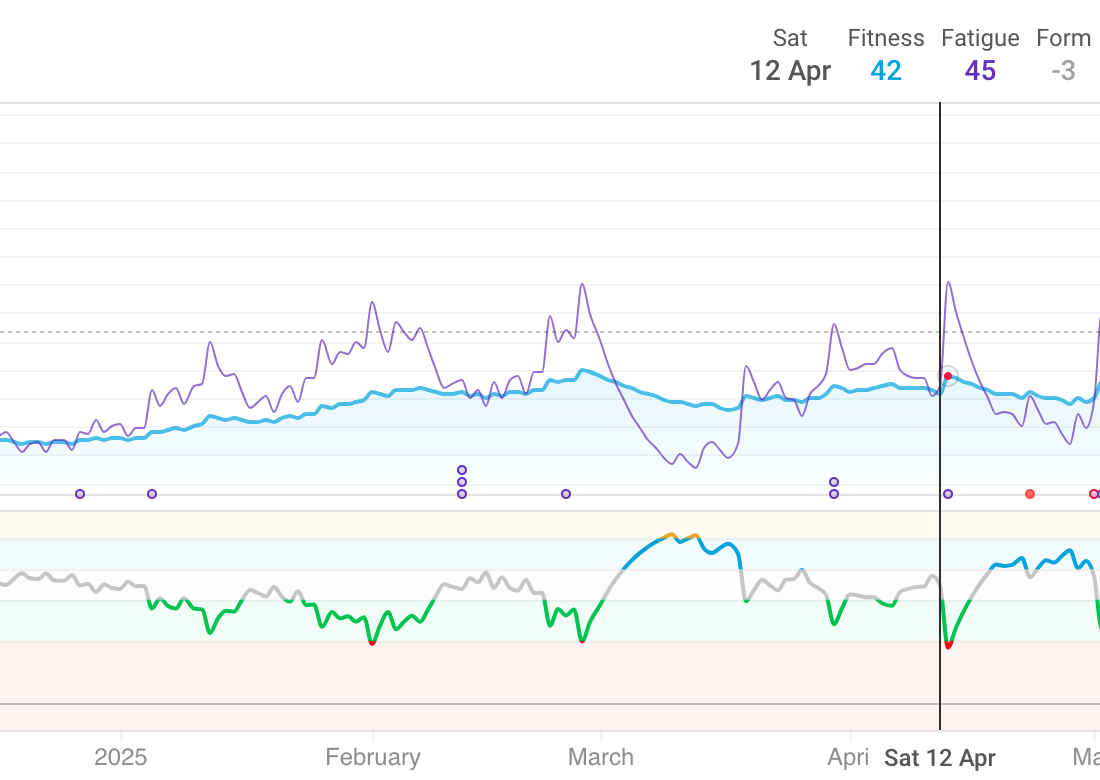
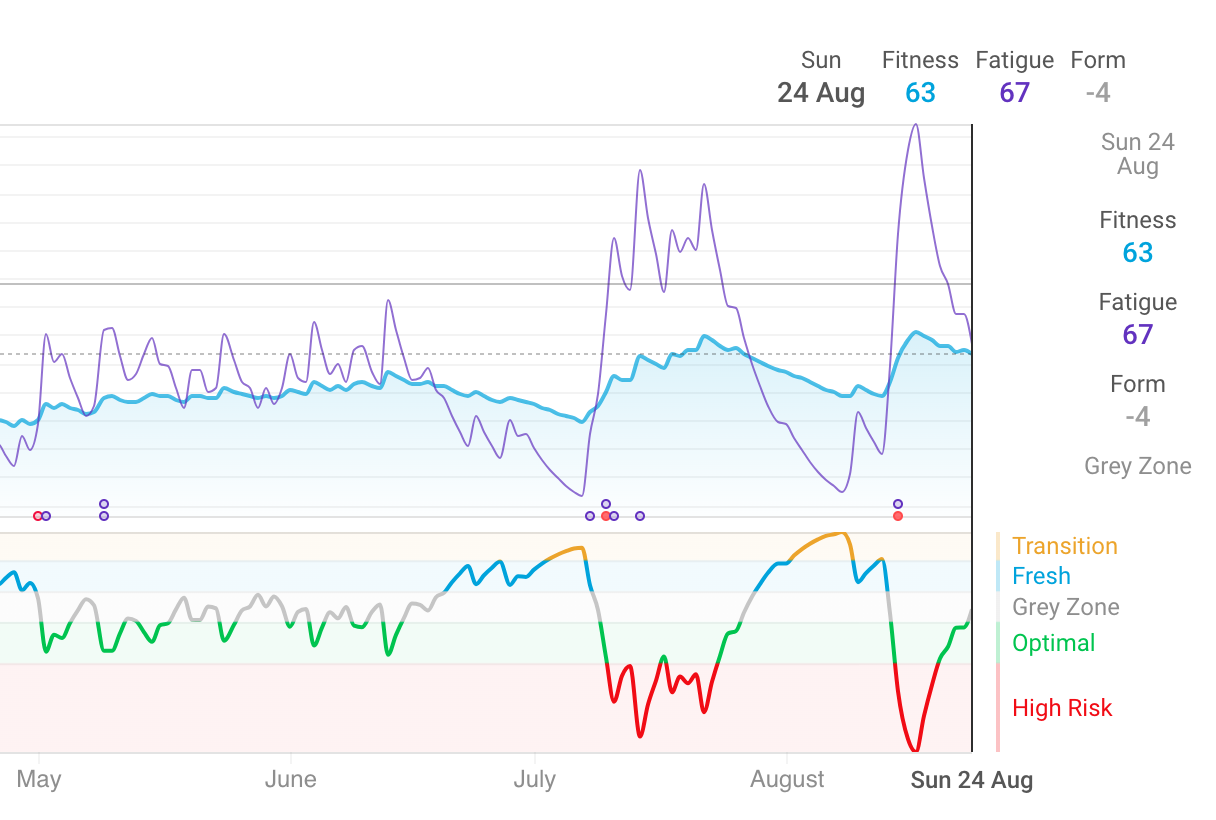
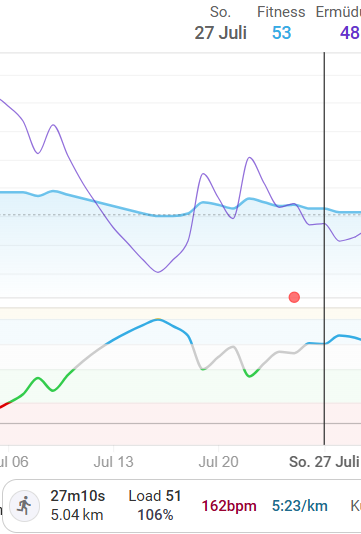
Now, in the second half of the year, I don’t follow a training plan anymore. I’m doing random stuff, including some substantial bike rides (> 100km >1500hm)
Fitness is the sum of your daily training load over time, using an exponential weighted (moving) average. Fitness uses the 42day average, while fatigue uses the 7day average. One measures the short term work done and the other the medium term work done. Form is simply the difference between fatigue and fitness.
It’s worth reading the guide/help about fitness, fatigue and form.
When looking at Fitness, you should mostly think at Cardiovascular fitness. Maybe not exclusively, but the Fitness metric is best at reporting that.
For athletes with higher volume, X-training is important. Even more when your primary sport has high impact on your joints, like running. Cycling in that case is a perfect opportunity to further develop cardiovascular fitness and improve running performance without risking injury and/or overuse. Especially for the long events like a marathon, the addition of cycling to increase your cardiovascular fitness without stressing your body too much, is for most runners a very good solution.
Cycling to improve heart and lung function, below LT1, can be done in much higher duration volumes compared to running.
Thank you both.
Looks like I need to study a bit more.
I’ll have a look at the “Fitness Page” first, and in my next marathon training, I’ll probably include more Xtraining elements. (Safer for my age and I like a bit of change anyway )
@jbulck Valuable information has been given. But it is important, I think, not to confuse Fitness with fitness, Fatigue with fatigue and Form with form. [Here I use upper case to denote the calculations that intervals.icu provides and the lower case to denote our intuitive understanding of these terms.] Fitness is a medium term averaging of an attempt to measure the relative stress of workouts. It’s not a measure of work or load.
The components of Fitness are average [normalised] power relative to your FTP and time. Load, by contrast is the total amount of work that you do – measured in kJ, or hours or distance. [Given several disciplines, kJ could be used for both.] Unless you are unlucky, cycling is really about cardiovascular load, and kJ summarises that. Running involves cardio load too, but also muscular-skeleto strains [kJ cannot measure these latter].
You can see that FItness is not a measure of work/load. Suppose that you ride / run at 50% of FTP for 2 hours 6 days a week. You get a Fitness score. As you keep doing this, your FTP is likely to rise. You keep riding or running the same amount, but because your FTP has gone up, your Fitness shows a decline. The amount of work you do has remained the same, but the stress on your system has gone down a little.
The daily score that goes into the Fitness calculation is TSS. You can see that this is not really a measure of stress on your body either. Suppose that you do a 2 hour ride at 50% of FTP; TSS = 2 x 100 x 0.5 x 0.5 = 50. Or suppose that you ride for 1 hour at 25% of FTP but you do 4 15-sec sprints at five times FTP; your TSS will be 26 -27, depending on the timing of the sprints. The 2 hour ride has the higher TSS, but I’ll wager that the 1 hour sprint session will take more out of you, will take longer to recover from.
In other words, by all means use FItness, Fatigue and Form, but beware of what they are not. And think of using alternative metrics of your training volume. Personally, I use kJ as a measure of volume, with a constraint on intensity.
I am confused by the whole metrics. I read the guide, think I set my values correctly (FTP, heart rate zones…) but I don’t get what I’m seeing.
Take a ride from two weeks ago, 4hrs, 100km, 1500hm. My FTP is 260 (from ramp test), the NP of that ride was 214W, 2666 kJ.
The load is 267, which seems excessive.
On the other hand, VO2max intervals recently, only 45 min but rather exhausting. Load is only 42, though NP with 214W is the same.
The long ride spiked my fitness tremendously, accordingly fatigue as well. The short intervals barely.
And when I look at my runs it gets even worse. 5km run and I’m exhausted, but it barely has any effect on my fitness values.
Depending on your fitness value and your average daily load, the long ride can certainly spike the chart if it’s excessively higher than average. As we can’t see your data, it’s hard to explain your actual data.
If your FTP is wrong, relative to “effort/RPE”, you can get a higher than expected training load. NP/FTP = Intensity. So 214/260 = 0.82307. Load can be calculated as Duration * IF (squared) * 100 = 268 load.
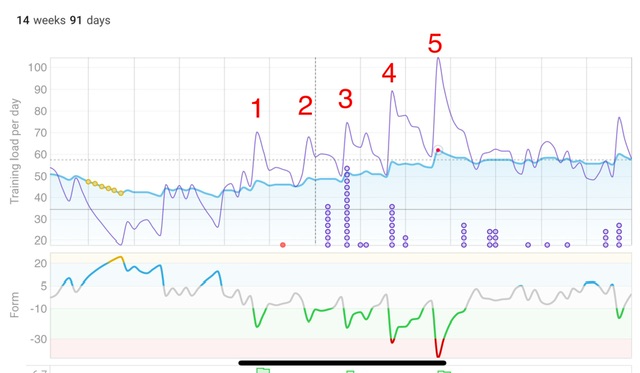
Here’s an example of how 5x 100-mile rides in about 6 weeks, spikes my fitness chart. It’s not physically demanding, but due to a lower base level, these rides appear to be hard, and pushing me to an eventual red form (< -30).
Load is the product from Intensity (squared) and Duration. Unfortunately, Load (TSS) is somewhat too much dependent on duration. But that’s another can of worms on which you can find more discussions here on the forum.
When comparing load from Runs and Rides, you need to make sure that thresholds for both are set correctly. What Load metric are you using for runs? Is it Power/Pace/HR? Power, if FTP is set correctly, should be best. But Pace is widely used. Avoid HR if you can because that will only work well for steady state work and only if it is dialed in correctly comparing Power.
Thanks guys.
My metrics curves look somewhat unsteady, but let’s ignore that for now.
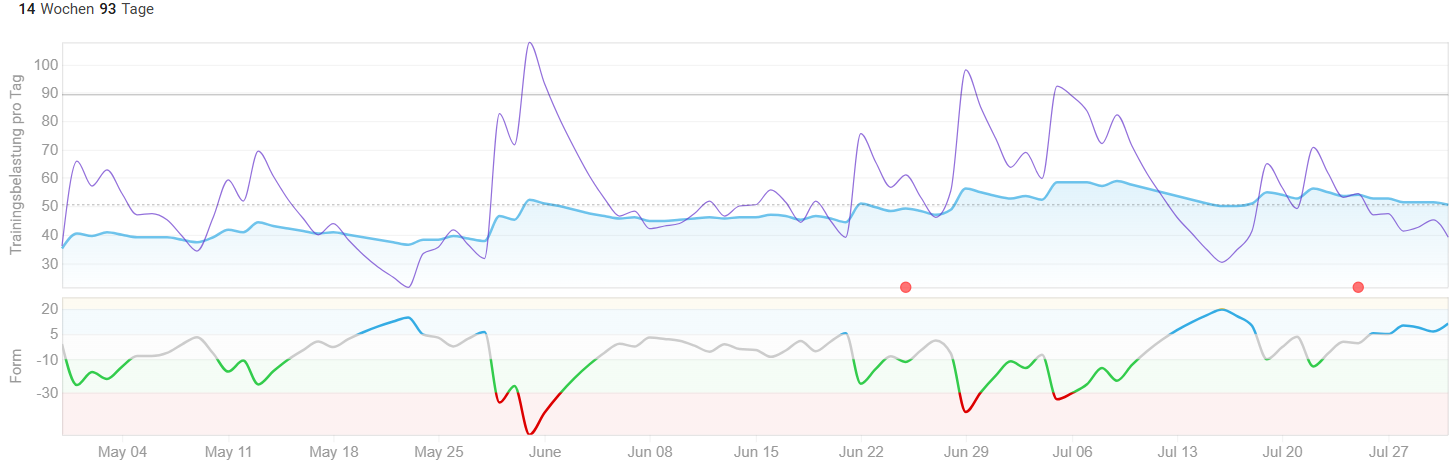
The big spikes in fatigue and accordingly fitness are longer rides, 5-7 hours.
Regarding load metric for my runs, I don’t do anything actively, just run and it records my pace, HR (chest strap) and calculates some wattage from whatever and derives load from that. I have not changed any settings.
@Daniel_G There are several things going on here.
[1] “Load” is a measure of accumulated stress, which as @MedTechCD says is overly dependent on time at the expense of intensity.
[2] Some of your feeling about the effect of a short run as opposed to a long ride is due to the muscular-skeleto demands of running.
In other words, “Load” cannot measure everything that you want it too. Arguably, a more comprehensive measure of what you seem to be seeking [the stress on your body] is RPE, the perceived effort you put into the session. You can readily calculate a measure of accumulated load over 6 week or 1 week timespans using RPE rather than TSS as the basis.
Thanks, that makes sense. If the duration is overly influencing the load, it is understandable that a 30min run has a significantly lower impact than a 2hr ride.
I see I can manually change the load value. Instead of changing the calculation to RPE, I could also simply increase the load value of my runs, would that be a logical approach?
I’d look at a couple of runs and look at their RPE; and a couple of rides and their RPE. You can then estimate the relative RPE of a [say] 5 km run versus a [say] 2 hour Z2 ride. That gives you the ratio by which you should raise the load value of your runs.
Of course, you would then need to be sensible in interpreting the resulting graph.