I’ve been thinking about picking up a Tymewear VitalPro and using it mainly for testing. Especially since it seems the positioning on rides can make a huge difference in how it reads. How do people feel about using it mainly for testing where your VT1 and VT2 fall on your power and HR curve?
Hi Timur, sorry i’ve to delete my post … i was totally mystified by the numbers and wrote b***t …
My FTP was actually 310 … i’ve messed up … it’s my VO2max that struggling with 350w 
So i’ve got little room to improve a bit yet 
Cheers
That can work for testing, but with an important caveat: the power and heart rate values shown by the test should be treated as maximal threshold values—the upper boundary of the training zones—and with a very large safety margin. If you plan to use heart rate and power in training based on ventilation data, you should apply these values conservatively, with extra margin.
But the real value of ventilation is in the live, real-time readings during workouts.
3 Likes
Well, let’s say that it is very likely that I do have a (measured) limited strength in one leg, despite 2+ years of physiotherapy, rehabilitation, and for the last 15 months heavy strength training, due to it’s accident & operation history.
Where does this rule come from? As 5s (anaerobic) and FTP (mostly aerobic) have very different “physiologies” a single number does not make much sense to me…
Btw., quick ask of chatgpt yields this
Rider type 5 s power / FTP Elite sprinter 6–8× All-rounder 4.5–6× TT / climber 3.5–5×
Looking at this with with the tymewear docs in mind, I would set/change VT1 at/to ~15:00 min and BP at/to ~22:00 h min … 
1 Like
Yes, I am not claiming absolute truth and I am not urging anyone to follow such conclusions. I also use GPT, and it does not agree with me either. But for some reason, as a first approximation, I trust the old-school coaches
Most likely yes. My lactate test showed LT1 power at 185 watts (which makes sense, around the 15-minute range). But I am definitely sure that ventilation matches LT2—around 230–240 watts—both by lactate and by ventilation on the graph
In general, when I analyze two tests and many training sessions, I get the impression that VT1 is lower than LT1. And LT1 falls right at the BP level (when LT1 is defined as the first lactate rise of 0.4–0.5 mmol above baseline), which, in my opinion, is FatMax.
I would also trust a real coach much much more than chatGPT. But the 0.4 as single factor simply does not make any sense considering the vastly differing physiologies. Just think about the PDC of a sprinter and an ultra-cyclist –> same ratio of AP(5 s) and FTP? No, surely not
I use my whole power curve, not just my FTP, so I have as many anchor points as I need. Especially after reading about all of the problems in this thread, I’m not convinced at all that it gives any more actionable info on internal effort than RPE does. I haven’t seen anything that makes me think it would give me data that is useful for my training, or I’d buy one right away. I think this is made for guys on forums who get anxiety over making sure that they’re doing the perfect Z2.
2 Likes
Totally agree — there’s really no better metric than RPE. In my case, though, I only really learned what RPE feels like after burning through 100+ lactate strips.
And ventilation… yeah, that’s definitely for hardcore data geeks 
2 Likes
In the words of Tim Kusick… not quoted:
You use power (or breathing) to calibrate RPE, then you use RPE to calibrate power (or breathing).
Every tool has its place in the toolbox. That said, it’s mostly the weekend warrior (non professionals) that use the devices.
1 Like
After taking an extended break from the bike I have been using the Tymewear VitalPro solely in base training below my VT1 from my first test. In 6 weeks this has given me a 20% uplift as seen from my test today. Yes I was coming of my break and I do have many years cycling to fall back on , the next 6-12 weeks will be interesting. Yes there have been a few minor technical issues with uploads but the developer is extremely proactive in resolving these. The HR monitor and breathing sensor have received firmware updates as has the app so progress is being made.
3 Likes
I I would not waste my money and time being they’re guinea pigs I get roughly 7 hours per battery, data is all over the place , inconsistent data, I am asking for a refund sorry for the spelling errors customer service is great at promptness but nothing changes
1 Like
I had the battery issue, however they have clear instructions on how to avoid, plus there’s a firmware release coming to resolve (forced disconnect).
1 Like
Super useful in workouts. For example, a VO2max interval (ie aim is to work at your VO2max) you can clearly see when you get to the correct physiological zone rather than relying on a HR or power proxy - and you can clearly see the truth for example for a 1 min interval you’re hardly eliciting VO2max, for 40/20s you can see that VE doesn’t significantly drop off in the 20s so as you get to the end of a set it is eliciting the response (obviously the 40s needs to be had enough).
2 Likes
Yeah, I did run into a couple of issues at first — the sensor was dropping out in the cold, and there was also a conflict when ventilation and the Core Body sensor were connected at the same time. But honestly, huge credit to the support team — they were amazing. I got help almost immediately. They updated the firmware and gave me clear instructions on how to set up the Core Body sensor in Garmin to avoid conflicts. After that, everything worked fine, and the ventilation data stopped dropping out.
One interesting thing I noticed: I did 2 tests on the bike, in 2 running, and also in cross-country skiing. The ventilation values are clearly quite different between these disciplines.
1 Like
And also there is a difference between MTB
and road bike because of position…
BUT… in last two months I am pacing my workouts (bike and run) by tymewear and is really useful
Yes, interesting data there for us data geeks. In fact, I am still not sure these 30/30s are truly yielding the right physiological response, i.e., true VO2max increase
If you look at this you see that power cycles between Z6 and Z1/2, RPE is really hard at the end, HR and HRV never got into top zone (Z5 for HR and Z3 for DFA a1), whereas VE goes into Z5 (VO2max) for most of the HIIT sets… is this good enough for VO2max training?
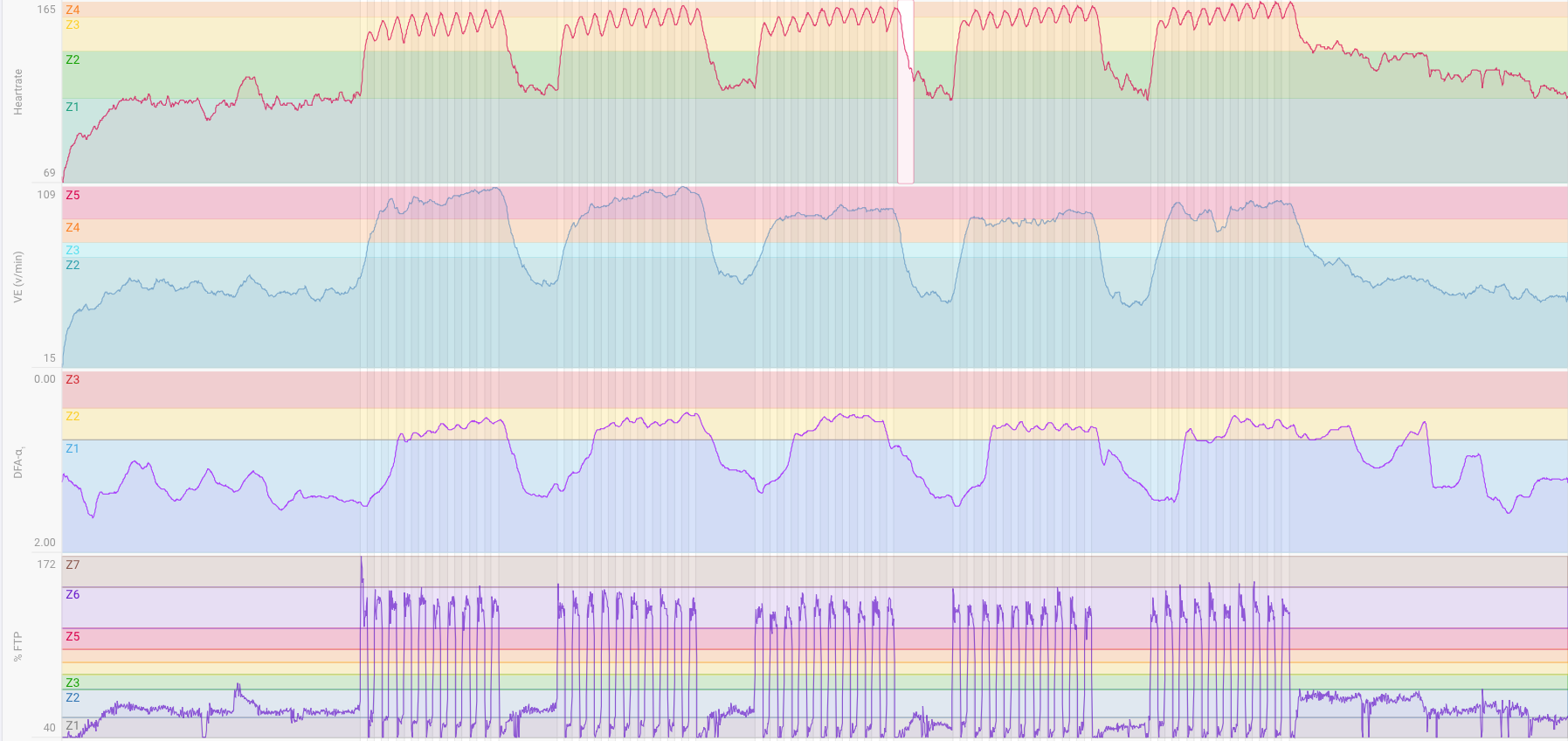
I don’t know yet.
And I obviously was sloppy, or tired, in sets 3 and esp. 4.
1 Like
Hi Yokuha,
You are right: the cleanest way to confirm VO2max work is a metabolic cart (gas analysis). I do not have one, but I do have a lactate meter.
For my VO2max blocks, I calibrate intensity using lactate measured right after the block. In my case, if lactate is above 6 mmol/L, I am confident I am in the severe domain (VO2max / zone 5).
I cannot build Interval.icu charts as nicely as you do, but I can share an example of my VO2max workout. It is not 30/30. It is this protocol:
3× block: 3 min – 2 min – 60 s – 45 s – 30 s
After each block I measure lactate.
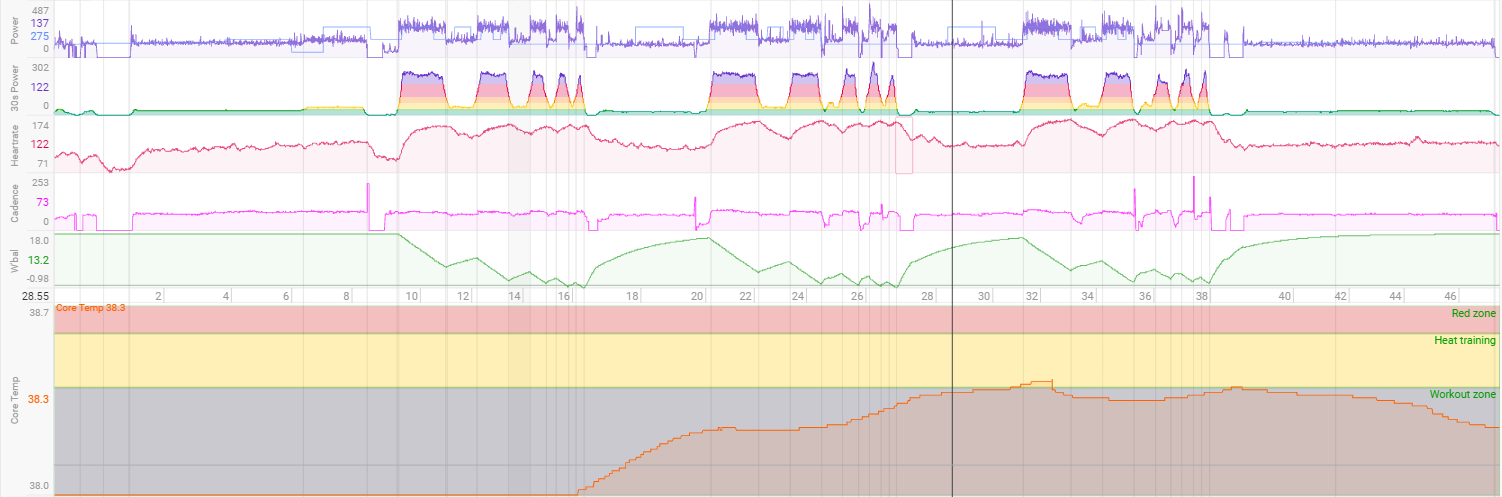
After warm-up, lactate was 1.3 mmol/L, which confirms the warm-up was good.
After the first block lactate was 5.9 mmol/L, and after the next blocks it was already 8.6–8.7 mmol/L.
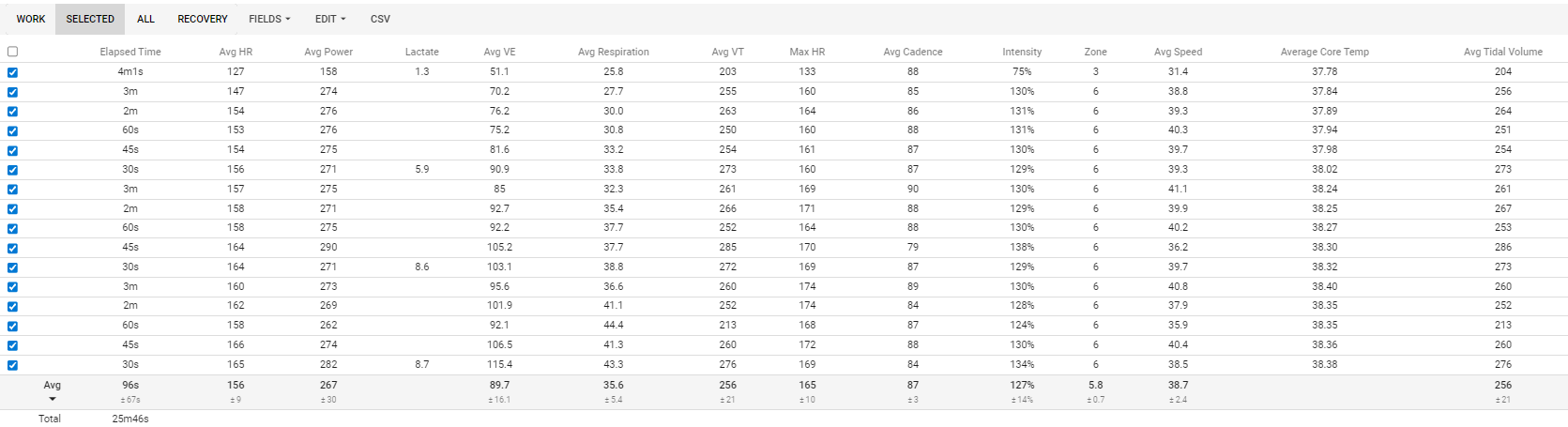
Power was in Z6 during the intervals, while heart rate and ventilation were in Z5. Lactate and ventilation helped me see that this interval duration and intensity are too high for my current goal (it is “too much”).
I have not done 30/30 with ventilation control yet. I also want to test it.
For reference: my 30/15 workouts showed much lower lactate, while heart rate was around sweet spot (lower end of Zone 4).
1 Like
Quick response: these charts are shared publicly:-)
1 Like
My response is just as fast — I just don’t know how to cook them properly