It may be useful and interesting to analyze the results of a cross-country ski race from a ventilation perspective and draw conclusions about limiting factors and improvement opportunities. This is the final race of the season: a 10 km freestyle ski race with 141 meters of elevation gain.
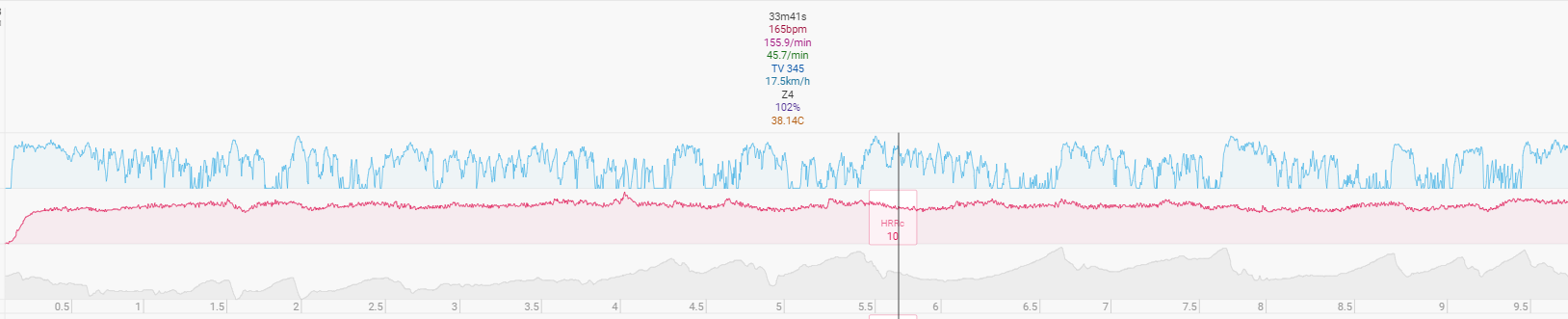

My finish time is 33:33.
My place in the category is 28 out of 80, +5:05 behind 1st place (28:28)

Short summary
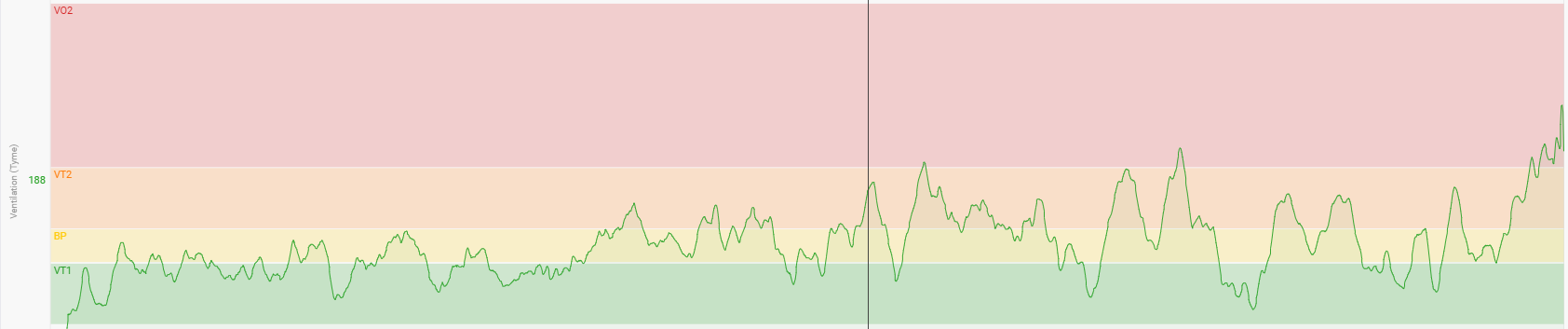
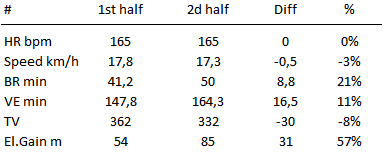
Based on ventilation data, the main limiter of the race is the increased cost of maintaining speed in the second half. This is shown by higher VE and BR, worse breathing pattern, and lower mechanical efficiency on the working terrain.
This points mainly to insufficient durability, especially on rolling terrain and moderate climbs, not to a major pacing error or a pure VO2max limitation.
Key training directions: threshold under accumulated fatigue, uphill durability, race-specific blocks of 20–35 minutes, and control of ventilation stability in key sessions.
Two more observations for me here:
- In skiing there is no power meter; there is only heart rate and speed (which depends on terrain). As can be seen, heart rate reached a stable level of 165 (which is slightly above my threshold level of 161–163). And while heart rate is almost stable, ventilation shows large variation—dropping on descents (recovery) and rising sharply on climbs.
- It is important to have high power at threshold levels (LT1/LT2) and VO2, but it is no less important—and likely more important—to have durability: the ability to maintain a given power for a long time.