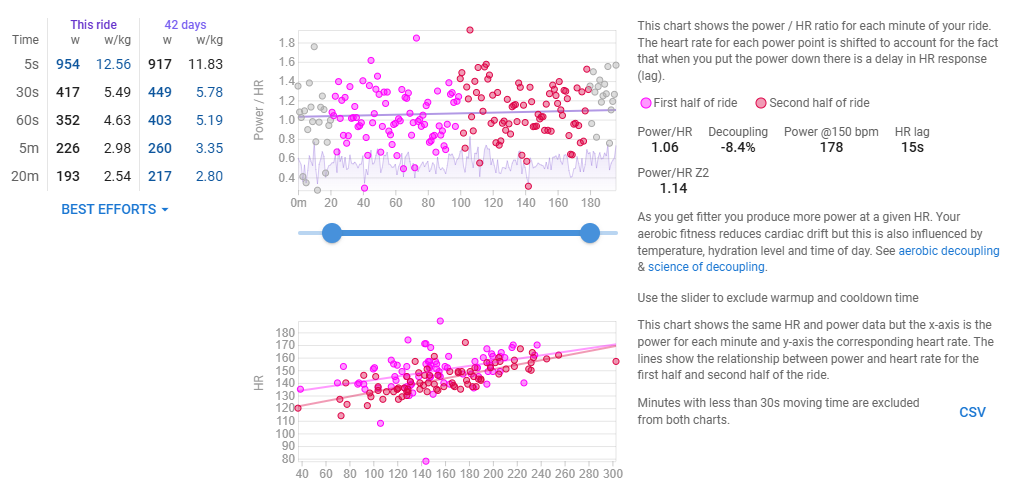
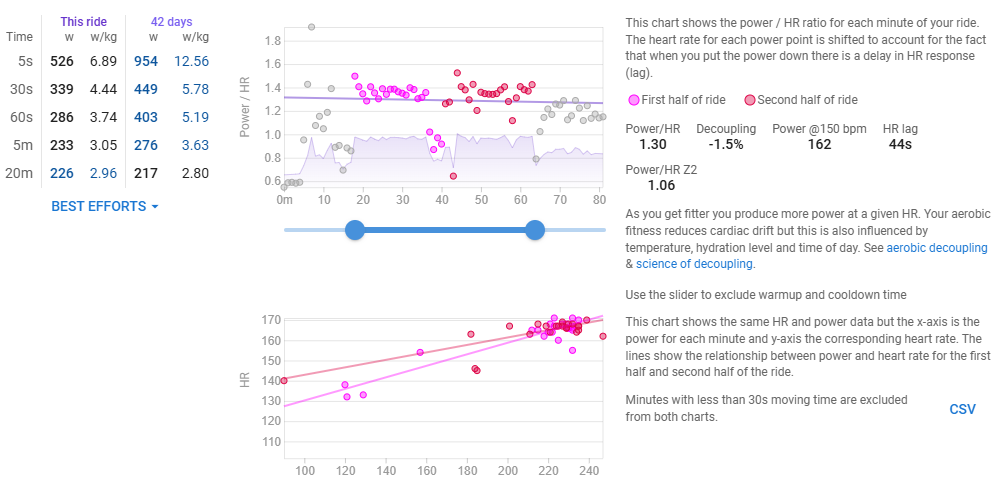
Thanks! My most recent steady-state ride was 1:07 at zone 2 power, zone 1 HR and showed a decoupling of -7.8%. I’ve seen similar efforts with positive decoupling. Seems to me to be highly dependent on the weather. 20-30% of my rides have negative decoupling, including some higher intensity ones. I’ve also had long base rides with +20%.
Another good reminder from you and @alex_cycles to maybe not worry about it too much, especially with the volume I’m realistically able to achieve right now. Part of me says though that low volume means I should be maximizing what little time I do have, so I should work this out. Don’t worry, I overthink about most things in life
Did you throw out the first 20-30 minutes? Don’t include the time it takes your body to warmup. My decoupling is quite stable out to 40 minutes at threshold, 90-120 minutes at mid to upper tempo, and 3+ hours at endurance/z2. All the time except after a season break.
The number has to be greater than zero to be valid. @WindWarrior What wind warrior said. Slide the bars at either end of the graph to isolate the consistent effort.
There is no period of that ride where the slope is positive. If I throw out first 20 mins instead of first 10 mins, the number becomes -10.1%. I think it’s too short of a ride to be a decoupling test, although as stated, I’ve also seen negative decoupling on 3+ hour rides and harder efforts in colder weather (see below).
The Decoupling requires a long steady ride where HR and Power is flat. Your second example qualifies except for the handful of minutes in the middle that throws it off and it’s too short.
There have been many posts about Decoupling in here which will go into far more detail. I find it useful to compare my base fitness progress over long periods of time. I don’t have a lot of flat roads and use a trainer for this. After a warmup when my HR reaches upper Zone 2, I freeze the HR and Cadence and manipulate Power, finding a steady state where all are in equilibrium. The percentage at the end of the test will verify if I have been successful.
The goal is to increase power, speed, at the same cardio and cadence. Base work. For me I have unfortunately found that I do my best tests at a cadence of 80. Although my legs are plenty capable of 90 for long periods, my heart argues and decouples. So, Power and HR are actually two metrics I need to improve on. Never ends
And your second one I’d focus on the 20-minute efforts. That said they are short at threshold and don’t offer much value unless you see high decoupling.
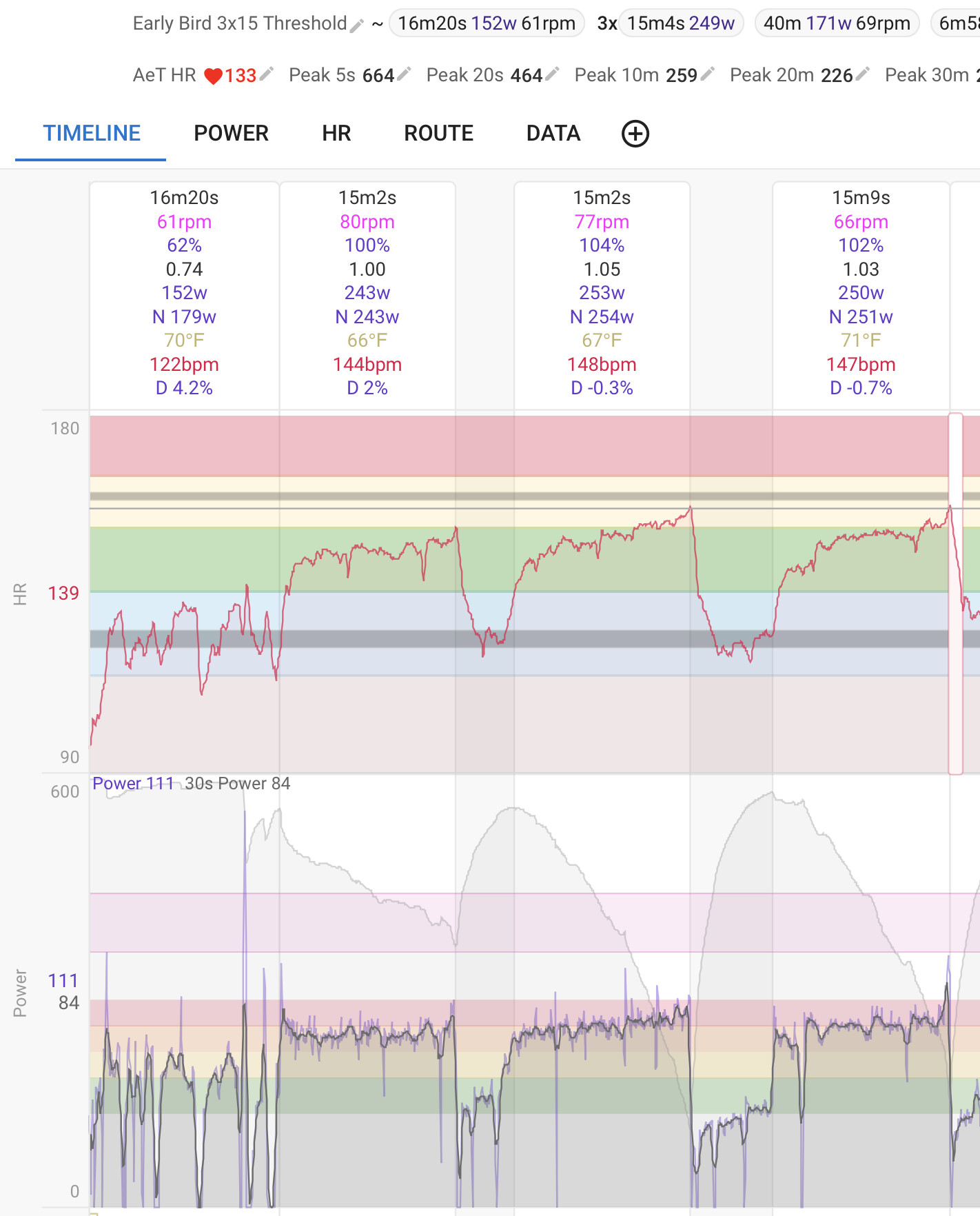
For example add the decoupling field to your timeline charts, its the last item listed above these 3x15-min threshold intervals
@fallingcow the first 15m 2s interval has D 2% just below 144bpm. Decoupling for the first one is 2%. The second interval has -0.3% decoupling, and the third interval has -0.7% decoupling.
How did you determine your FTP? If you’re relying on eFTP, I’d recommend doing a long-form FTP test like Kolie Moore’s protocol (The FTP Test: Physiology and New Protocols). After a warm-up, you’ll start below what your current FTP is for 10 minutes, then slightly above your current FTP for 15 minutes, and then gradually ramp up. Approach it somewhat rested and you should be able to determine the point when your effort tips from firm but sustainable to unsustainable. Set your FTP at that point and largely ignore HR zones. Over time, you’ll see where your heart rate typically is for the power zones, and it will give you a check for when the HR is higher or lower than normal. That could be due to sleep quality, temperature, stress or any number of things. Just consider it to be a secondary indicator and focus on power. Hope that helps.
His protocol is 10 minutes below the target FTP, then 15 mins at 100% of the target FTP. It’s not based on your current FTP. He says that because using tools like WKO5, he can ball park the estimated FTP.
Here’s his (base) protocol:
Baseline Test, 35-45 minutes or TTE
10 minutes at 92-95 percent of target FTP
Increase to 100 percent of target FTP for 15 minutes
10-15 minutes gradual power increase until exhaustion
Agreed. The version I use on TrainerRoad has the 15 min section at 102%, which targets a slight increase. For the OP’s purposes, this from Kolie is probably relevant:
“If you want to use my tests but aren’t sure where your target FTP is, a 3- to 8-watt increase is a reasonable starting point; however, if during the test you believe you can do more, try it.”