We’re a research group at ISGlobal (Barcelona) studying how training load shapes autonomic recovery — and we need your data.
Every endurance athlete knows the feeling: you’ve followed the plan, the numbers look right, but you show up to race day flat. Or the opposite — you felt buried in fatigue all week and then produce a personal best. The gap between what the training plan says and what your body actually does is real, and it’s largely invisible in the metrics we currently use.
A big part of that gap lives in your autonomic nervous system — the machinery behind your heart rate variability (HRV). Morning RMSSD is one of the best windows we have into how recovered (or how suppressed) you actually are. Most athletes already track it. But interpreting it is harder than it looks.
The problem with rolling averages
The standard approach — a 7-day rolling average — assumes your body responds to training immediately and linearly. Neither is true. A hard block of intervals doesn’t fully hit your autonomic system the next morning; the suppression builds, peaks days later, and fades at its own pace. And the relationship isn’t proportional: doubling TSS doesn’t double the HRV drop. The response is delayed and non-linear, and rolling averages simply can’t capture that.
What if the model actually matched the physiology?
That’s the question driving our research. We use a class of statistical models called Distributed Lag Non-Linear Models (DLNM) — originally developed for environmental epidemiology — to capture exactly this kind of delayed, non-linear response. Instead of flattening everything into a 7-day window, the model learns your individual lag structure: how long it takes for a given training load to affect your HRV, how intense the effect is, and how quickly you bounce back.
Once calibrated with enough data (~4–6 months), the model can do something genuinely useful: predict your RMSSD trajectory under a planned training week before you execute it. Different load distributions — say, front-loading a block versus spreading it evenly — produce measurably different predicted autonomic suppression, even when total weekly TSS is identical. This is the kind of insight that rolling averages structurally cannot provide.
We will present our preliminary results at the European Congress of Sport Science (ECSS) in Lausanne this July, and they’re promising. But our current sample is small (12 athletes), and we need a much larger and more diverse dataset to validate whether these personalised models generalise across the broader endurance population.
What we need from you
We’re asking for a minimal, fully anonymised dataset:
-
Daily TSS (your training load) + Session duration (in minutes)
-
Morning RMSSD (your HRV)
-
Age
No names, no locations, no identifying information whatsoever. The age is only because HRV has a well-documented decline with age, and without accounting for it we’d be confounding training effects with biology.
Ideally, we’d love time series of at least 4–6 months (the minimum needed to calibrate the lag structure), but longer is better.
Why this matters for you
This isn’t just academic. The end goal is a tool that athletes and coaches can actually use — one that moves beyond “your HRV is lower than your 7-day average” toward “given what you’ve done this week, here’s where your autonomic system is likely headed.” Understanding the delayed effects of load distribution, not just load volume, could meaningfully improve how we plan tapers, recover from blocks, and arrive at key events in the right state.
How to participate
We’ve set up a study page with all the details:
If you have questions, feel free to ask in this thread — we’re happy to discuss.
Thank you to David for supporting this and for building a platform that makes this kind of research possible.
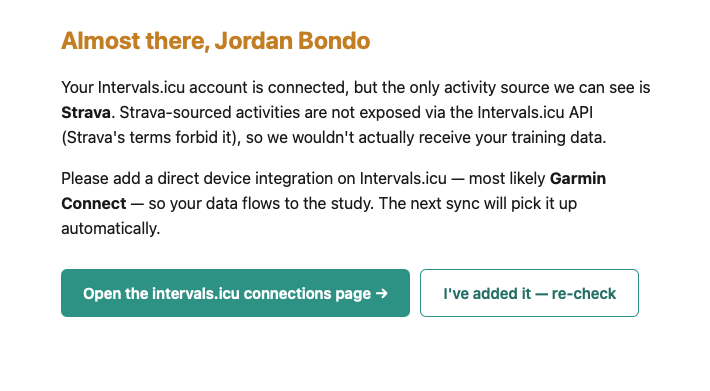
Please remark that activities must be synced to Intervals.icu through any connection type except Strava since the API terms don’t allow to get the needed information.
Víctor Nàcher Castellet, Prof. Juan Ramón González
Bioinformatics Research Group
Barcelona Institute for Global Health (ISGlobal)

 .