Thanks! Worth a try I think 
That’s right. This is not specific for alphaHRV, but any CIQ datafield requires this procedure, because Garmin only exposes power to 3rd parties if this comes from a powermeter. I think I gave this advise to someone else in the past
2 Likes
Just did an easy session yesterday. Started off easy. 8 or 10 minutes in I have my highest a1 value of 1.32 (no artifacts). So is my 1st threshold supposed to be 1.32-0.5 = 0.82?
makes no sense if this is the case. Maybe this method just doesn’t correlate very well for me individually.
Thanks a lot for sharing that paper! Fascinating also how we’ve gone from (I think?) high confidence in the 0.75 threshold and low confidence in the 0.5 one, to only that 0.5 being a trusted fixed HRVT2 marker for everyone…
And funny that during long rides I’ve usually aimed for alpha1 at 1.0 all this time, looks like I had a point… (Also because that felt better to begin with.)
But 0.75 has always been pretty far off then… :-/
1 Like
Same for me 0.75 felt way too hard on my legs to feel aerobic.
I’m entirely opposite. I can go much lower than 0.75 and be barely breathing (slight exaggeration).
I’ve just had a look again at the quick test that I did last week. My highest value in an artefact free few minutes in the first easy section was 1.33
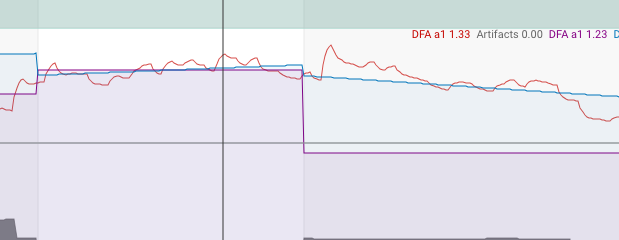
So the midpoint between 1.33 and 0.5 I put at 0.92 0.5+((1.33-0.5)/2)
This would show then a Power & HR for me at HRVT1 of 131W & 121bpm
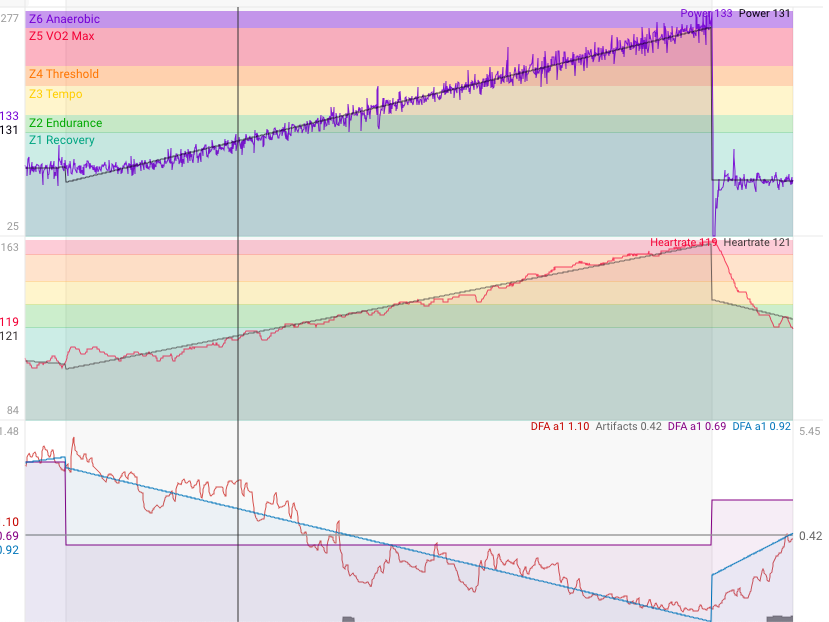
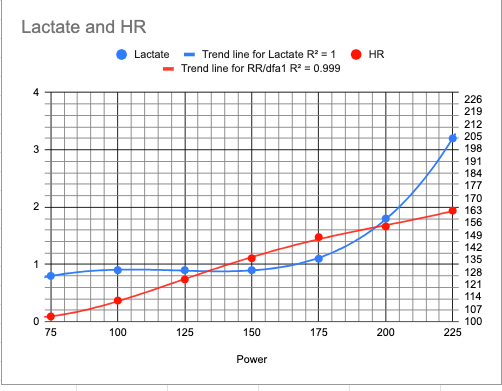
which is considerably lower than a lactate measured LT1 of 175W & 148bpm.
3 Likes
Can you send me the fit?
I have been saying for a long time since the pandemic that there are no fixed dfa values for any threshold.
1 Like
I would do but I can’t workout how to attach a file on this forum.
Could you DM with an email address so I could attach it to an email to you?
Personally I see the 148 bpm and 175w values with that graph as overestimated LT1.
Would you put it at the point just as lactate starts to increase then?
I would put LT1 at 150w and 130-135 heart rate.
1 Like
If we analyze HRV values, I would put LT1 at 130, honestly I think we’re wrong again if we look for fixed values of a completely fractal and unstable metric. We need to customize and analyze each graph and not focus on fixed values.
2 Likes
Thanks. On an RPE basis that “feels” about the right level for me when I’m on an normal "OK "day. Higher when I’m feeling really good and lower when I’m on a bad day or fatigued.
Analysing your test, if you are going to record with alphaHRV, do not start the test when alphaHRV takes the first readings, if you look at your graph you will see values that are not correct, wait for alpha and rra1 to stabilise before starting the test. This data at the beginning may cause an error. At 120 beats you have a first change in heart rate variability, that change in variability is producing artefacts or the artefacts are causing changes in variability (you should try moving the heart rate monitor), this change occurs between 120 and 130 beats, between 130 and 137 you have another period of variability instability. Between 141 and 151 beats you have a stable period and from 152 onwards there is no more backlash and the variability instability continues. Personally and looking at the ramp you have decided to use to measure lactate, I think you are measuring previous lactate, if you are going to measure lactate you need a minimum of time to make sure that the measurement is from the ramp you are on. I am not in favour of using tests with a few minutes of ascent, as the variability fails to stabilise and can lead to incorrect interpretations. And remember that the thresholds are not fixed, they move from day to day depending on your state of fatigue.
5 Likes
does this mean that values derived from any workout (including ramp tests etc.) actually have no meaning for other workouts? i.e. they cannot be used to set training zones etc.?
I seem to get a lot of artefacts no matter where I placed the polar sensor on my chest. It seems to be better if I use a gel but it is still not good.
The lactate test was a 5min step test from a short while ago, not from this one. I’ve found I can’t really do the same tests at the same time as I get a lot of artefacts when I stop pedalling to take lactate.
I have to do the tests on my own because, despite of the attraction of sticking needles in me, my wife has a problem with blood.
The problem with measuring a data with a fractal metric, which is calculated through cardiac variability, is that one day you may be fine and functioning, but another day you may have either sympathetic or parasympathetic activation, so the values dependent on that metric will be affected. Considering that a threshold is changeable even on a daily basis, imagine if you put zones through alpha-1. Then if you do a ramp test and you have a correct variability, within your confidence interval we could take the value as a reference, but if that day of the ramp test the hrv is either too high or too low, the alpha-1 values are going to be affected. The best thing to do is to take some approximate values and see what happens on different days, comparing data with hrv and then draw better conclusions.
3 Likes