How to ride more?

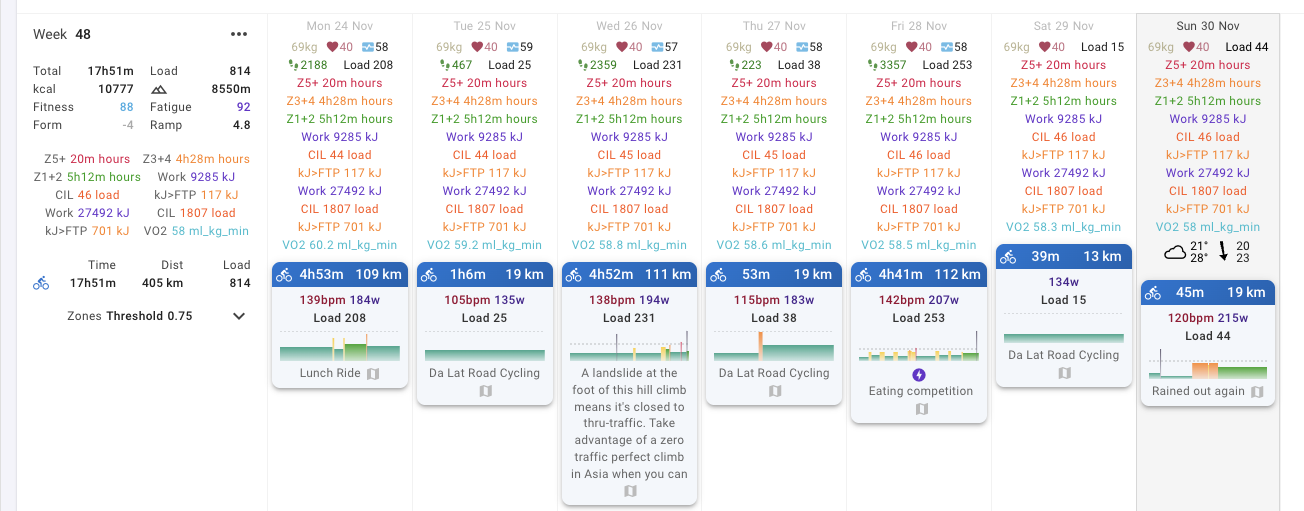
I dont know what to do. I feel like I literally cannot ride more. Between the weather, acute fatigue, etc. I cannot seem to break through 10,000+ KJ in a week.

Is it motivation? Is it living at 5200 feet? Willingness to sacrifice more of my life?

I don’t know what to do to break through.

Hi Steve, first to understand ur history. How much volume do you ride in the past weeks? As i see your weekly summary i think, ur volume is (very) high.That might be no problem or the “problem”.
If you ride week for week such high volume i might question you, where is your recovery? Maybe you, on the other side, just have a plateu. This can be a physiological barrier - as said, your body cant do more in the given circumstances. What happend if you ride more - do you feel (more) exhausted or psychological unwell?
Last but not least, what is your target?

1 Like

Have you got a big enough prize waiting for you on the other side of that objective?

1 Like

I think you don’t need to ride any more — a rest day might be a better idea. Riding for almost 18 hours is a lot. If you want to get into better shape, adding more volume may not be the right approach. Take 1 or 2 rest days and do shorter, harder intervals, for example 5×6 minutes close to FTP.

Short and simply reply and I think you’re right. I need to figure out a better carrot, ey?

1 Like

Hi Steve,

Firstly, the acute fatigue was the first thing I picked up on, Perhaps taking some time to rest and recover; start to feel fresh and regain motivation.

Second, there are big rides of nearly 5 hours, which could be quite taxing? And thus limiting what you can do on other days. Maybe a slightly different distribution of rides, for example you could use a 3 day microcycle with a day off in the middle? 18 hrs a week over 6 days is an average of 3 hrs per day.

M: 3.5h, T: 2hr, W: 3.5h, T: off, F: 3.5h, S: 2h, S: 3.5. That’s 18hrs, in a week including a day off; which you don’t have in your current week. This may allow you more flexibility and opportunities to add more riding.

Second, riding more isn’t always the answer. Is there a particular goal in mind? If it’s riding for fun, do you need to ride more? If you have a goal in mind, how does riding more achieve it?

Why the need to break 10,000+ kJ, is that your goal in cycling? 18hrs/week is quite a lot of time spent to hit some random endurance metric, especially if you’re frustrated, fatigued, tired, stressing about numbers and not enjoying it.

Also, this might seem paradoxical but if you get fitter (produce more watts, burn more KJ for the same effort) you will hit that number more easily. This would require building up your threshold fitness, doing more intervals – paradoxical because you’ll have to ride less (but more intense hours) to ride more again later.

But if you are literally asking how you can break 10,000 KJ in a week right now, I’d have to say sign yourself up for something like a week-long supported ride with lots of climbing (Raid Pyrenees, Haute Route). Or just go on holiday to some hilly warm cycling-mecca place and ride every day…

1 Like

You need a strict rest day.

Activities on your rest day: sleep in long, then eating, reading, coaching, watching TV, playing video games, having nice healthy snacks, maybe some midday napping. Go to bed early.

When did you think your body is repairing and getting stronger?

1 Like

Yep just took two full days off the bike. Not by choice, but because it rained for 48 hours straight.

Thanks for the reply — really appreciate you taking the time. My goal is progression because I have a fair bit of racing planned for 2026 and I want to improve on last year.

I might be misunderstanding, but I see threshold work a bit differently. In my experience, threshold intervals help raise FTP and improve metabolic efficiency, but for multi-day durability I’ve found volume, long tempo/sweet spot, and repeatability work to have a much more direct effect.

That said, maybe we’re just defining “durability” differently — I’m thinking specifically of being able to produce steady power day after day without breakdown.

And yeah, a big sportive or training camp would definitely spike the KJ number — I’m just trying to improve sustainable weekly load rather than one-off efforts, so I’m curious how people approach that.

Open to hearing your perspective if I’m missing something.

Hi Steve

Thanks for blowing my mind. Thats a lot of KJ you’re working towards, and I must first preface that I can barely grasp this dedication without a paid contract.

I race all year on Zwift. I’m in A- class, and captained a few teams and rode with 4 other ones the last 5 years. I don’t really have “seasons” - so slow Z2 work doesn’t really plug into my paradigm. I am trying to get as much done in the least amount of time so I can do my life. I get my time in with 6 hours a week. If I am having an easy day, it’s sweet spot. I meet a lot of people in the pens that race too much, without concern of their recovery - and it hurts them. Its easy to have happen on Zwift due to the community I think.

I typically take 2 days off before a >50 mile race. I try to race all out - Z3/Z4 to keep my lactate clear.

4500-5000kj a week is enough to podium most every race I enter. But truly, I focus on great nutrition, and proper recovery.

What is the average wattage on these monster rides you’re doing? What is your goal with this heavy load?

1 Like

Hey Molly,

Average wattage is kind of pointless in this context because of the downhills – I literally cannot pedal more and still take turns – every ride im hitting 75kph with light pedaling. Its jsut steep downhills.

. You can see the NP for the 3 larger rides, 184, 194, 207.

Sorry I missed that Steve. I get your frustration with the downhills, and how they end up being averaging pretty low wattage rides. That is the main reason that I choose to ride / race indoors. I live in really steep mountains, and need to do 3k feet of climb on every ride to go over 20 miles. Have you ever considered augmenting your training indoors? No wet roads, no downhills, no squirrels, no cars. Just all power and fitness focus all the time. :slight_smile:

1 Like

Riding inside solves one problem and creates others.

Well, as I said, it’s just simple maths. More watts = more KJ. Get your FTP higher and your other zones will also increase and that means more KJ for same effort.

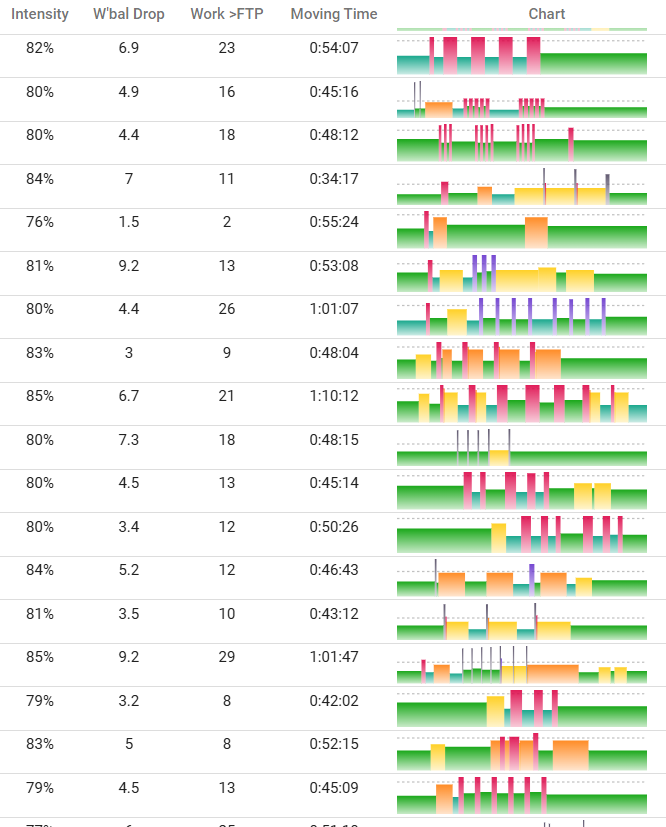
To me, it looks like you’re riding your long rides too hard and your short rides too easy. My equivalent to your 10,000KJ is about 8000KJ and I can hit that easily in a big week of riding, with a good base of my usual training of 10-12hrs/week.

I couldn’t do it week after week but certainly I wouldn’t struggle to hit it on a good week or a cycling holiday. I have even hit 10,000kJ a few times when I was super fit and motivated on a training camp (years ago admittedly when my FTP was 10-15% higher than it is now).

Using TSS (as that’s a more comparable measure amongst people than KJ), I do about 600-700 TSS a week from 2 or 3 endurance rides about 150-200 TSS each and 2x zone 4/5/6 interval sessions around 65 TSS each. The long rides around 3.5-4.5hrs, the intervals are 1hr each. So not riding every day, only 4-5 days a week.

The other 2 days are active recovery for me: lifting weights (mostly core/upper body), yoga/pilates, walking a lot. Or I take a day off, I don’t schedule rest days but instead take it when I feel I need it. Nearly 20 years of riding as a serious amateur/ex-elite means I am confident to do this, but a lot of people would benefit from a coach if overtraining is a risk for them.

YMMV of course. You say your goal is progression but that 18hr/week can’t be your norm? If it were, your CTL would be more like 115 not 90. So what has your training been like outside of this week?

Personally I think you need to train smarter/more efficiently/less on your “normal” (not big) weeks, I think this is what will build up your FTP and also let you recover. Long tempo/sweetsport is overrated in my opinion, you can plateau very easily on that type of stuff, it’s too hard to recover from, but not hard enough to improve your fitness, once you hit the plateau. Short repeatable but not killer Z4/5/6 intervals is what works for me to increase my durability and fatiguability in long endurance rides.

I’ve included a snapshot of my own intervals in the past few months to show you what I do:
3 Likes

Maryka - thanks so much for sharing this wisdom. I’m about to turn 65 and had an injury in May that caused me to be unable to exercise for about 4 weeks and then it took another 6 weeks or so of slowly increasing my activity level before I was able to do a “real” interval workout. Needless to say I lost a ton of fitness, and have been struggling to get back to my prior form. I’m probably about 80 or 90% back but have plateaued the last couple of months.

Your comment turned on a light bulb for me; previously I consistently did 2 hard interval workouts a week during the indoor season but since the timing of my comeback coincided with outdoor season I mostly was doing tempo/sweet spot or long group rides. I’m realizing that the missing piece of the puzzle to get back to my prior form is to revert to consistently doing the 2 hard interval workouts each week.

2 Likes

Thanks for the detailed reply — genuinely appreciate you taking the time.

I think a big part of the disconnect here is that my training environment isn’t comparable to what you’re describing, and a few of the constraints I mentioned maybe got lost in translation.

1. Terrain:
My long rides aren’t “too easy” by choice — they have to be whatever the terrain gives me. I live at 5,200 ft and every ride is long, steep climbing followed by fast coasting where pedaling isn’t possible. So NP matters, but average power/KJ are artificially suppressed. That’s a physics constraint, not a training-structure one.

2. Altitude:
You didn’t mention this in your response, but living and climbing daily at 1,600 m means Z2 costs significantly more oxygen. Fatigue accumulates faster, so comparing your sea-level workload to mine becomes apples-to-oranges.

3. Durability definition:
Your durability model seems built around Zwift-style repeatability (Z4/5/6 sessions). Mine is built around multi-hour climbing at altitude and being able to reproduce steady power day after day. Those are different metabolic problems, so the solutions aren’t identical.

4. Load ceiling vs. one-off peaks:
I’m not struggling to hit 10,000 KJ once. You mentioned training camps — and sure, in a camp I’d hit it too.
My bottleneck is raising the sustainable weekly ceiling, not spiking for a single week.

5. Distribution vs. constraints:
I agree in principle that “smarter distribution” helps, but right now my issue isn’t motivation or structure — it’s that the combination of:
• altitude
• terrain
• coasting/downhills
• weather windows
• faster-than-expected fatigue
…all collapses the number of rideable, productive minutes in a week.

So the problem I’m trying to solve isn’t “How do I train smarter?” — it’s “How do I raise weekly workload ceilings within an environment that limits KJ/hour?” Besides just moving of course.

This seems to scream indoor riding like that other fellow suggested? Not exclusively, but maybe one or two sessions per week where you can fill in the gaps mandated by your environment?

Ok, well we can’t help with the terrain and altitude or where you live. Weather affects all of us. How or where you choose (or have) to ride isn’t something any of us can change for you. Argue for your limitations and they’re yours… maybe you just need to accept that your reality means it’s not possible to hit the mythical 10,000KJ you want to hit and choose another goal.

I still don’t think you are riding many 18hr weeks if you can only amass a 90 CTL but if you post your entire last 6 months worth of weekly TSS/load then maybe that will be more illuminating.

Your original post was a bit misleading as now you’re talking about sustainable weekly ceilings rather than managing to get to 10,000KJ in a single week, but it seems you haven’t amassed the CTL needed to sustain 10,000KJ/week anyway.

“How do I raise weekly workload ceilings within an environment that limits KJ/hour?” isn’t actually that different a question to “How do I train smarter?”. I’ll now bow out of this thread as I have never lived/trained at altitude with nothing but long climbs so don’t have much more to offer there.

Except to say, what you’re doing doesn’t seem to be working, so if you don’t want to change how you train then you’re probably just going to keep seeing the results you’re seeing. That’s how it works – adapt or plateau. Change the stimulus or you won’t see improvements. Try something different and see?

1 Like

Thanks for the follow-up — and no worries on bowing out. I appreciate the perspective even if our contexts don’t line up.

Just to clarify the miscommunication in my original post:
I wasn’t asking how to hit 10,000 KJ once. I’ve hit plenty of big single weeks over the years. The question was specifically about raising the sustainable ceiling in a place where KJ/hour is capped by terrain, altitude, and the available riding windows.

I’m not “arguing for limitations” so much as identifying the constraints I actually have to solve for. Altitude and terrain aren’t excuses — they’re variables that materially change the physiology and math. That’s why I asked the question in the first place: the solution isn’t as simple as “just do more” or “just change stimulus.”

And for context, the CTL snapshot you saw was after a long rebuild, not during a period where I was riding consistent 18-hour weeks. I can post the full 6-month load chart if helpful — it probably paints a clearer operational picture.

But all good — if altitude-based training with long climbs isn’t in your experience set, then I get why the conversation sort of dead-ends there. I appreciate what you were able to offer.