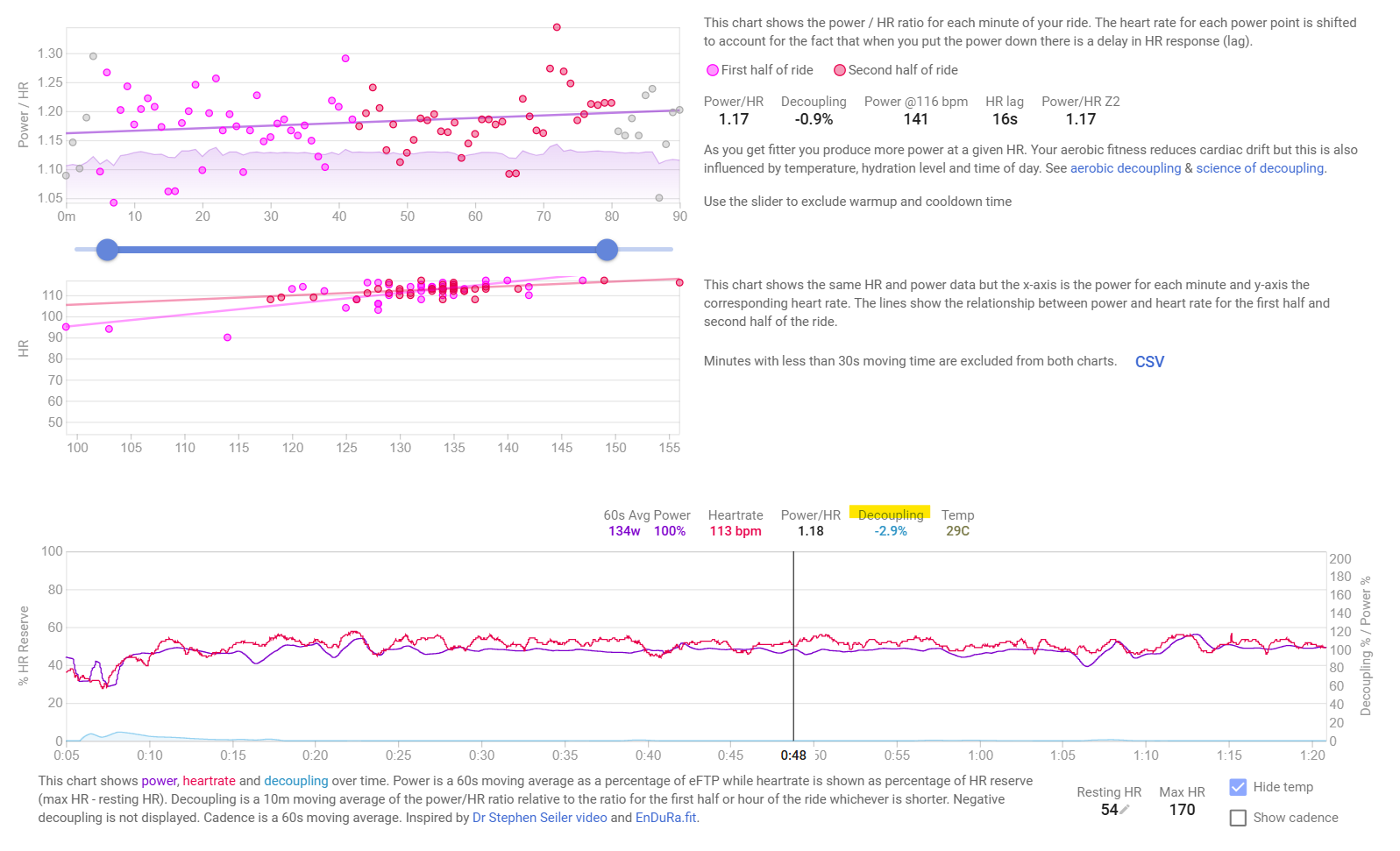
I have a question and I don’t think there has been a similar request in forum. The question: how does intervals.icu use the warm-up and cool-down (default 5 min and 3 min) in the calculation of the various parameters (in particular NP which is used to calculate all the other parameters and HRSS)?
I thought that the warm-up and cool-down were excluded from the calculation of ALL the parameters. I read more carefully and I noticed that the guide says that warm-up and cool-down are excluded only from the decoupling.
Is that so?
If so, I nedd to modify my workouts because in the first 5 minutes I go very slowly (I also stop for a few seconds) to get my body ready to the training. The same in the last 3 minutes: I go very slowly thinking that these minutes are not included in the calculation of the parameters.
In my stupid opinion, intervals.icu should allow the user to insert (or not insert) these minutes in the calculation of the parameters. Otherwise (at least for me) you need to warm up and cool down very slowly outside of the true session of training, otherwise my data is a bit too influenced by the very low warm up and cool down values.
Thanks
I think it can interfere a lot or a little… it depends on how fast you go during the warm-up and cool-down and how long you ride on your bike between one and the other.
If I understand correctly, but I am ignorant, NP is one of the “central measures” for the calculation of many other parameters, it is good that it is calculated very carefully.
One of the first steps to calculate NP (I hope to have understood well) is to calculate the exponential moving average (in italiano media mobile) of the instantaneous power using a time window of 30 seconds. So, I think that if you go very slowly the first 5 minutes and the last 3 minutes and the training lasts only half an hour (30 minutes) NP could vary a lot.
Less if the training lasts an hour (60 minutes) but still a lot because out of 60 minutes you could go “very slow” for 8 minutes (about 13.35%).
However, I do not want to go into the subsequent steps of the calculations because it could be that this gap is balanced by some other parameters.
I ask because in my opinion it has a significant impact especially on workouts up to an hour long (60 minutes). Also many people warm up for 10 or 15 minutes and in these cases the percentage incidence could increase.
I believe, but always in my feeling, that the impact on TRIM is less since the differences in HR are large but not so large how the difference for the power.
So, I believe it is important to verify the percentage incidence on the calculation of NP. It would be necessary to perform a test on large numbers of bikers to verify the percentage incidence of warm up and cool down on NP. For example take the data of 50 workouts of 100 athletes (50 * 100) who have set same time for warm up e cool down. So you will have equal and random data and you will try to remove warm up and cool down from NP. Compare the results with the current data and you will have a good answer at the question).
I believe this but maybe I didn’t understand your question. I don’t understand English well sorry.
Simple, why don’t you warmup without recording? Same for cooldown, stop recording and go easy homewards.
Typical Warmup would start around 50% FTP and gradually up to workout target.
Cooldown maybe 40-50% FTP.
Perfectly. I think so like you. I would like to know if this is a good way or not. Another reason is that I work with numbers and I would like to understand a little better.
thanks
Personally I look for example for P/HRZ2, CP, TTE to track my progress.
For such cases I wouldn’t look at NP. If you do HIIT, you can push that number to the top.
If you want to track your progress using NP, and don’t want to include Warmup and Cooldown, then start recording after warmup and stop recording before cooldown. That would be the easiest way. I wouldn’t do that, but if I understand you right, it is what you have asked?
Instead of create a new topic, I will use this to try to understand a bit more.
I run 2 kind of weekly workouts, 7 days a week.
One kind is an easy run with steady slow pace the entire time (so without a warm up or cooldown), from 40 to 120 minutes.
The other workout kind is a subthreshold with variable warm-up and cool own, sometimes 5 minutes each other times 10 minutes each (depends on my free time) and a 30 minutes subthreshold in the middle.
With this type of workouts , what would be the best values to set for my warm-up and cooldowns? As I’m a bit confused about how will the settings i put , impact the overall calculations like form and fatigue, I would like to ask you for advice.
The setting for Warmup and cooldown defaults has no influence on Load/Fitness/Fatigue/Form.
It serves to exclude the beginning and end of an activity where Power and HR haven’t reached stable values due to working up to a steady state. If these were not excluded, the metrics Power/HRz2 and decoupling would be miscalculated. I think these 2 parameters are the only ones where Warmup/Cooldown time is taken into account.
Knowing my use case, with the 7 days week run with those 2 types of workouts, in a watch that dont measures power (only HR) what would be the settings for WU and CD you would recommend me set?
If you don’t have power, I think it doesn’t matter at all at this moment.
But there is some interest in Decoupling measured for runs, based on Pace (GAP) and HR. Nothing implemented yet, unless there’s some user developed custom Activity field that I’m not aware of.
For Warmup, I would suggest to have a look at your easy runs, to see how much time you need for HR to get to steady state at the easy pace. Then calculate some margin by rounding up and use that.
If you keep the steady pace until you stop recording on your device, cooldown time is not even needed, but setting it at 5 min gives you some time to walk at the end of your workout and let your HR drop.
In the Decoupling chart (also on the Activity Power page), you can see how it is implemented in case you have Power. The Cooldown and Warmup phases are excluded from the chart and you can easily track how well Power/HR remain ‘in sync’ during the activity. If this get’s done for Pace/GAP, you will see something similar.