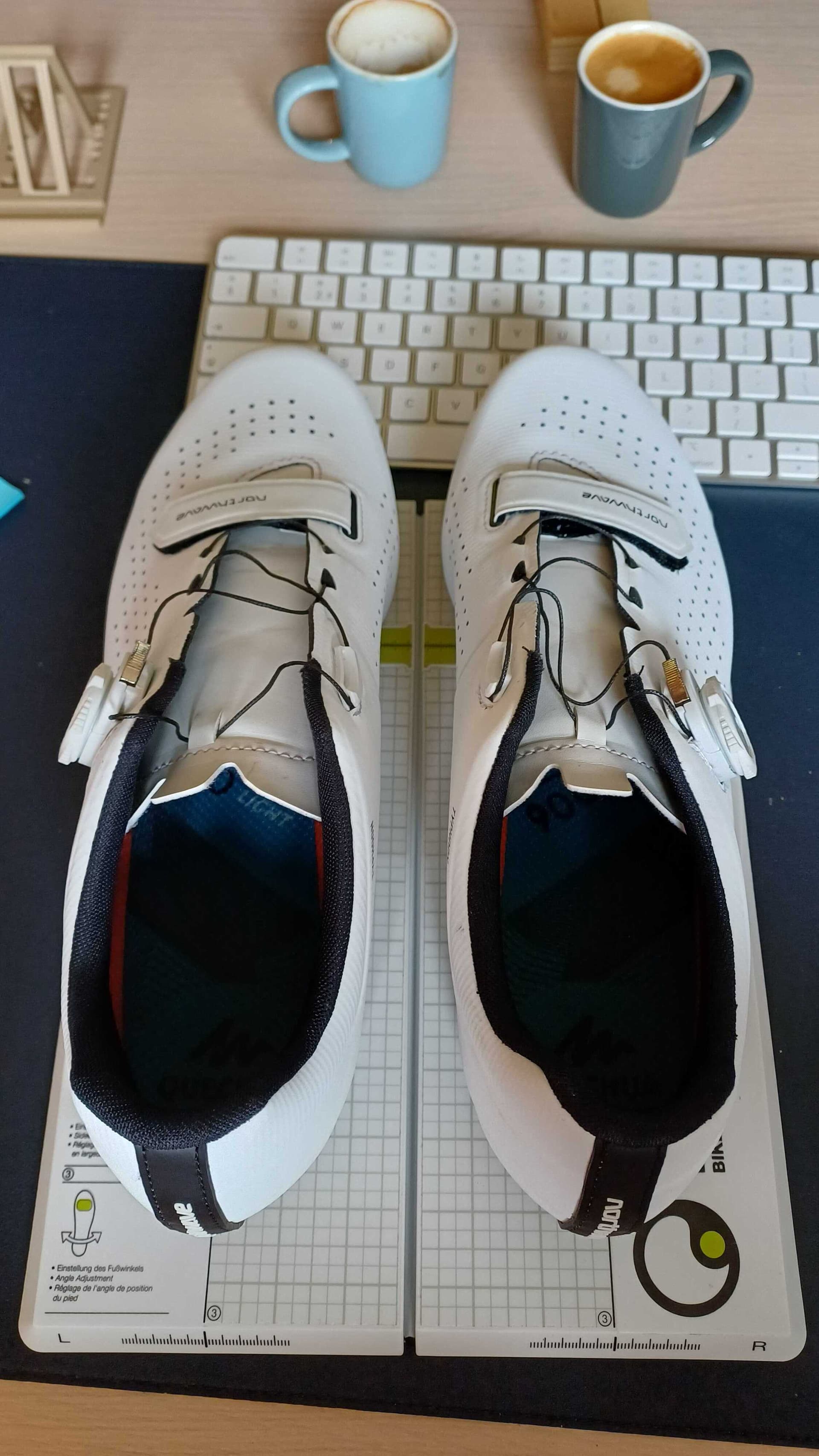
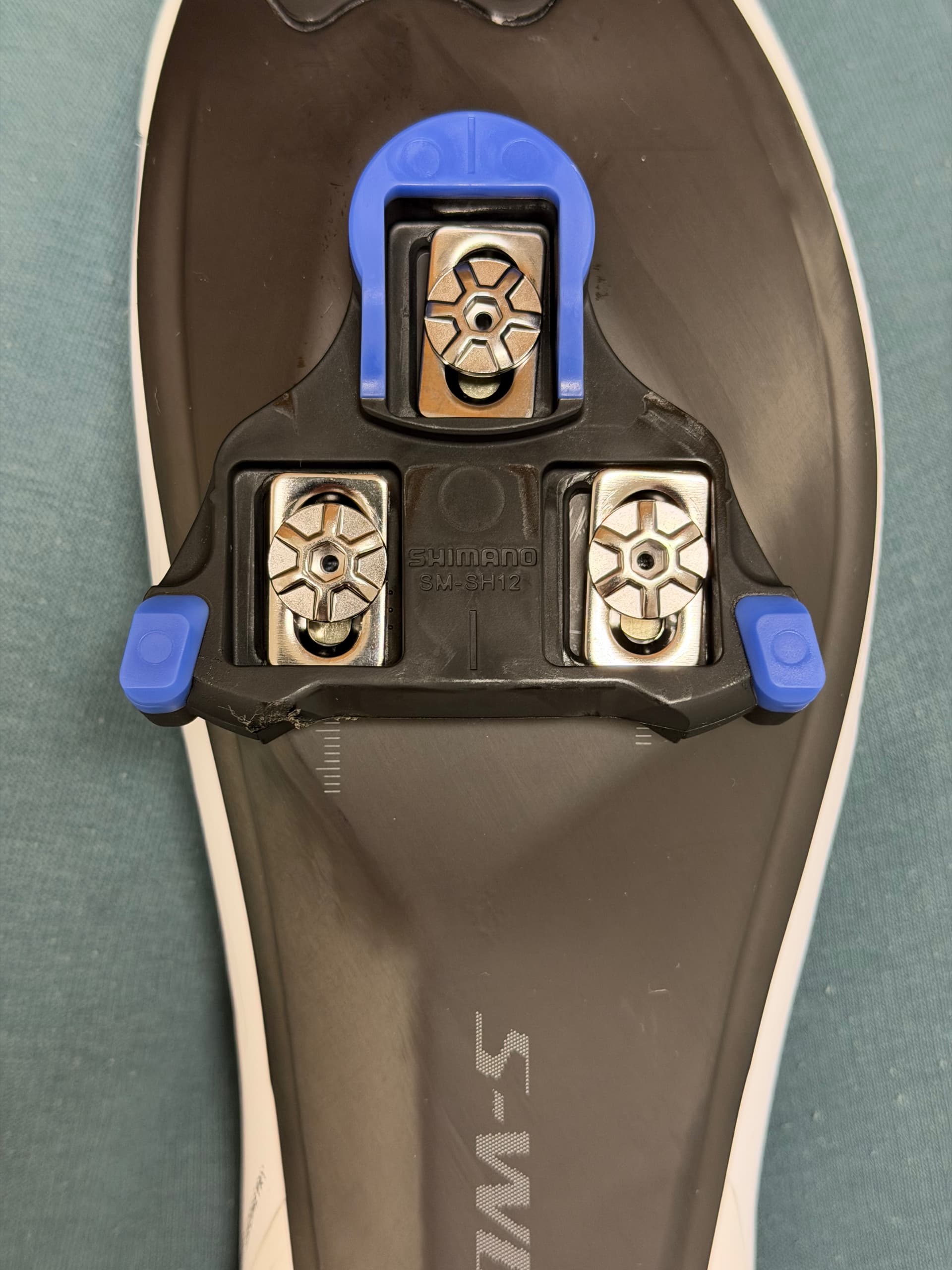
Yeah that makes sense. My hypothesis would be that the pinching/uncomfortable/numby feeling making me think “hey my legs feel weaker than usual, maybe I should eat more”.
Gonna revert my cleat position until my replacement saddle clamp gets delivered.
AFAIC, bike shoe technology is the differentiator here. Specifically, sole stiffness.
Putting major power with your arches (or your toes) is just not fun (or effective) when a shoe is floppy. Thus, the ball of the foot position made lots of sense.
We are no longer constrained by that, IMHO, hence able to explore other cleat positions that favor our own bodies. I do get more power with “slammed back” cleats, but that does load up the calves.
Just my $0.02.
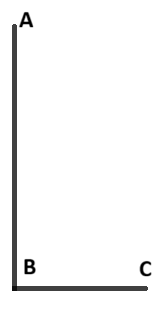
It’s pure triangular math. A downward force on point A transfers 100% to point C on the condition that point B keeps it’s place regarding to A and C (basically the angle at B remains constant). In the human body, the angle at point B (the ankle) is kept constant by primarily the calve muscle (A-B). The stiffness of segment B-C is nowadays fairly stable thanks to the quality of the shoes.
When the angle at B collapses, you ‘loose’ force. The shorter B-C (slammed back cleats), the less force is needed to stabilize the angle at B.
So following this thread I reviewed my inseam measurement from a 2020 bike fit and actually came to the conclusion that they measured me at 953 inseam, where I came to 920-930 depending on how hard I press my perineum (how hard should you press?). This measurement actually measured what the rental bike company measured a year ago.
Filling that into
I’ve now dropped my saddle by a whopping 35mm Also feels better regarding saddle setback/needing to ride on the nose of the saddle.
Gonna try the new setup with some resistance tonight. It feels a bit cramped right now so I might want to come up a bit more. Also gonna do some filming and measuring based on that.
Cyclists having their saddle to high by 20-30 mm is not an exception unfortunately…
When you look around in a group and pay attention to their pedaling, you see people rocking side2side, pointing their toes to get to the bottom of the stroke, all while discussing they think about raising their saddle another couple of mm. I have no idea why this madness of going higher has so much attraction…
I stopped trying to convince them to lower the saddle because most of the time, they just ignore it or counter it with other nonsense.
If you are too low, you will notice right away because your pedaling stroke will become erratic when coming over the top position (caused by hip impingement). From that point, if you raise the saddle 10-15 mm, you are very likely in a sweetspot, which can be fine-tuned for performance.
If you can’t find a position where both top and bottom passthrough is fluid and smooth, you may need shorter cranks to accommodate for a smaller adjustment window.
When I set my saddle to the suggested heights via myvelofit or zwift ride suggestions my quads fail (burn) at very low power. I have 25 inch thighs at 72kg cause I squat a lot , am fast twitch, good jumper, thrower, peak sprint etc
if I raise my saddle I feel my glutes contribute more to the movement which takes load off my quad.
I believe my quads are mostly fast twitch and glutes have good aerobic performance due to walking/hiking 10-12 hours a week and running so it massively helps me. I’ve also learnt the trick of saddle set back slammed all the way back and pedalling with the mid foot which also engages more posterior chain as does lifting the front of a zwift ride on a yoga block.
So it depends on the individual and their fibre type. I think do much advice around training and bike fit has a slow twitch bias purely cause of who’s actually good at the sport.
New day, new question. After a bit of messing around I now feel I have the fore-aft dialed in. However lateral is a different challenge.
I tried as wide as possible, but that has lead to flare-ups of gout in my big toes due to increased pressure on the inside foot.
So I’ve moved back the cleats back to center, at least according to the markings on the sole of the shoe. Both shoes are 99% similar in lateral alignment. However, when I’m riding and I look down, I see the left foot moving past the crank much closer than my right foot. And lo and behold, my left knee is more painful than the right.
The Ergon tool isn’t really helpful in aligning lateral, cause I can’t see where I should be.
How do you set lateral alignment with this tool (or in general without the tool). It just feels like a guessing game. Referencing off any part on top of the shoe feels useless, since they’re not the 100% the same
Pain on the inside (big toe) of one or both feet, usualy is an indication that the arch of your foot is collapsing under pressure. And that transfers to the knee that gets pulled inward on every downstroke.
Can you get a hold of insoles with arch support?
While setting both feet equal is not wrong practice, your feet aren’t equal by definition.
Look from above what your knee is doing or film from the front. The knee should track up/down with as little lateral movement as possible. A knee moving laterally can also be caused by the cleat angle that is not adapted to your natural foot position. I hope you’re not using ‘fixed’ cleats? Always use cleats that allow some rotation on the pedal.
For a 75kg 1.85m normal rider looking to move from this position to «slammed», where would you start with q factor? As you can see I currently have it «maxed» but with a slight 1 degree toe in. My observations are:
I like to point my knees toward the top tube under load
My feet aren’t naturally angled in. They are pretty neutral with a hint of toe out
I do get some sore spots on long indoor rides under the foot which I recon slamming would fix
Slammed on a s works shoe isn’t very far back anyway unless you modify/adjust the mounting points
My cleats are all the way back, so I’m not arguing this from bias. But I don’t agree with the premise.
The “triangle” model is too simplistic. It assumes a static system with fixed force direction, but pedaling is a rotating, multi-joint system where both joint angles and force vectors are constantly changing.
Even the analogy breaks down when you look at actual mechanics. A piston engine, which is far closer to what’s being described, doesn’t produce constant torque. The crank sees varying torque and velocity throughout the stroke, with peaks and dead spots depending on crank angle.
Humans are even more complex because we’re not constrained to a fixed force direction. The ankle isn’t just “stabilizing” , it’s actively modulates force direction and timing throughout the stroke.
A more forward cleat increases that ankle leverage, which can help smooth torque delivery and modulate those peak forces. That doesn’t show up in a static triangle model, but it absolutely affects fatigue and how power is produced over time.
So yes, moving the cleat back reduces the stabilization demand at the ankle, but it also reduces the system’s ability to dynamically shape force, which is a real tradeoff that this model ignores.

 Also feels better regarding saddle setback/needing to ride on the nose of the saddle.