Cleat fore–aft experiment: mid-foot vs. toe-forward using Favero Cycling Dynamics

I ran a small N=1 experiment comparing two cleat fore–aft positions using Favero Assioma Duo pedals and Garmin FIT files. The goal wasn’t to prove one position is “better,” but to see whether the cycling dynamics data could detect any repeatable mechanical differences.

Test
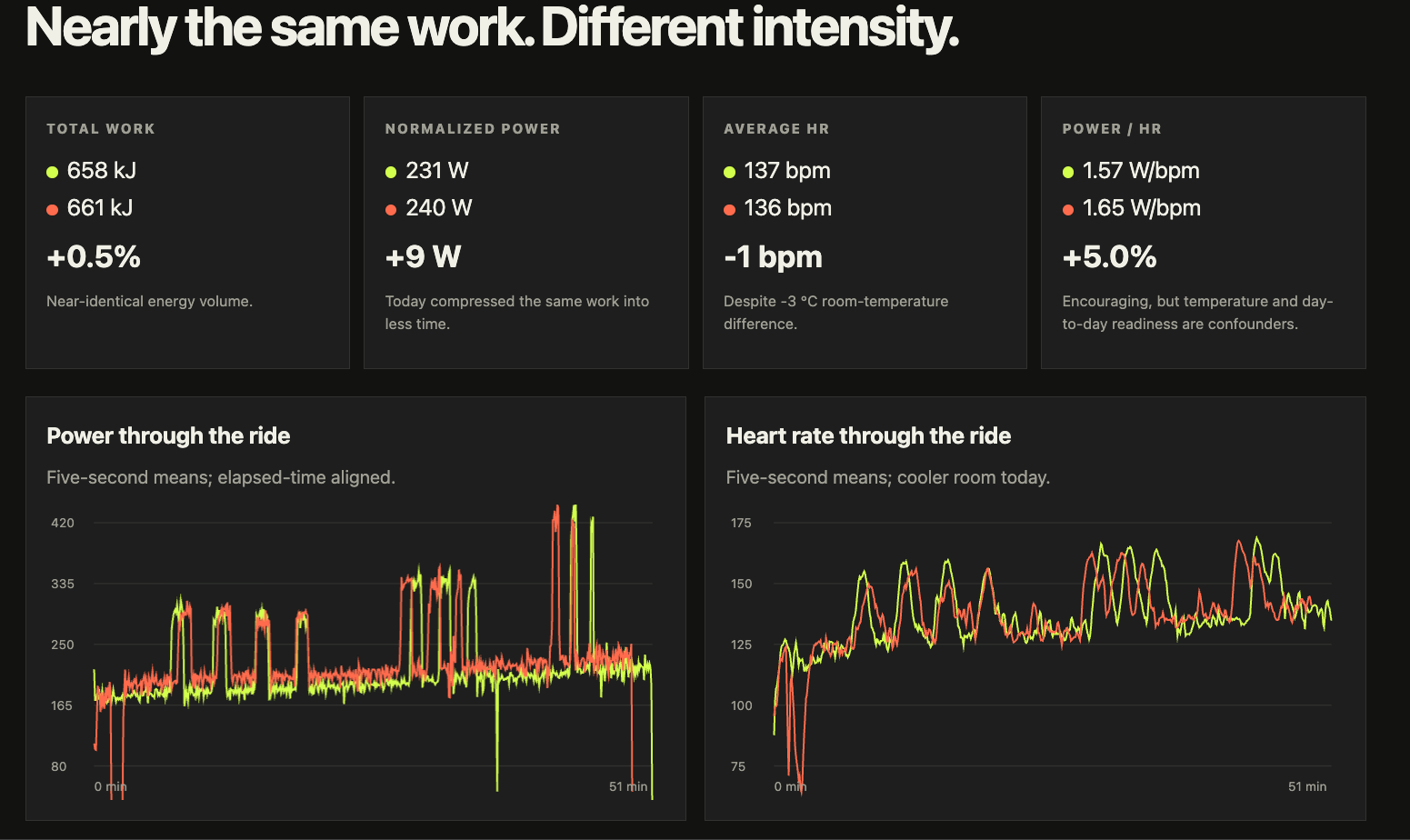
Two nearly identical indoor rides on consecutive days:

  • July 28: cleats as far back as my shoes allow (toward mid-foot)

  • July 29: cleats moved forward toward the toes

Both rides were:

  • Same bike

  • Same trainer

  • Same Edge 840

  • Same Assioma Duo pedals

  • FTP set to 280 W

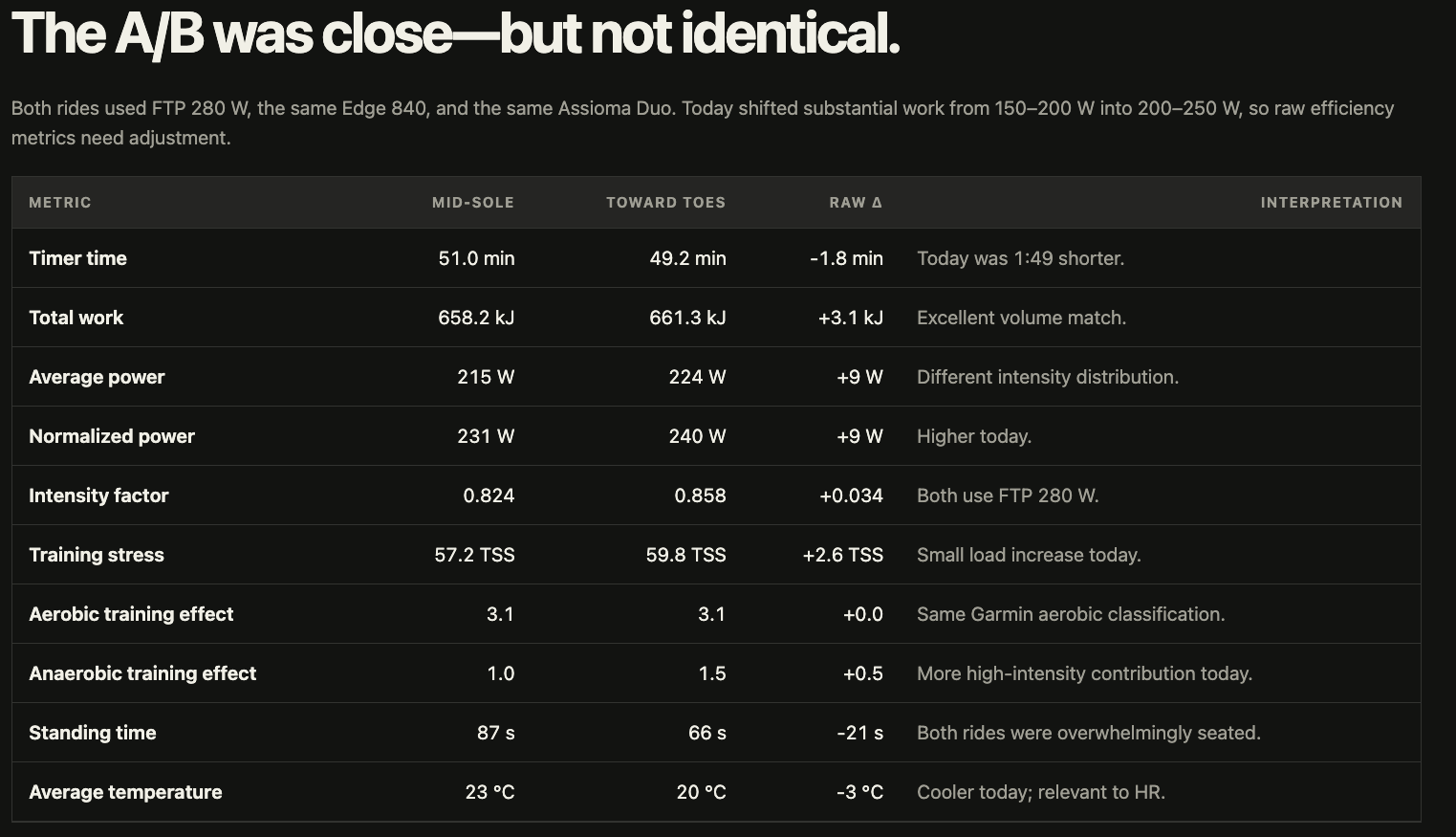
The rides were intentionally similar (~660 kJ each), although the second ride ended up slightly harder (NP 240 W vs. 231 W). To account for that, I compared not only raw averages but also power-matched metrics by binning the data into shared 25 W power ranges.

Results

The interesting part is that almost every cycling dynamics metric moved in the same direction.

Power-matched changes:

  • Left torque effectiveness: +0.9 percentage points

  • Right torque effectiveness: +1.4 percentage points

  • Left pedal smoothness: +0.6 percentage points

  • Right pedal smoothness: +0.5 percentage points

  • L/R balance shifted 0.49 percentage points toward symmetry

  • Power phase widened slightly on both legs

  • Phase midpoints moved slightly earlier

  • Peak power phase was essentially unchanged

Perhaps the most interesting physiological finding:

  • Power-matched heart rate was about 2.7 bpm lower with the toe-forward position.

Meanwhile, several things were essentially unchanged after matching for power:

  • Cadence: −0.1 rpm

  • Calculated crank torque: +0.20 Nm

  • Respiration rate: nearly identical

So this doesn’t look like I adopted a different pedaling style. Instead, the data suggest a small improvement in how force was applied throughout the stroke.

Caveats

This is absolutely not proof that toe-forward is superior.

There are several confounders:

  • One ride per condition

  • Second ride was performed at slightly higher intensity

  • Room temperature differed by about 3 °C

  • Consecutive-day recovery differences

  • Possible adaptation to the new position

Thousands of pedal strokes do not equal thousands of independent experiments.

Next step

Rather than drawing conclusions from one A/B comparison, I’m planning to repeat this as a controlled experiment.

Current plan:

  • Alternate the cleat positions (ABBA or AABB) across multiple rides.

  • Keep the workout identical each time (same ERG workout, cadence targets, fan, fueling, calibration, and time of day).

  • Continue logging:

    • Torque effectiveness

    • Pedal smoothness

    • L/R balance

    • Power phase

    • HR at matched power

    • Comfort (foot pressure, calves, Achilles, knees)

My decision criterion isn’t “highest torque effectiveness.” It’ll be whichever position repeatedly gives the best combination of:

  • repeatable power/HR,

  • stable cycling dynamics,

  • and the best comfort.

I’m curious whether anyone else has done controlled fore–aft cleat testing using Assioma or Garmin Cycling Dynamics. Did you see consistent changes in TE, pedal smoothness, or power phase, or were the differences mostly lost in day-to-day variability?
2 Likes

Interesting experiment.
Did you account for saddle height?
A cleat position more midfoot, will in most cases require a drop of the saddle height to get through the bottom position in a similar fluid way.

1 Like

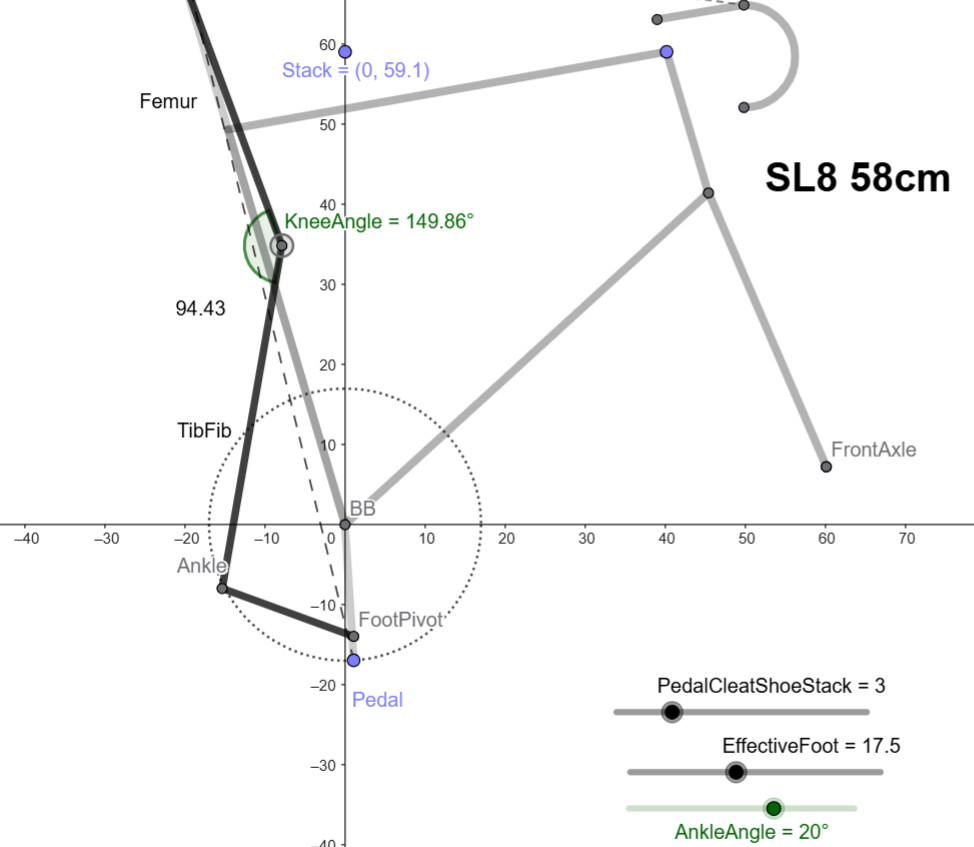
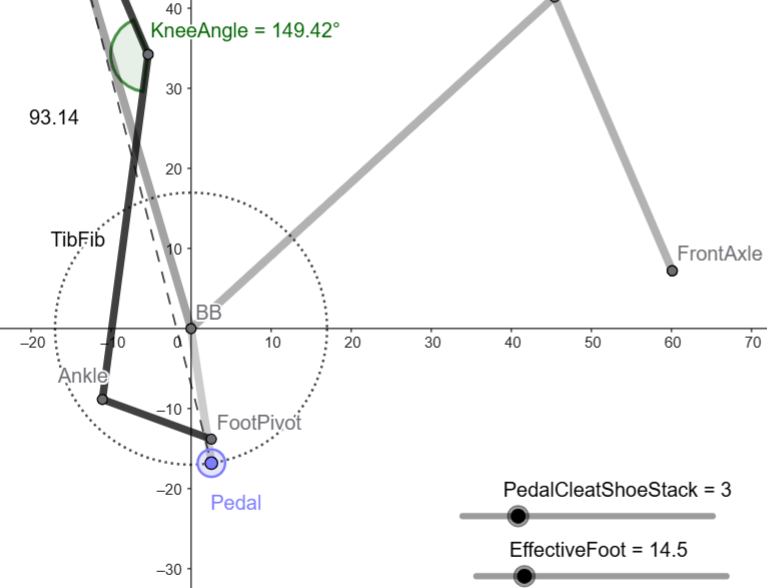
Perhaps I can ask you, scientifically, in order to preserve the ~<1 degree knee angle change that 3cm of cleat fore-movement would create, what do you think is the required saddle height adjustment?

Is saddle height the lever that should be pulled or is that lever just one that has lots of impact?

Lots of assumptions baked into your response.

It wasn’t really a response, more a question…
It is a matter that has no strict answer because it depends a lot on the athlete and his bikefit.
For someone who naturally pedals toe down and has the saddle height set for that, the cleat movement will have serious impact on the fluidity through bottom stroke. For someone with an almost horizontal foot position through the bottom of the stroke, it will probably have no impact at all.
It also depends on the shoes, because cleat adjustment range can vary wildly.
It wasn’t meant as any form of critique, I’m just genuinely interested in this kind of approach. I know that you are quit thorough in this kind of things and just wondered if and how you are accounting for it.
If you sense no difference in pedaling technique, it may be insignificant for you.

1 Like

The correct answer is that in order to maintain knee angle, an approximate 1mm height change is required.

That is correct only if the rider has their feet more or less horizontal at the bottom of the pedal stroke. Cyclists who point their toes down will often have their saddle height adjusted accordingly.
If you then move the cleat 30mm backwards on the shoe, the saddle will have to come down by 10mm (~20° toe down), maybe 15mm (30° toe down) or they want be able to reach the bottom position without rocking in the saddle.
I’m not saying that saddle height adjustment with toe down is good practice, but it is common practice. For some reason I don’t understand, they want to be as high as possible while being lower is more aero…

TBH, I’m not seeing anything in your data that suggests one position is better or worse than the other. Daily differences could easily account for all the variation and then some. Here’s the first two hours of rides I did on consecutive days:

Day 1: Average 261W (263NP), average HR 138bpm (max 164 while holding steady power), average temp 29 degrees
Day 2: Average 254W (259NP), average HR 124bpm (max 143), average temp 17 degrees

The post literally says it’s not stating that one position is superior.

The interesting thing is the widened power phase with cleats towards the toes.

1 Like

For my own bike setup, with ~20 degree down-angle, I’m seeing approximately a 1.5cm saddle adjustment (directly in the STA, with no change in saddle fore-aft) from a 3cm cleat position shift, but tib/fib/ankle-centre/ankle-to-pedal length are all guesses.

1 Like

Sure. I used a different calculator. I guess the premise of the original question was incomplete. It’s almost like there were a lot of assumptions baked into it!

I guess I was wrong assuming that the question could be answered without requiring more context like his assumptions about fit that weren’t stated. But I cant sit around here all day making sure other peoples questions are complete.

:man_shrugging:

1 Like

I do like your approach of the experiment a lot better then some of your responses, so at the risk of being flamed again, I’m going to come forward with another parameter that, according to anything I ever read about this, could be of importance.
The more rearward placement of the cleats has been ‘promoted’ for AFAIK, these 2 main reasons:

  • Comfort (which you already mentioned). Pain/pressure at the ball of the foot can be reduced/eliminated, by placing the cleats more to the center of the feet.
  • The one thing that is most claimed, but I have never seen any decent proof of it, is that the cleat-back position would reduce calf muscle fatigue (shorter lever needs less force to stabilize the foot - looks ‘logic’ at first sight). I know, you have that mentioned under ‘comfort’.

Given your excellent performance condition, it is unlikely that the second point will surface on 45-50min rides. Or it might after a couple of weeks of continuous load???
And, as it looks now, this wouldn’t match the 2.7bpm lower avg HR. More calf strain would intuitively call for a higher HR. I’m curious to see if this will hold on multiple test rides?

That is an especially important question for triathletes wanting to minimize quad and calf fatigue to have fresh legs for the run leg.