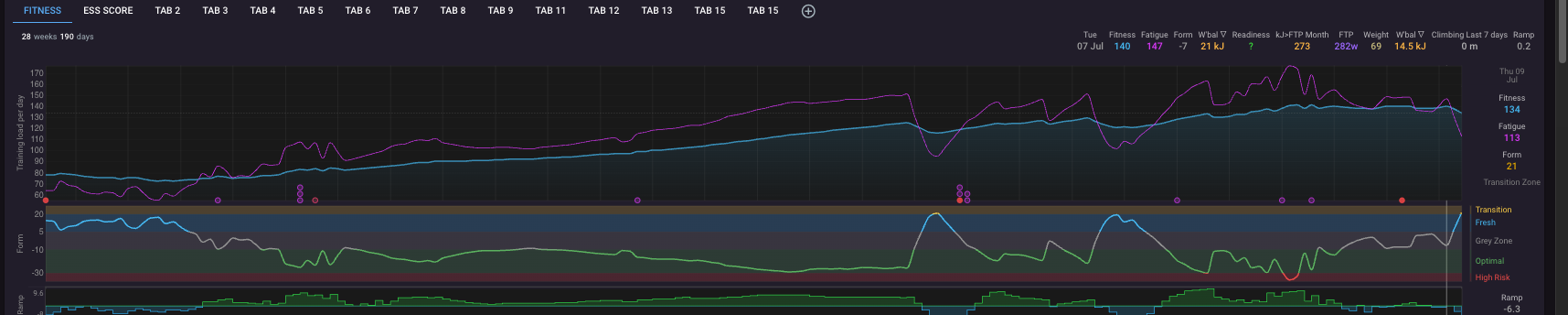
Seems like my body has a hard cap right now at 140 CTL. Like no matter what i do, i physically cant push past 140 CTL. Even dropping hr and power way down doesnt really let me break through this.
It seems like some sort of mathematical governor, probably tied to the number of hours I can dedicate to the bike and my FTP or some other formula.
Maybe limited by recovery capability?
Everyone talks about genetics as being important for sport performance, and people think of VO2 max etc. Ability to handle consistent load is also a genetic trait, you could have the best VO2max in the world, however if you can never consistently handle load (both total volume and high week after week, not two good weeks then a bad week) due to fatigue, injury or whatever, that’s a genetic limiter.
Good news is you can easily be competitive at the highest level at 140CTL - that’s 20-25 hrs per week if you’ve got your FTP correct and got your training zones dialled.
1 Like
Also looking at your picture, did you do 20 or so weeks without recovery there? Good lord man, get some rest once in a while. 
Yes. I wanted to take zone 2 to the limit. Peaked out at 16,000 KJ per week @ about 220w.So roughly like 20+ hours. All on the trainer btw!
I have no clue what my FTP really is anymore. It’s some where out back buried under a pile of trash. Luckily though, this block did indeed increase my recovery capacity greatly. Like i could easily go out and stack back to back 280TSS days. However, all things have a limit.
Maybe the next breakthrough comes after sustaining your work close to this current ceiling level for a while?
Quite what a while is, I don’t know.
But I suspect it is months rather than weeks.
I’ve a race in about 100 days i want to do well in so i will change to specificity and gym work. I reckon this block has built enough base for the near term at least.
1 Like
The theory is that the better base will help you get more out of the race specific training.
So you should be in a good place for that.
If it is a race you have done before, the comparison with this instance will be interesting.
I was watching a video by Ed Laverack about his recent participation in the Marmotte. He was comparing his overall results with his last attempt in 2022. Interesting (to me) how much quicker he was and also how much more competitive the event was.
I think everyone is getting faster. Anyone with chatGPT can get say, 80% of what a professional coach is. And a lot of people had decent fitness for years off of 0% of what a professional coach is.
1 Like
I wouldn’t worry too much about chasing a higher CTL. At some point your recovery becomes the real limit, not your motivation. If you’re still getting stronger and completing your key sessions, I’d take that over a bigger number on the chart.
1 Like
For sure, it’s true that if you’re getting stronger, you’re getting stronger. The question is how we define strength.
I’m trying to build the largest aerobic engine I reasonably can so that it supports greater future performance and stronger peaks. I think many cyclists reach a point where they have to choose whether to emphasize building capacity or expressing the capacity they already have. You can work on both, but it becomes increasingly difficult to maximize both at the same time.
I eventually reached the highest CTL that seemed productive within my available time and recovery capacity. Adding more volume meant increasingly fatigued, lower-quality hours, and the marginal benefit no longer seemed worth the trade-off—especially since I wasn’t prepared to spend 25 hours per week on the trainer.
1 Like
Don’t chase that chart, the modelling assumptions underneath do not give you a full picture and can lead to going beyond what the body can actually respond to
I’d advise to take a look at your training intensity distribution and periodisation - are you hitting the systems properly and hard enough to send a strong enough signal for them to adapt. Or are you just hitting them all, but not in a focused way to send that strong signal (typically the case when chasing CTL)
2 Likes
Hi. Have you ever thought about doing four consecutive climbs—each lasting 20–25 minutes at your limit (around 90–95% of max effort for each climb, except the last one, which is an “all-out” effort)—recovering only on the descents, just to see how much endurance you have? I used to do this 15 days before my most important race (the Italian Gran Fondo Championship—which I won). Whenever I managed to hit my personal best on that final climb, I knew I was in peak form. I call it a “Super field test.”
Daniele Marrama - Italia
1 Like
What’s your goal. I’m 72 and just hit an all time high of 133 two days ago but I’m hiking rather than biking and I have a lot more time than you do. I’ve gone from 94 to 133 in just 12 days hiking in the Sierras. I have no idea what I could push this to if I gave it another 15 days
I’m almost never above Lt1 but it’s hard to say where that is at an elevation of 11,000 feet.
I’m just chugging along for 8 hrs a day
Even if I got to 160 I bet I could never do what you can do but a plateau on the chart does not mean your performance has stopped improving. You can maintain a flat fitness score for months while becoming a much more efficient, faster athlete. You can literally feel it.
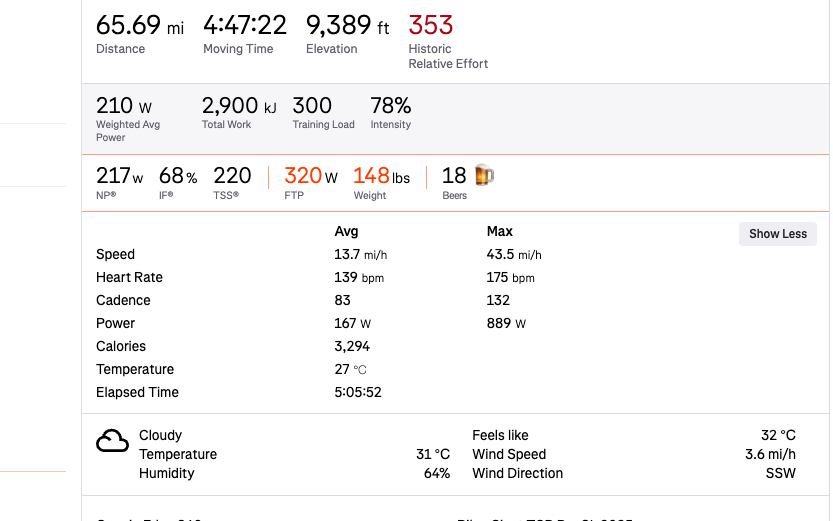
Like this? This was at the tail end of june training block
Approximately a month into the race specific training block.
I am curious about how you view the big base build’s contribution.