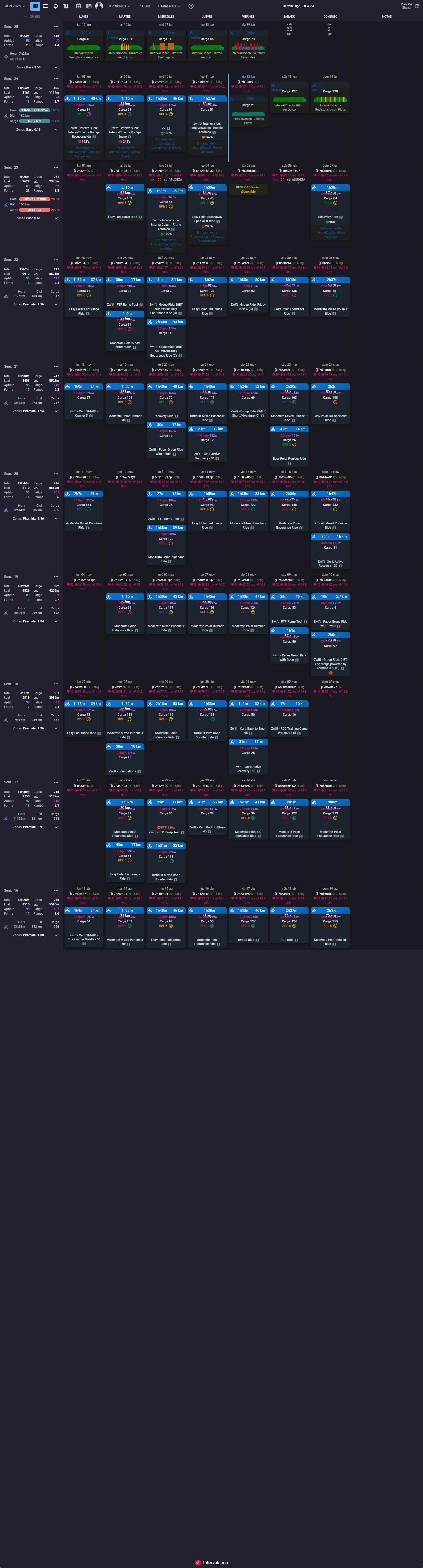
Hi everyone, for about 8 days now my HRV has been extremely low and my resting heart rate is 5% higher than normal. It’s true I’ve had three weeks of heavy training, and I’ve reduced the intensity and volume, but nothing’s working. Could someone advise me based on my data? Thanks, I need an opinion that confirms it’s not overtraining.
What‘s your feeling? Do you have fun doing this? Do you feel good/sick/stressed? What are your goals?
Is it overnight measurements or „manual“ morning measurement?
I’m eager to get out and ride; I’m not in the mood for easy training. The measurements are taken with a Whoop, so they’re at night.
I am 50 years old and I have been training with Xert this past year and I think the load has been too high
overnight HRV is not very reliable. Do not let a number convince you something is wrong. It may show you trends, but can be completely off.
More important is how you actually feel. Energy, mood, legs, sleep, stress. Those signals matter far more than a wearable.
You said you think the load was too high. Why do you think that? Was it the volume, the intensity, or just too many hard days in a row?
Also, what are your goals? Getting fitter, preparing for something, or just enjoying riding? That changes how much load makes sense.
When you should not ride:
- if you feel sick
- if your sleep is bad and you feel drained
- if your legs feel dead and nothing responds
- if you’re not motivated
2 Likes
As @R2Tom mentioned above. A distinct morning HRV measure appears to be a more accurate way to determine autonomic status as it’s furthest away from the previous day’s stressors; and gives a more ‘up-to-date’ picture i.e. on the morning that you’ll make your training decision.
That being said, if the HRV values are tracking along with how you feel then taking a longer break might be on the cards.
- sleep quality
- motivation (I find this is a big one with athletes)
- overall tiredness/fatigue
- peak power can be useful to track fatigue
2 Likes
Just be careful not to confuse motivation with discipline. It may sound like a trivial distinction, but it is not uncommon among highly data-driven athletes who are very good at following plans and checking boxes.
7 Likes
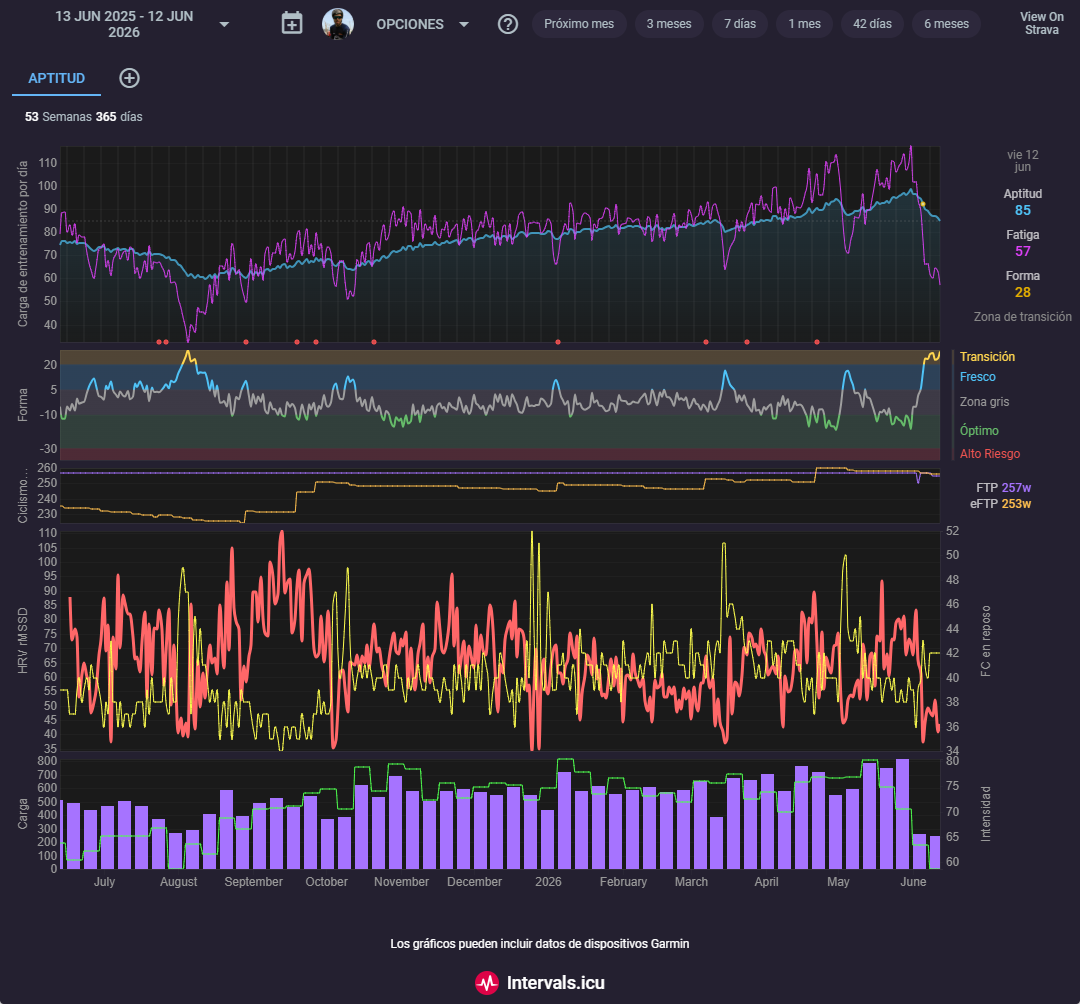
If I’m reading this correctly there is a very clear relationship between training load and responses in HRV and resting HR. It’s hard to know for sure if it’s so zoomed out but it seems like you get an elevated resting heart rate and depressed HRV at the end of a rest (or easier) week. I also notice that you had a period at the end of last summer where HRV was consistently much higher and you were improving quite rapidly.
So first of all, these 2 weeks are a clear break in the pattern that was very consistent for months, so you’re right to notice that there’s something to figure out right now. My first thought was, based on that break in pattern that can’t be explained purely through training load, it could very well be something outside of the training. Like stress in your personal life or at work or something along those lines that affects these numbers so much.
Looking at the comparison of HRV response between now and September last year I think there’s a possibility that it is some form of overtraining after all - although overtraining and burn-out are similar enough that it can come from more than just training - because I have seen that before in other people. You get the high HRV, low RHR for a while and you’re improving a lot. Then something happens in or around October. Tiredness or something that you didn’t recover from quite enough before starting to train hard again. And that tiredness never really got resolved, you keep building on it, and then at some point it catches up to you even though you’ve done everything right for the last 6 months.
You mentioned in the opening post that you’re looking for an opinion that it’s not overtraining - and I’m not saying it definitely is - but not being open to an opinion you don’t want is something that happens quite often with overtraining. So I’d suggest looking at last September/October again and thinking back about whether something happened that might make sense with this explanation, and consider whether there’s something outside of training in the last couple weeks. All I know for sure that there’s something that’s changed between the pattern from the last couple months compared to the last 2 weeks or so.
1 Like
No one can say if youre overtraining or not. To be frank, looking at your data, youre progressing steadily. That is rarely overtraining.
1 Like
You specifically mention that you have had three weeks of heavy training.
Later you mention that you are 50.
Age is only a number and all that, but it is not unusual for masters training plans to have a recovery week after three loading weeks.
As an example from a training platform I use, a plan I picked at random has the following sequence
Week 1 8h25m / 427 TSS / 6 rides
Week 2 9h30m / 510 TSS / 6 rides
Week 3 9h30m / 530 TSS / 6 rides
Week 4 5h15m / 160 TSS / 5 rides
1 Like
Wow! Well, in mid-October I had a drop in blood pressure one day that made me go to the doctor because it wasn’t normal, and I was going to the bathroom a lot at night. They did tests to rule out colon cancer, and what they detected was prediabetes. Since then, I’ve had to change my diet to include more complex carbohydrates. Two weeks ago, my last blood test confirmed that I’m out of the prediabetes range and my blood pressure is back to normal. Very good eye @jen
My last few weeks have been:
-786
-747
-817
-261 (this is where I got sick and the HRV decline began)
So you got sick and ask why HRV is declining and RHR is increased?
The decline had already begun before he got sick, and I think the illness came from overexertion; that’s what I think.
HRV changes can, some say, be a sign that an illness is setting in
A training peaks article
There are more scientific papers available
2 Likes
Ok, the sentence sounded a little different, so I was a little surprised, and asked that question.
As @ivegotabike says, I have also often observed that HRV is a first sign of illness, even before you notice anything else. A so-called open window effect does not exist, i.e. You don’t get sick from too much or too hard training. as far as I know, there are already scientific papers about that.
1 Like
Dito. Have experienced that several times. Low HRV in the morning without really feeling bad, then early afternoon clear signs of a cold.
2 Likes
I also find that HRV will drop days before symptoms of illness show up.
1 Like
@tortilla
Hey!
I agree with many points that have been said already.
Some of my thoughts:
- Hard to say if you are overtrained from the data you showed. Some TiZ Data (especially HR) could be useful to look at
- In my own experience, if my HRV and Resting HR are consistently low over a many days, if know something is wrong. The last two times (couple weeks back and around 2 years ago) it was (at least my own analyze) a combination of training load (not necessarily volume or TSS, but just stress from training) and (too much) load from work/stress from work literally. I then experienced sleeplessness (even though i should be tired), nervousness, etc. Is that maybe the case for you? A combination of stressors in your life as a whole?
- I would, if I where in your shoes, take a week or at least 5 days off the bike. I know i know, but do you have a reason to believe why the HRV should come back up and resting HR down when continuing? (maybe heat stress that will be gone or something?)
I believe it is better to take some time off and not rush it (!!!) and let your body maybe know that everything is all right, then getting deeper and deeper into a whole. - Also a marker i have experienced when something was really off >> My sleeping HR was higher then my resting HR during the day
- Do you have consistent data over many years and have had similiar things happen before?
1 Like