Advice for 47 yo mtb newbie

Hi, I’de love to get your thoughts on improving my 2-5 minute power for single track mtb riding.

I started riding single track mtb at age 45 and was very out of shape (in fact, I’ve never been “in shape” my entire life). Fell in love riding and ride with a couple friends (who are very much in shape). I’ve not seen much improvements in power/FTP but over the two years I have seen dramatic improvements in recovery (heart rate, etc.) both during rides as well as post-ride and VO2Max estimates (garmin) from 34 → 40.

I haven’t been following structured training, but given my Friday mtb rides are very intense (for me) and effectively interval type training, I tend to try and do zone 2 on the trainer Mon-Wed and shoot for that 80/20 polarized training. When riding mtb on Friday’s I tend to get to Max HR within a few minutes on a trail, take a rest, and then continue on. My friends are very understanding but I also know they are effectively doing Zone 1-3 while I’m Zone 4-5.

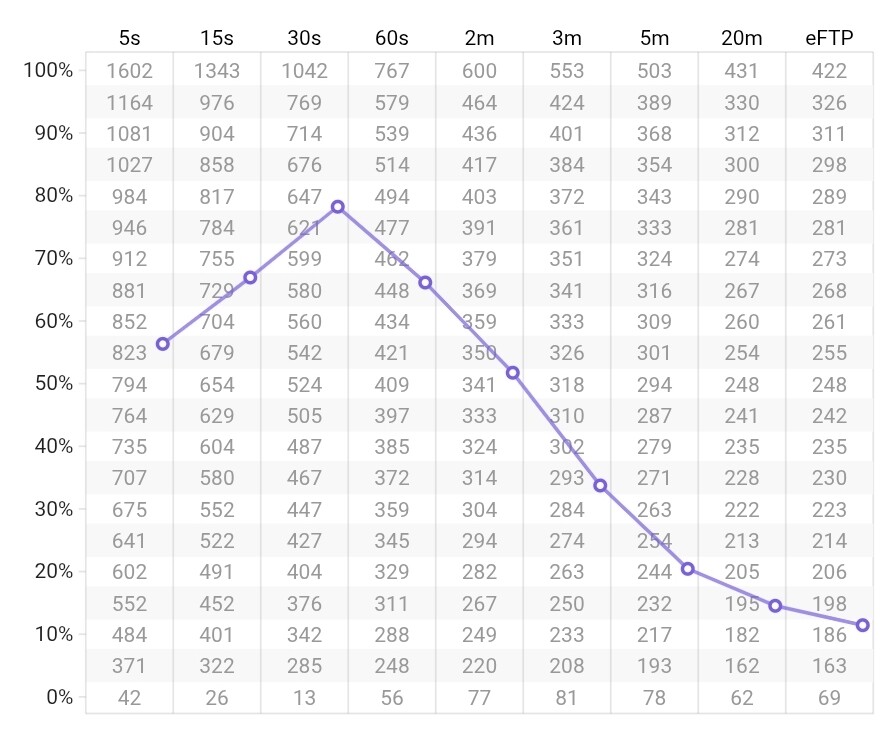
Here is my indoor trainer power curve (don’t laugh!), while the longer durations are not all-out race power, I do think the eFTP (150-155) and power curves are accurate (and I have done some all out 5 minute efforts, ramp tests, etc).

As you can see, there is a dramatic drop at the two minute mark. Given my goals (keep up with my buddies), what would give me the most bang for the buck on my trainer? Add an intensity day (Tuesday)? Should I focus on my “strengths” and start training the 2 minute intervals and work my way “down” the power curve? Or start somewhere like 5 minute intervals (or longer) and work my way “up”? Should I add a strength (barbell lifts) day?

I have trainderday and mywhoosh for my trainer to impliment structured trainings.

I know these are probably silly questions …

Two questions: How often and how long do you ride a week and how regularly did you ride in those two years? Before you change your training routine, how does your diet look like? This could also have a huge impact of your training progress.

1 Like

These are from intervals.icu for cycling (note, I don’t have a power meter on my outdoor/Friday rides):

2023: 136 hours, 165 workouts, 1845km, 498 kJ, Load 7879
2024: 152 hours, 122 workouts, 1895km, 135 kJ, Load 8124
2025 YTD: 45 hours, 39 workouts, 779km, 227 kJ, Load 2485

In general I try to leave Thursday as a rest day (to be recovered for MTB rides on Friday), and usually also try to leave open the weekend for Family (although I have also tended to do my longest outdoor easy rides on the weekend, but hard to be consistent there).

So, M-W & Friday is the intention, but as I am not following a plan, that’s not consistent (and the past two summers I spent in Japan, leading to more inconsistency). But I’m usually always motived to jump on the bike in the mornings if life is not in the way. (i.e. I can’t think of I time I felt like not getting on the bike unless I was busy, sick, etc).

My diet is not optimized. I tend to have two cups of coffee a day, chia seed drink, some dark cherry juice for the rides, low fat/no sugar yogurt after rides (20g protein) or whey protein mix. As I’m mostly responsible for my own Breakfast and Lunch, no excuses here, I tend to eat dinner leftovers from the family for Lunch (all home made, my wife’s hobby is cooking, we hardly eat out, but we aren’t eating just chicken breast either). It’s a mix of things like insta-pot soups/chilis during the work/school week and every type of cuisine on the weekends from steamed salmon, broccoli, pizza/pasta, etc. I’m super lucky because I feel like I get five star meals for every dinner (and I used travel a lot internationally in europe and asia). I used to calorie/macro count, but my wife hated me doing it (and it is way easier to do during meals than after and gave up). I am not low carb, low fat, or really following any particular diet. I probably overeat on average (am overweight BMI ~ 30 and % BF also ~ 30%). I drink occasionally (maybe a couple days every other month, usually tied to an event/outing or vacation).

you can read this thread as well. Seems like lots of good into. Applicble or otherwise I am not sure, but it MAY help your outdoor rides

MTB rides are more punchy so your doing more 80/20 is a good idea tho I would also argue that in order to be able to push (weekend), you need to be able to actually train to push too.

from your yearly data, youre doing 136/165 ~40m and 152/122 ~1.5h rides on avarage. That’s good you’re increasing your time spent on the bike. Z1/2 adaptations occurs > 90m (or so I read) so you also need to spend more time there.

I also have to say that nothing beats improvement vs time on the bike.

2 Likes

Thank you for reply, I ended up deciding to spend more time on the bike and set out a goal to be able to ride 100km non-stop (on my MTB but mostly flat gravel/pavement) by end of year.

Here is my update, I effectively doubled the distance from the prior year with longer rides.

2025: 199h55m, 163 workouts, 3759 km, Load 11794

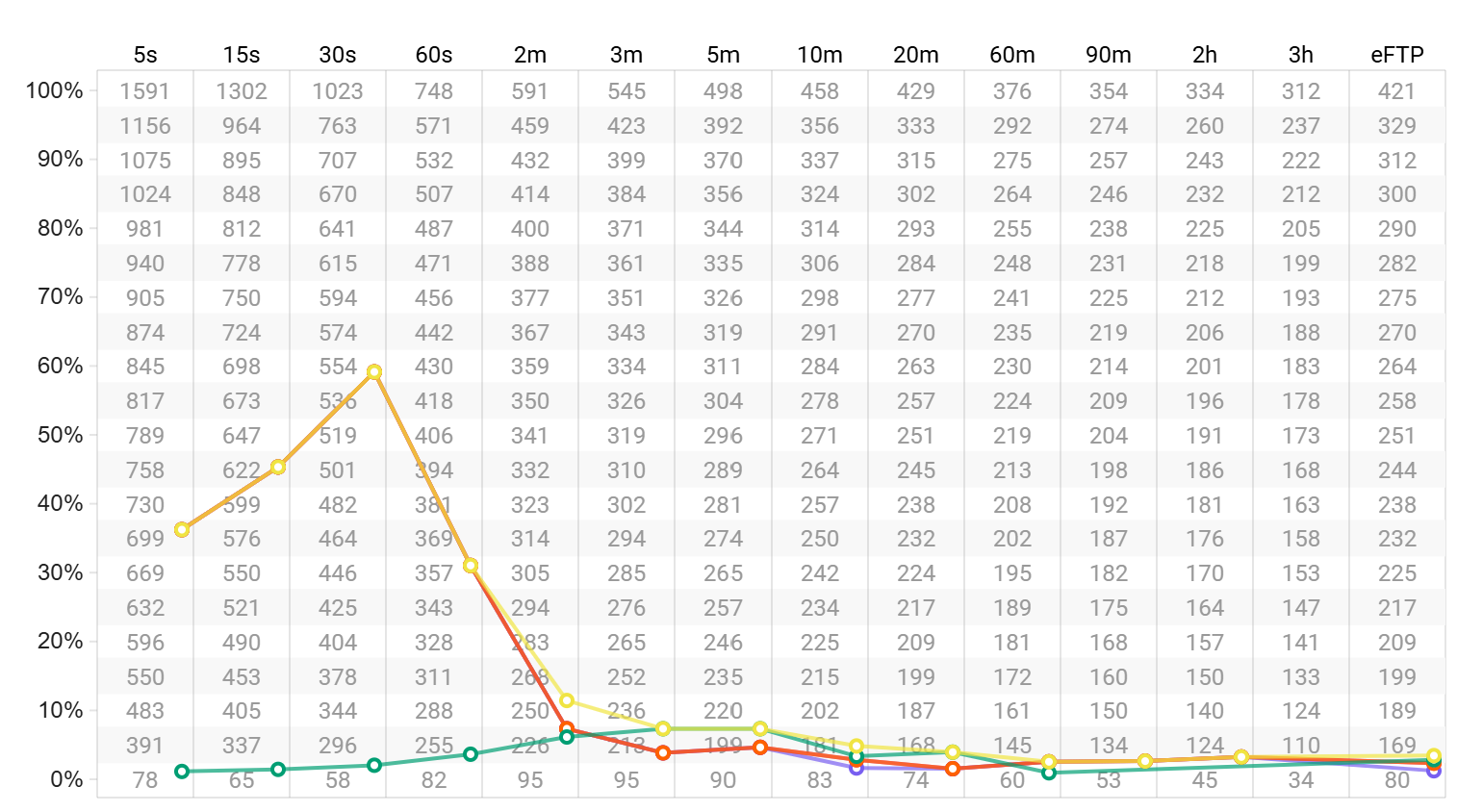
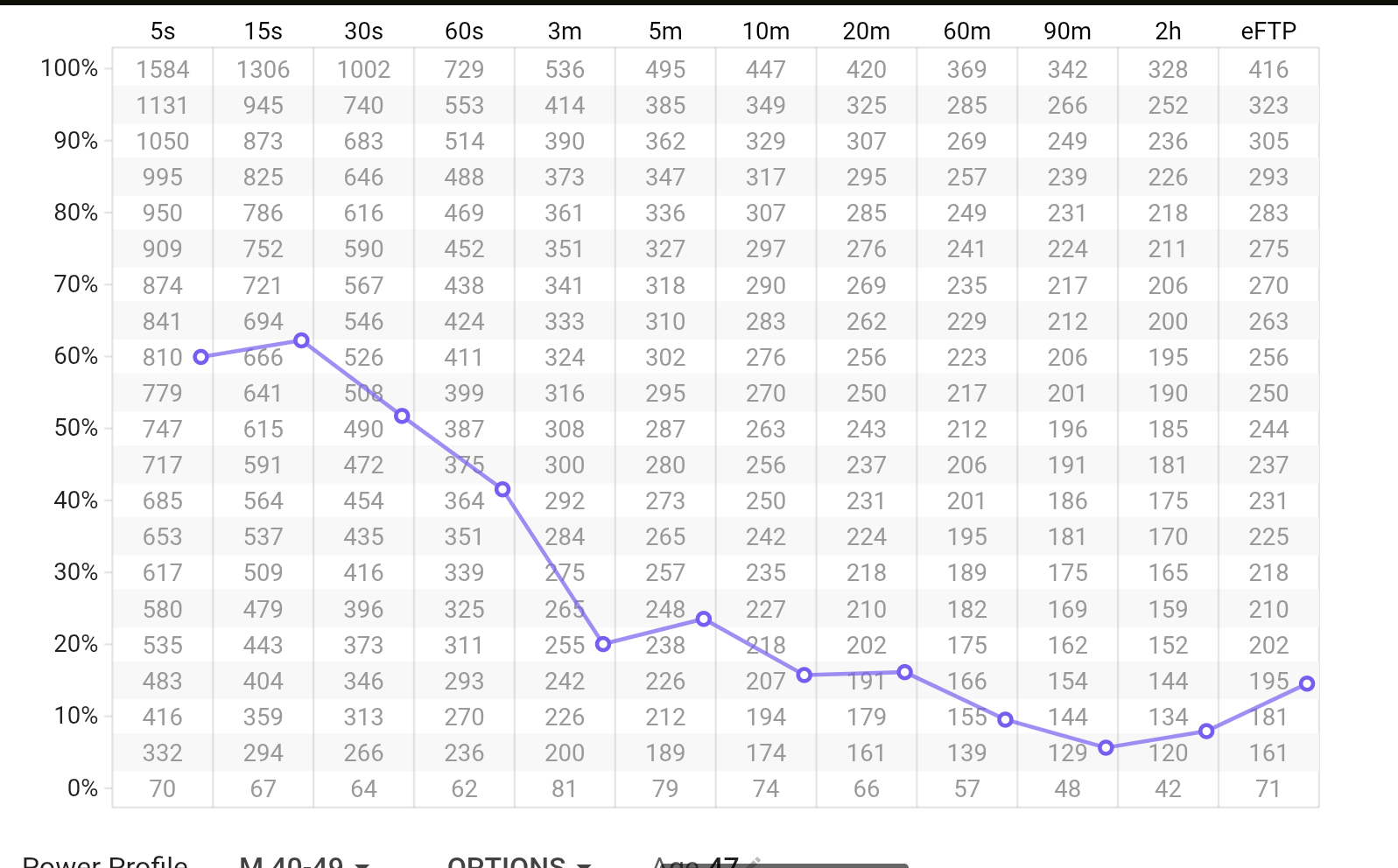
and my updated power curve

The massive drop over 60 minutes is because I never did an all out effort over ~ 40 minutes (and I don’t use a power meter outdoors).

What I learned through trial and error (no specific benchmarks) is that I don’t have great repeatability (as well as poor durability and relatively easily fatigued after efforts).

This year I am thinking to have a couple of new goals related VO2 /MAP to ( i.e. 4-5 minute efforts for ~ 16-20 minutes of work and repeatability of 30-60 seconds ).

Would love feedback from the community.

How much time are you able and willing to spend on training? You are “only” averaging 4 hours a week. If you want to improve you’ll have to commit to more volume especially if you are not pleased with your repeatability/durability and fatigue levels after efforts. I know your “real” power curve is probably flatter than what you presented but your avoidance of all out efforts over long durations tells me you have an undeveloped aerobic base. You need an aerobic base to ride 100km non-stop. Building that base takes time, not just in hours per week but in number of years. But I don’t think too many of us are scared of having to ride a lot!

You do very well on the short efforts and I’m sure you appreciate that since MTB riding can be very surge-y, having to do quick pushes up inclines and over obstacles. I don’t think you need to perform VO2/MAP intervals on the trainer - you’ll get that exposure on your actual MTB rides. Instead you need to devote your training time pushing out your TTE on aerobic efforts. For example a goal is to be able to ride 40 minutes at your eFTP. Could you do that now?

I could see you spending most of your training time doing rides at 65-85% of your FTP, or slightly less “intense” if you are able to ratchet up the weekly hours to 6 or 8.

Could you show your 2025 time in power zones? That is, how is your % distributed across Z1-Z7? For example, mine was Z1/Z2 = 77% Z3/Z4 = 18%, Z5+ = 5%.

Doing the math you had 11794 load over about 200 hours. That works out to 59 load/hr which is an average IF of 0.77. That’s very low tempo which on paper should build your aerobic base but you could also get the same IF by doing only VO2 and recovery. So that’s why it’s helpful to see your power zone distribution.

2 Likes

I agree with @briangabel - it is all about the base.

Your situation might be very well served by some high tempo / low sweet spot intervals.

As you have trainerday, I will message you with links to a couple of workouts that you might consider: 3x20 minutes at either 85% FTP or, with the HR+ function, ~80% HR.

1 Like

Thank you for sharing your experience and insights along with the questions.

Yes, I could dedicate 6 hours a week (including outdoor/MTB rides), this is a comment I wrote this year after my longest week while taking some time off work:

“10hrs done. Happy I had the chance to put the time in. I now know that 6 hours is probably the sweet spot for me. Had to start making measurable sacrifices (as a dad, husband, coach, manager, volunteer) at 8 hrs. Going to commit to 18 hrs/month (6 hours for 3 weeks), mostly 3 hrs Mon-Thu and 3+ hrs Fri-Sun with Mon/Thu as recovery days.”

My power curve is well represented at 5 seconds, 5 minutes, 20 minutes, because of specific efforts I put in for benchmarks, i.e. those are all probably “true”. Efforts longer than that are likely not true best efforts (but I share a couple of 20-40 minute data points below).

For clarity, I had a goal to do a metric century last year, which I did work up to and complete in 6 hours 17 minutes including 30 minute stopping time for breaks and traffic. I know that’s slow, was on my mtb with no power data. Averaged 135 bpm, which is around LT1 (around 127bpm-137bpm) for me, high of 168 bpm (my max HR is > 190 bpm).

Fridays tend to be my ~ 1-1.5 hr group ride on MTB and Sundays I have been trying to ride longer steady rides (2+ hours) for building a base. I haven’t been following a structured training plan but since my Friday group MTB rides are intense I usually rode with low intensity indoors on Tue/Wed with maybe some more intensity on Wednesdays periodically but always wanted to be fresh for my group ride.

Here is my TIZ over last 12 months, I only measure power on indoor rides:

I agree that my FTP by ramp/20 minutes are likely overestimated and no, I’ve never done any full effort “long” (for me!) steady state efforts/training outside of those.

I recently did a “Wahoo Full Frontal 4DP” test which is a 5 second full effort, recover, 5 minute full effort, recovery, and 20 minute full effort (they take 100% of the 20 minute full effort to set FTP). That 20 minutes was @ 183 watts / 176 bpm.

I’ve also done a couple of MyWoosh events where I ended up pushing as hard as I could, both of those efforts were 191w for 30 minutes and 181/184w for 40 minutes, although they were also not steady state as I was still surging a bit to try and not get dropped and settling in where I could hang. In those two rides the real “meat” where I was really consistently pushing hard was about 26m @ 194w/172bpm and 35m @ 188w/176bpm.

So, could I push 183w (FTP from Wahoo) for 40 minutes? Yes, but I could certainly not sustain it longer and it also doesn’t feel “healthy” given my current capabilities.

In all three of those I really didn’t leave anything in the tank and it probably took me several days of recovery (i.e. they were very intense for me and did impact my life/work).

I have a subscription to Wahoo SYSTM for structured training, I had considered a VO2Max/MAP/5 minute block after using ChatGPT to explore my power data, which I take with a huge grain of salt but I’m going to include a summary here for point of discussion:

ChatGPT summary: " Your next training block should prioritize VO₂max development with high-quality 4–6 minute intervals at ~110–120% of current FTP, done 1–2× per week, supported by one steady aerobic/threshold session and one long, easy endurance ride, while maintaining (not chasing) neuromuscular power. This focus is recommended because your power curve shows strong NM strength but a suppressed 5-minute and 20-minute power, meaning oxygen delivery and utilization—not muscle or explosiveness—are the primary limiters of MTB performance and FTP right now. Building VO₂max first raises your aerobic ceiling, which then allows FTP and durability to rise naturally; focusing instead on threshold, tempo, weight loss, or more sprint work at this stage would improve comfort or aesthetics but would not unlock the largest gains in sustained MTB speed, repeatability, or 20-minute performance."

Thank you for getting to know me and thank you for your recommendations “spending most of your training time doing rides at 65-85% of your FTP” which is < sweet spot. I’m curious if this would include some intervals @ FTP w/ rest, or over/unders, etc., or avoid those for a more “polarized” training (which I think I’ve been striving for on average).
Thank you for the specific recommendations and power/HR is also very consistent at ~ 155w / 155bpm. I have been spending a lot of steady state LT1 time (~ 135w/135bpm ) on the indoor training, looks like I need to change that up a bit.

1 Like

Your TIZ charts seem pretty reasonable. I do notice that you spend more time in HR Z5 than HR Z4. That just tells me how hard your MTB rides are.

I recommend you try to determine two thresholds: Your ventilatory threshold (VT) and your lactate threshold (LT). These provide boundaries in the 3-zone model: <VT, VT<>LT, >LT. Recreational riders do not need to deal with lab testing to figure tease the numbers out. To learn your VT you perform a test called the “talk test” and to learn your LT you perform a structured FTP test. The benefits of these tests are not just about the numbers. They help you learn to perceive real-time physiological changes which occur when you exercise.

The talk test is a prolonged and gentle ramp test where you try to find the point where your breathing makes a subtle change and you find that it is not as easy to talk anymore. You need to take more breaths between phrases, can only get a few words out at a time. The real benefit here is that you learn how to listen to your body, to pick up on cues. You might have to perform the test across multiple days to really feel it out. You then note your wattage and HR when you reach that ramp step with the difficulty change. Those numbers inform your base training ride parameters, you would perform long rides that stay below that wattage and HR. In a polarized training model that’s your bread-and-butter zone 1 easy ride type.

For FTP I have become a fan of Kolie Moore’s test design. Instead of doing a shorter-duration “all-out” test where your FTP number is derived from the test results - and hope you are close to the “average” rider that those formulas assume - you just ride at FTP. The benefit of a “Kolie Moore” FTP test is that you learn-by-feel what your actual threshold is. It also trains you to know what it feels to be over and under threshold. I don’t proclaim to be an expert but I can feel a difference 5W below and 5W over FTP. Once I’m over I’m like, no, I’m not going to be able to keep this up and then once I drop below it’s like OK this is still hard but I think I can stick with it. “Stick with it” does not mean a specific period of time. FTP is a 2-dimensional value: wattage AND duration.

FTP tests are hard workouts but they should not require days of recovery and impact one’s life and work. The only time you should feel like that is if you just finished a huge race or you are suffering an illness. Therefore I recommend you do a search for “Kolie Moore FTP test” and try it a couple of times (spaced at least a week apart).

ChatGPT said “Building VO₂max first raises your aerobic ceiling, which then allows FTP and durability to rise naturally”. I’ve been taught the inverse. You first work to extend time to exhaustion (TTE) at FTP. This pushes your power curve to the right. Then do VO2 to push the power curve up. But VO2 blocks assume you already have a solid foundation. I don’t think recreational riders should consider VO2 blocks, not unless they are like 25 yrs old and can recover fast.

1 Like

Everyone’s different and I haven’t seen anyone in this thread mention weight training, however, my top end short power is noticeably better when I mix in some leg work at the gym. 1-2 days a week of squats, usually after my riding. Especially as we get older, it’s important to retain muscle.

One added benefit I notice is that I often have “one more match” so to speak if I’ve incorporated weight training.

This is highly dependent on if your body can take the added training stress.

2 Likes

Let me start by giving you some kudos on being level-headed about goals. “Keep up with my friends on the Friday ride” seems like a great objective, in that it’s both rewarding and measurable. Given your limited total hours available, and the fact that you are already doing two intensity workouts a week (including the Friday ride), my suggestion would be to do that Wednesday z2 ride at the very, very top end of z2 to “push” your endurance from below. I find the zwift robo-pacers particularly good for this type of workout. The effort level isn’t all that high, so even a very short period of coasting or a stop sign outdoors gives you a noticeable amount of recovery, while the relentless pace of the robopacer forces you to really stay on target for 100% of the ride.

1 Like

It’s great that you’ve fell in love with cycling.

As you’re still new(ish) to cycling, I’ll say that most things will work at this stage so enjoy your training. Spend as much time on the trails as you can, you’ll get fitter, improve your technique and have much more fun versus training indoors!

Let’s say you’re riding MTB once a week, and at the moment, that’s a hard session on the bike. I’d look to include:

  • A longer easier ride 1-2x per week
  • Another intensity based session. Your MTB ride sounds stochastic, a very hard effort (close to HRmax you say) and then recovery. You could look to add longer intervals at around Z3-Z4 and aim to increase ‘time in zone’ across the weeks. This is one way to help bring up your sustainable power, and make some of the MTB trails feel easier.

1x very hard session (MTB ride), 1 kind of hard session (Z3/Z4) and 1-2 longer endurance rides per week covers most of the bases. You’ll find as you get fitter, you’ll be able to handle more load (read frequency of intensity). The exact session content doesn’t matter as much as the progression of load over time.

There are other ways to achieve what you’re looking to do, this is just one example. Hope it’s helpful!

1 Like

Thanks everyone for your advice, I’ve been adding 3x20 sessions (both HR @ 155 bpm and Power @ 135w) as well as more intense/SS sub threshold work. The reason for 135w 3x20 is because that’s where I would hit 155 bpm at the end of the workout.

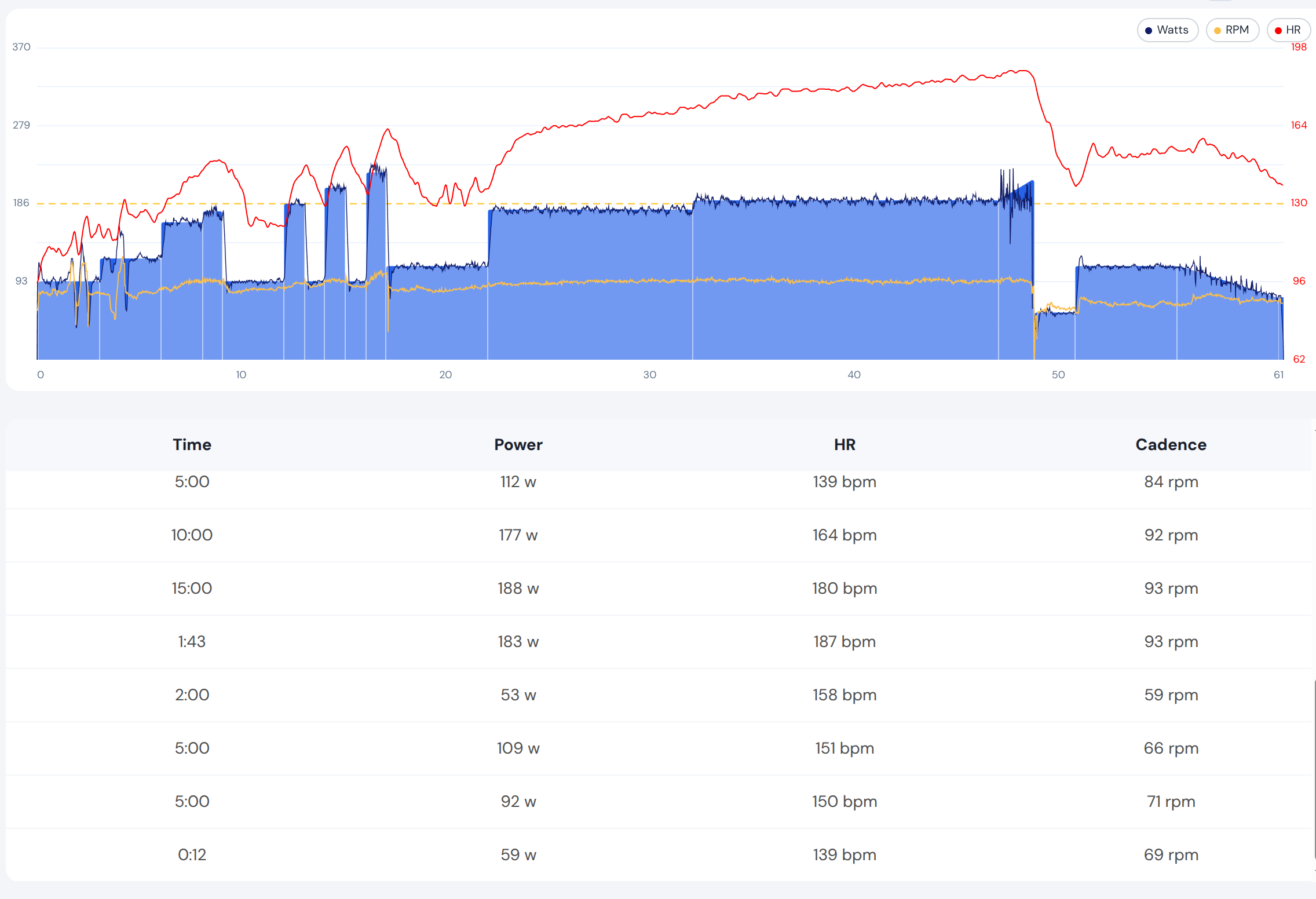
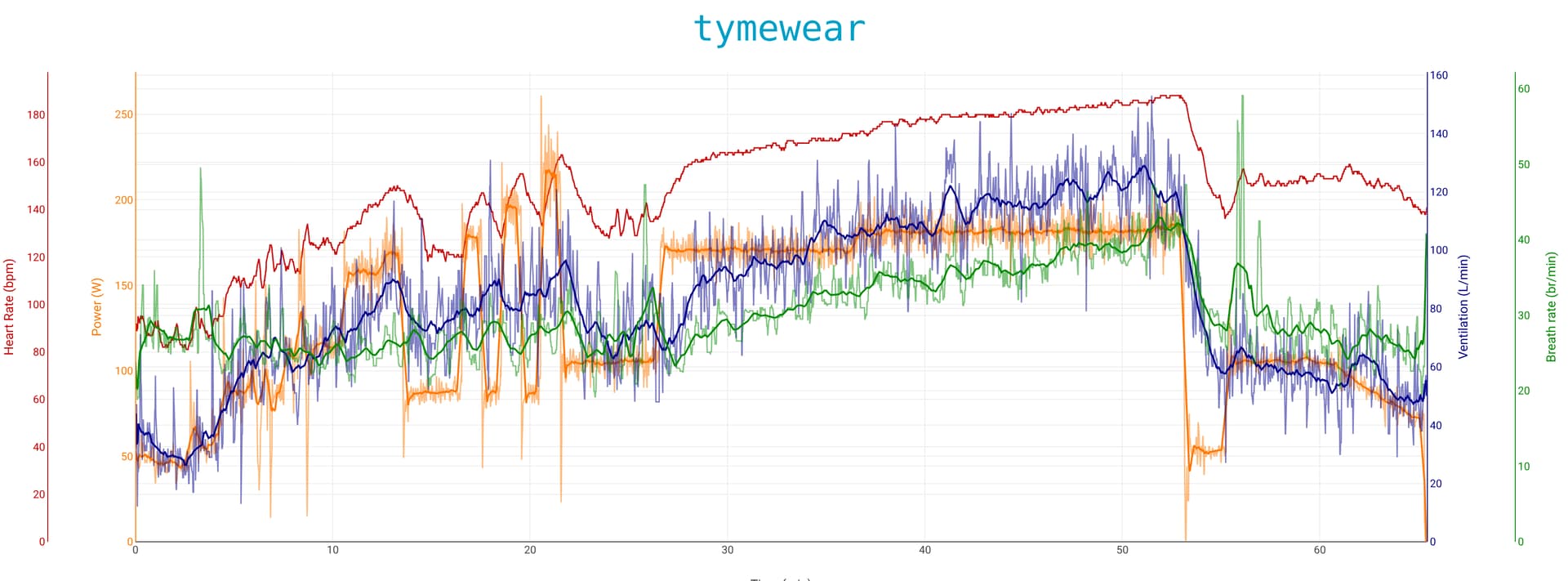
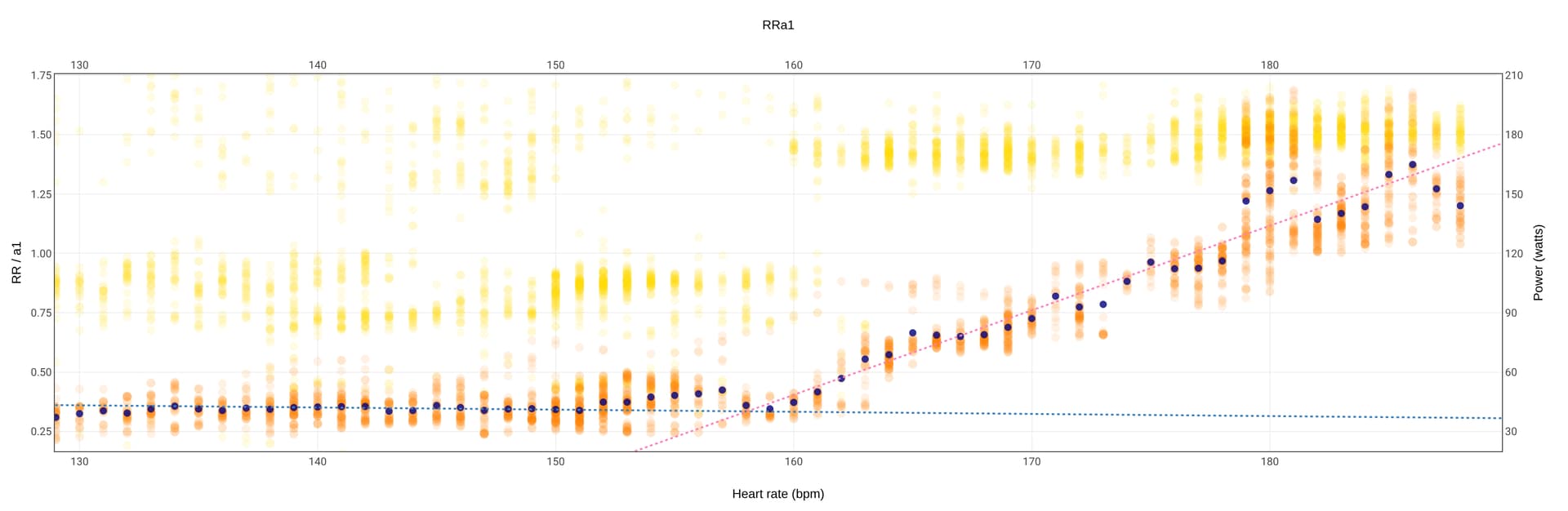
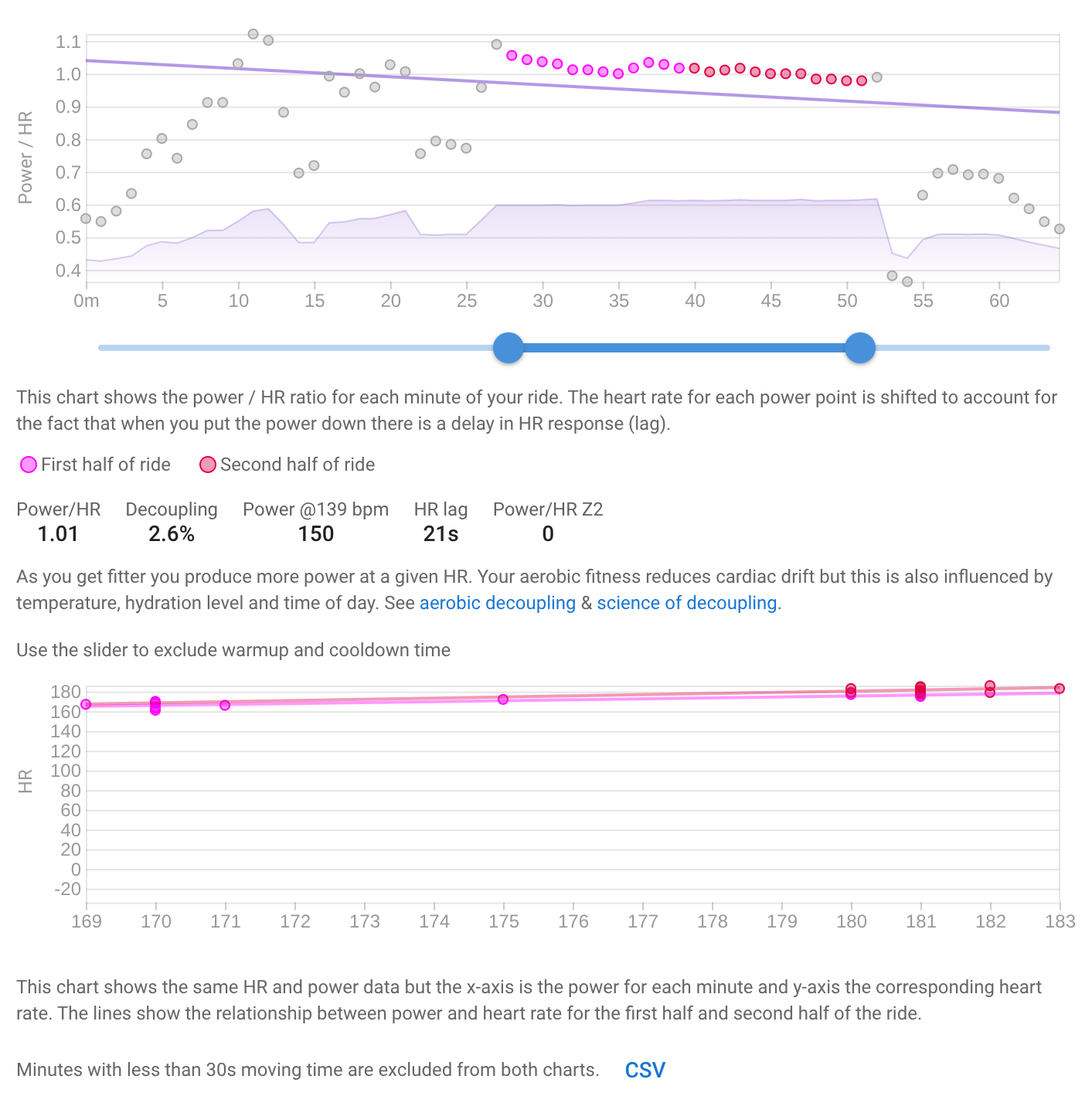
Today I did the KM FTP test.

During prior ramp-based tests it was my legs that gave out first, but by the end of the 25 minutes of the KM FTP test I felt like my legs were still strong, but my heart was the limiting factor. Once I hit the final ramp I was clearly past some threshold (breathing was very hard). HR didn’t reach my max HR (> 190bpm) but I also didn’t feel like I could keep going.

One thing I noticed is that at about the 15-18 minute mark (or 5-8 minute mark into the second block just over FTP) my HR sort of leveled off at about 180 bpm before climbing again, I wonder if there is any significance there. icu detects LTHR at 175 bpm, TP detects it at 170 bpm for this ride.

Given that I feel it’s my heart that is the weakest link here (i.e. my legs could keep going), I’m wondering if that should guide my training and maybe train by HR in a certain range… or discover what HR training would give me the most bang for the buck here to improve my aerobic performance (and catch up to what my legs can do).

Here is how it went:

  1. I know most of these graphs are meaningless in the context of this test

  2. There is +7w difference with trainer day because it’s using my kickr vs icu which is using Garmin/power meter pedals (and I’m not power matching). KM FTP result is ~184w via TD/kickr and ~177w via icu/Garmin/pedals.

Keep racking up the Zone 2, Tempo and Sweet spot hours.

Building aerobic fitness is a long term project.

Mix it up a bit among those zones. The difference that a few watts or a few bpm makes is marginal compared to whatever motivates you to keep throwing your leg over the bike and pedalling.

2 Likes

I agree with this - my experience is that for newish riders who still have significant gains to be made simply by riding regularly, riding whatever you enjoy the most could be the most helpful thing for your fitness. I wouldn’t worry too much about structure at this point, as long as you aren’t digging yourself into a hole from smashing full gas every ride.

1 Like