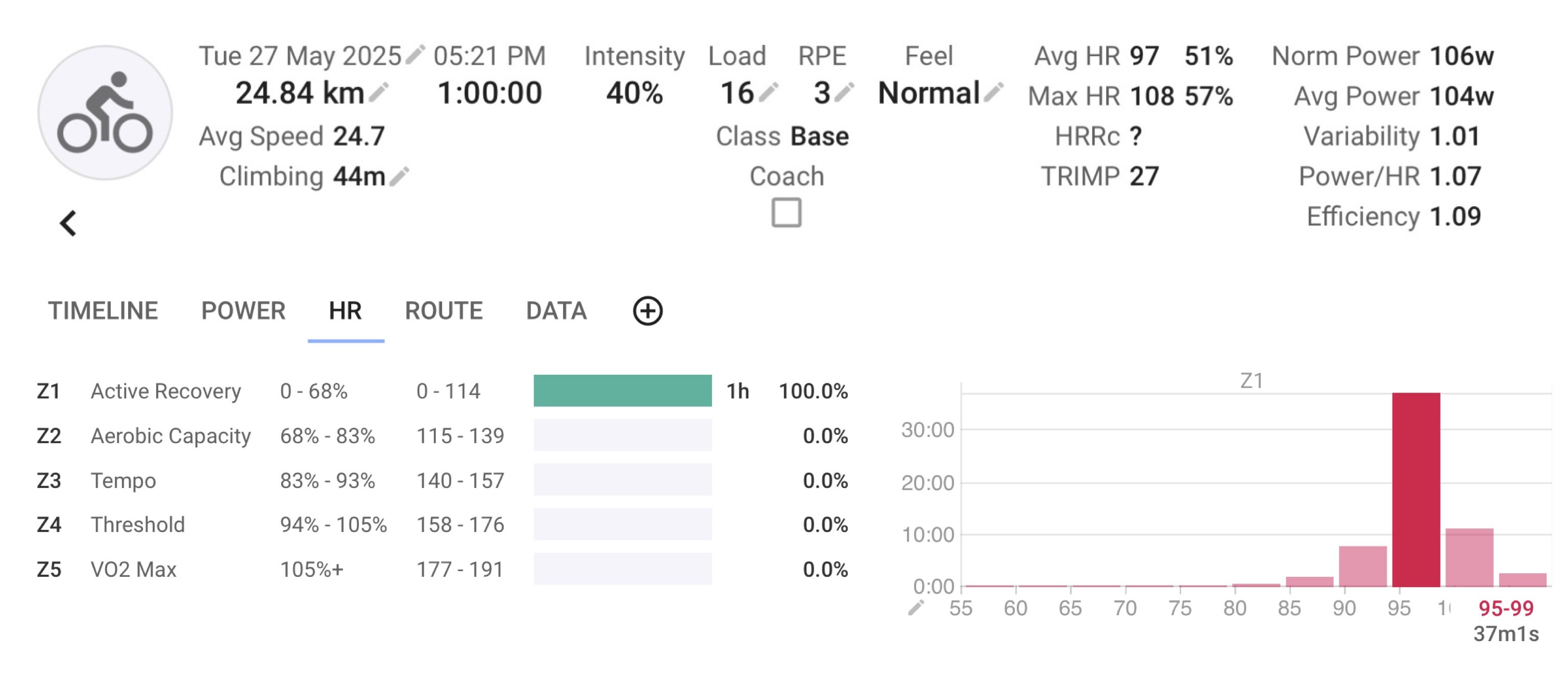
Here’s an examples of an easy ride. I could’ve (or rather should’ve) gone easier as I wasn’t paying attention on one of the 2% gradient - HR “spiked” to 108. 
2 Likes
I looked up the Tymewear strap. I feel like it’s another device trying to sell false precision similar to Whoop. Maybe not.
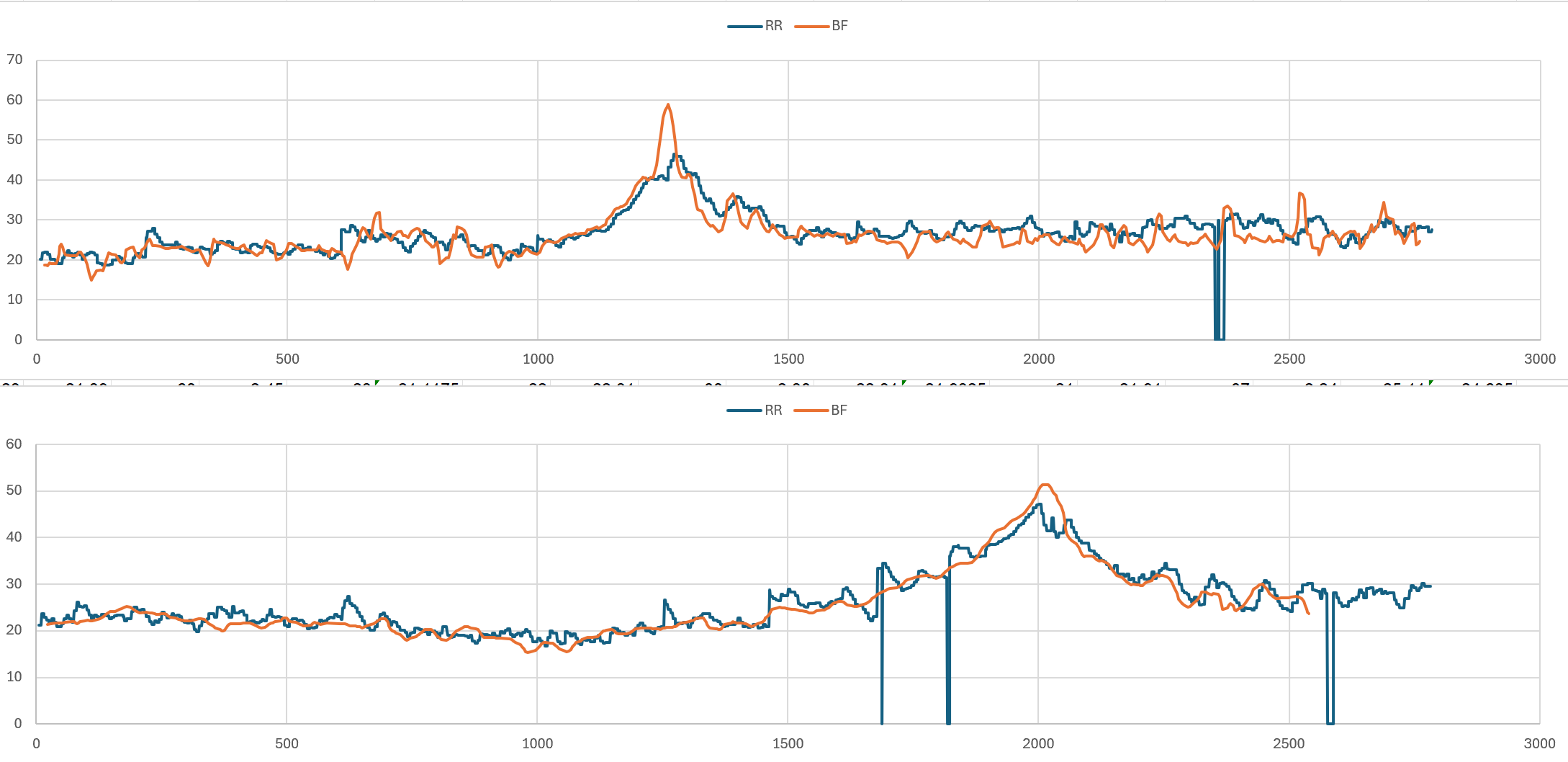
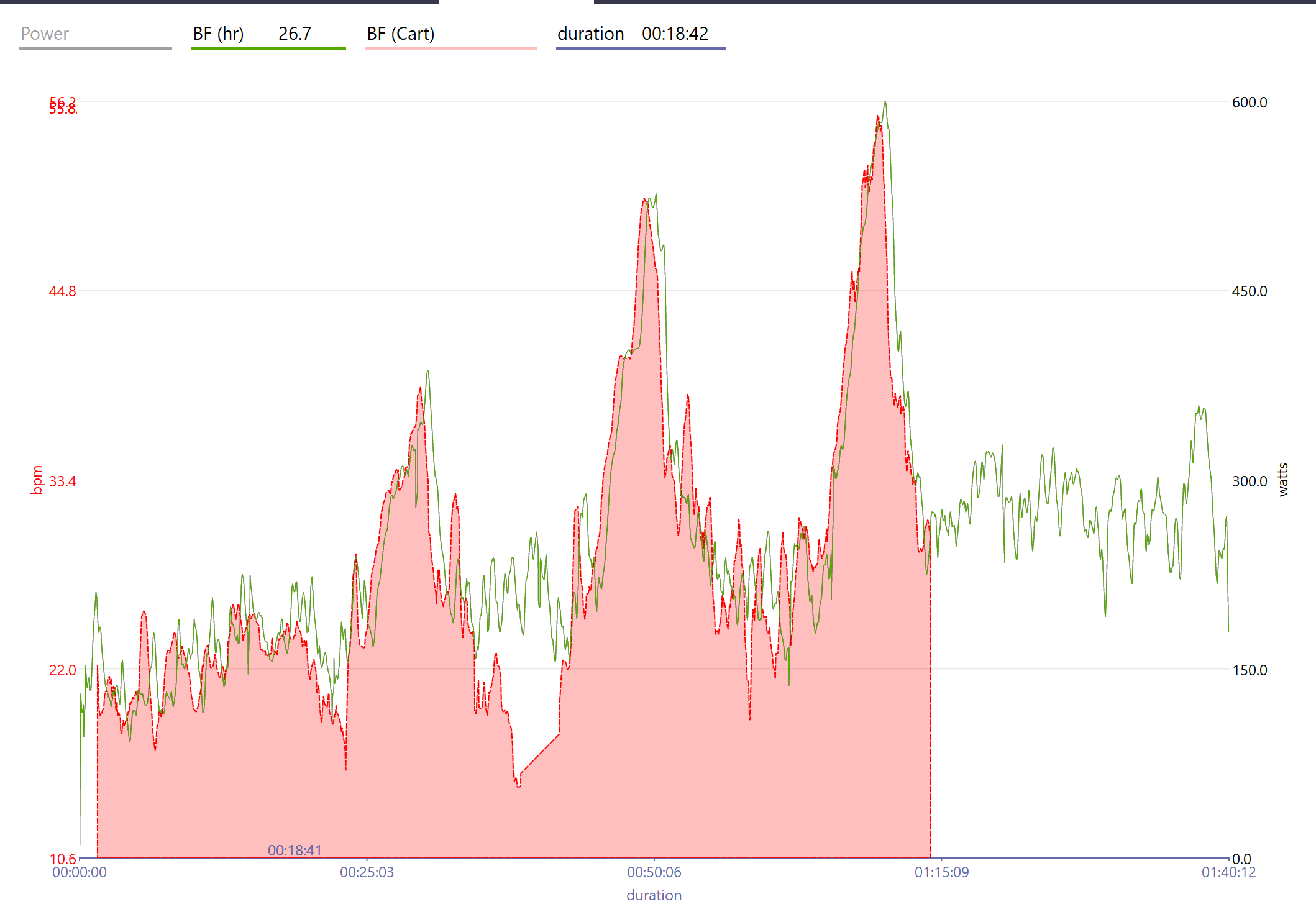
Breath frequency from heart rate has been available to anyone collecting RR intervals with a decent HRM. Here are some recent examples from a Polar H10 (and Garmin watch) and Pnoe metabolic cart. It’s pretty good, I think.
Ramp tests. Dark blue trace is breath from RR intervals. Orange is from the metabolic cart measurement.
Interval session. Green trace is breath from RR intervals, red is from the cart measurements.
2 Likes
I’m going to lean towards the “maybe not” right now based on the fact that sleep measurement is just not the good on any device and that constant HRV measurement is even worse. And there are some decent studies on how breath rate tracks with RPE.
I’ve only seen that this data is fairly worthless, so I’ve not used it. I mean, HR is already impacted by a number of factors not related to performance, how useful is another metric that is derived from an already not consistent measure?
“More breathless marketing?” Pun intended? 
I don’t disagree. On the flip side, we already use the talk test and nose breathing as metrics as part of riding to feel, as well as your earlier post about paying attention to breathing at higher efforts. I think with the correlation of breath rate and RPE, this seems like a metric with potential - especially as it’s not correlating multiple metrics to give you some type of score.
“Precision Training” right on the home page. Precision is intended to make you infer its optimal training, at least from my point-of-view.
I’m sure it’s going to help some people that train too hard. The biggest thing I learned from Erg mode was how to stop pushing the pedals hard all the time.
I’m not the target customer, but would play around with it if someone gave me one.
Ha ha, yes, pun intended LOL. And pardon my skepticism, because easy is easy and we do it for several reasons - autonomic stress, more elastic heart, and more mito in muscle, to name a few. Yet another metric isn’t going to replace common sense. Its going to send folks chasing another holy grail of “optimal.”
First time checking out this forum. I am not sure how any of you create a plan or know if you are on the right track haha. Listening to some podcasts on longer rides and reading articles/forum posts has shown me that there are several competing theories and that much of what is advised is cyclical as with many other sports. There does seem to be a strong consensus on making hard days hard and easy days easy. Where I find things to get a bit nuanced comes when you are at that weird amount of training time, I currently find myself at 6-10hrs. 6hrs and under would seem to qualify as “time crunched” and should have more intensity and over 8-9hrs becomes long enough that there should be more “easy” rides.
One good point made during this thread revolved around motivation. I find that I really hate riding on the trainer unless I am racing. So, motivation can suffer a bit and make me feel like when I do ride easy on the trainer it is really just “junk miles” since I cannot typically ride longer than 60mins.
Outside I am getting much better at monitoring my efforts and recently started doing some group rides again for the 1st time in years. My RPE during these rides is a solid 2-3 points lower than a similar power output solo ride. Is this typical for others?
Thanks for the good read, hopefully I can piece some of it together to make a sensible plan moving forward. It is hard as someone who coaches athletes in multiple other sports to feel like I cannot help myself haha.
it will depend on your group rides. Here’s is 10/10 every time heheheh
“The enemy of good is perfection?” “Fix it until it’s broke?”
Stop dialing back my expectations of this product! No seriously, I appreciate your comments on this. There’s probably limited value for me on the immediate feedback of this metric - although I know I can still decide to push too hard on intervals, so maybe it could help. I’m curious to see what longer term metrics they think this can provide, and is there a possibility you could get a better derived load than TSS or volume?
IMHO the entire point of LT1/VT1 is that staying well below those markers results in very little autonomic nervous system stress - so more hours/week is possible. And the mechanical stress of easy contractions in zone1 or very low zone2 is enough to stimulate mitochondria growth with ‘enough’ hours/week. So that takes care of making your slow twitch muscle fibers more aerobic, and those easy contractions help your heart be more elastic and generate more stroke volume. Good stuff, and optimization is pretty much ride easy (“take a walk on your bike”), be able to talk, and ramp up the hours. So then from a training perspective you have to think about making your fast twitch fibers more aerobic. And selecting certain durations to train and improve. Then once you’ve plateaued, and are up above 15 hours/week, about once a year (maybe) do some really hard vo2max intervals to improve the heart’s ejection fraction.
3 Likes
You’re very right!
I can’t slow down. I get a few thoughts while running:
- “I’m out of breath, my fitness is slipping so run harder!”
- “If I’m not out of breath it doesn’t count as a run!”
Those two combined mean I go out intending to go easy and end up getting to tempo-threshold speed and then I’ll add a quick hard 4:30/km pace at the end ot really crush my body!
IN some ways it feels like self abuse. I’m amazed my 41yo body has survived so far. I was couch-to-5k last March. Did a HM in 2:06 in Feb.
I just keep, pushing harder. It’s like a running/pain addiction. I’m chasing that burn every run.
I ran cross country in high school, and even though that was a long time ago, I still know it’s easier to ride easy than to run easy. On the few times I’ve run recently, it’s just like you said, you start out easy but it never lasts.
I don’t have any good advice for this, other than to stop running and get on the bike. 
IMO, the competing theories generally end up with the same results. Which basically means, do what you like to do. Because the workout you stick with is going to be more effective than the one you don’t do because you hate it. You are definitely right about it being cyclical, with whatever the best pros are doing being what gets the limelight, until the next hotshots come around.
This being said, if you race or want to be at your best in a peloton-type event, you probably need to train all of it. Which means you need to do some stuff you don’t “like.” But you don’t need to go all in on that particular effort, and this also gives you a lot of different workouts to choose from, so just try to get a at least a small dose of your limiter in.
You have a beautiful mind!!! I guess I can say that because I tell people all the same stuff you are telling them…  People come to me and say what should I do. If you have any inconsistency in your blood do what is fun!!!
1 Like
Did you ever consider the “stress” factor? You say you have a young kid shared 50/50.
My legs are always horrible after mental tough week(s). Tough as is in work stress, family stress or whatever the cause. And I’m not talking about burn-out sides of things. Even when I’m feeling fine and (mentally) relaxed a specific day, if the days before I had moments of (unconscious) stress, it impact my legs and how they feel. Despite my physical training level is on par.
So when legs feel terrible. go for a free and relaxing spin.
1 Like
There is a lot of truth in here I think.
E.g. Jumbo-Visma cycling trainer states: “train either very slow or go 100%, but nothing in between”. So very polarized training.
But other pro-teams take a (slightly) different approach and results aren’t that much worse.
Same went down in Ice/speed skating.
E.g Jutta Leerdam, a top female sprinter, went to Jumbo-Visma, lost weight and had to train via a strict scientific regime. A scheme and Coach that had a proven record of making Champions. But for her it didn’t work.
Now she’s on her own, gained weight, is feeling more relaxed (still training her butt off obviously) and is breaking personal bests.
And many more examples out there.
Point is: there is no single best method for training.
There are defenitely do’s and don’ts. And one of them is not over doing things.
So that key take away from Fabric5000 is a solid one.
But with every method, there comes a point that you will reach a plateau. Sometimes just by talent/natural gift is running out and sometimes because your body isn’t getting the training sparkle any longer (I know, they aren’t mutually exclusive reasons). So changing training schemes/patterns can boost again your level.
And what might have worked when you’re 20, is destroying you when in your 40s.
1 Like
I don’t discard. I’ve been through a divorce, reformulating my life, and studying for a certification. So, yes, there are lots of triggers for stress.
The thing is, I had good legs with high stress and bad legs with easy life. Plus, it’s a cyclical thing that always happens. However, I think I started to put the 2 and 2 together. It seems that I’m/was overdoing my rides, no surprise at all. The “how to avoid” and “how to deal” is where I think I’m getting. 1 intense, maybe 2 but aiming for 1. The rest are easy rides. But for easy rides it’s easy. Less than 130bpm/210w. That intensity for about 2 hours my legs/body is recovering very well, and I’m getting the power back and the sense of legs trashed going away.
Not a huge fan of indoor, but zwift and robopacers are helping with that. 2.6w/k is a pretty good easy ride for me.
Bottom line: easy is easier than I was doing. Intensity tops at 2 per week aiming for 1.