Hi All,
Have been signed up to Intervals for a while but only recently found myself on here more than TP for simple analysis of rides. Thank you guys for all this work!
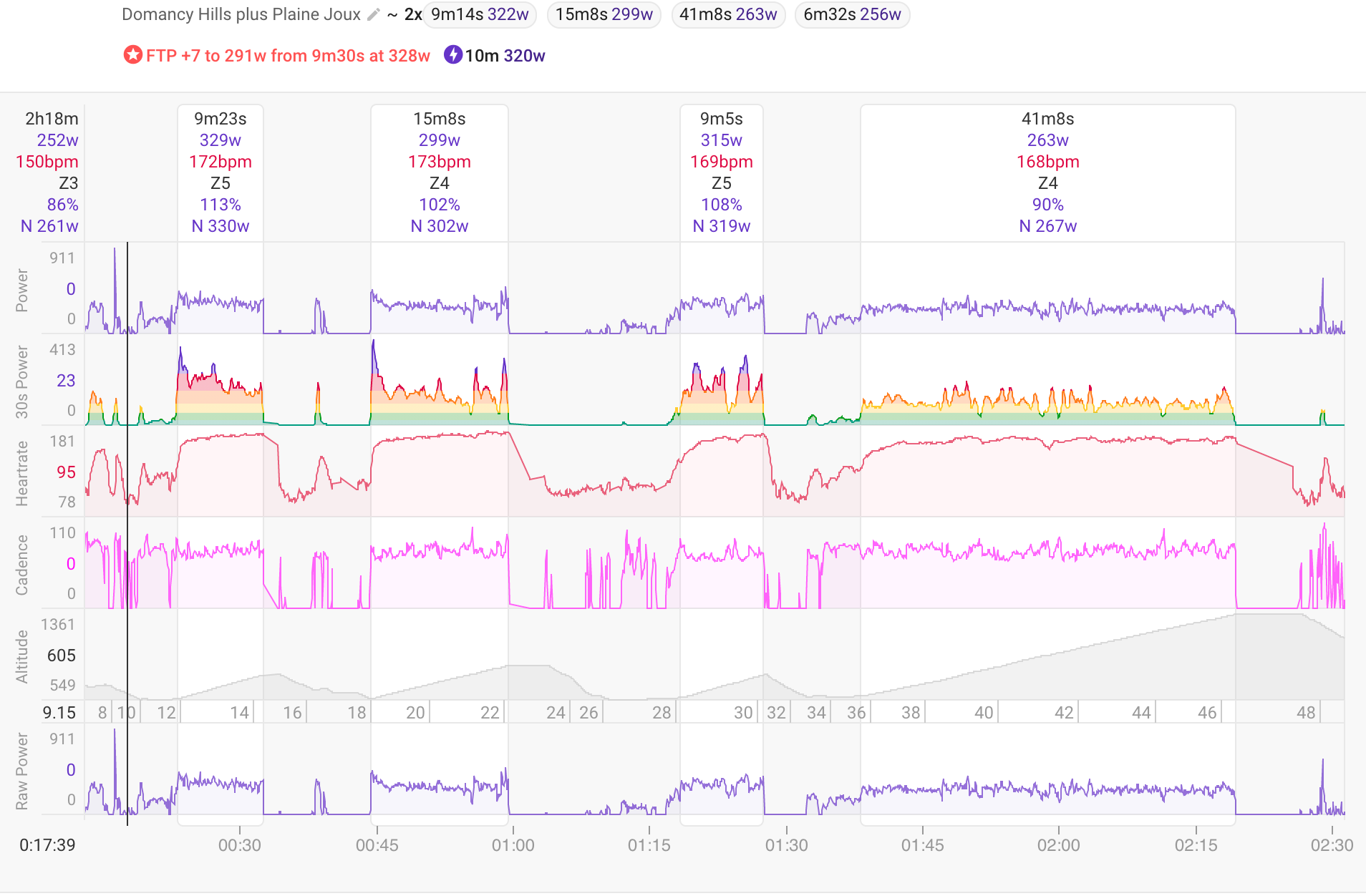
Today I went for a ride (see attached) and did three short (about 10min) all out intervals, then a longer 30min sub threshold interval. I got a bump in my eFTP on the first of the three intervals. I was wondering does the algorithm giving estimated FTP take into account subsequent work done in that session or could I have packed up and gone home after that first interval in terms of my estimated FTP calculation?
It would nice if David could explain how the eFTP is calculated.
I assume Interval takes the best period from a whole workout. But if you keep the default period of 3 minutes, I wonder how correct the eFTP is compared with your real FTP. For example an often used FTP-test is 95% of average 20 minute workout. Even this is questionable how correct this is. So a 3 minutes test is probably even more inaccurate.
Tx. It uses the best interval from the workout and doesn’t give extra “credit” to later intervals done with some fatigue. The best interval is the one that is long enough (configurable in /settings) that puts you on the highest modelled power curve. It is essentially a generalisation of the 95% of 20m rule of thumb to any duration though the curves are not all the same.
I agree with @Markku_Siipola that the default 3 min duration is likely too short for many people. I am going to be changing this to 5 min soon.
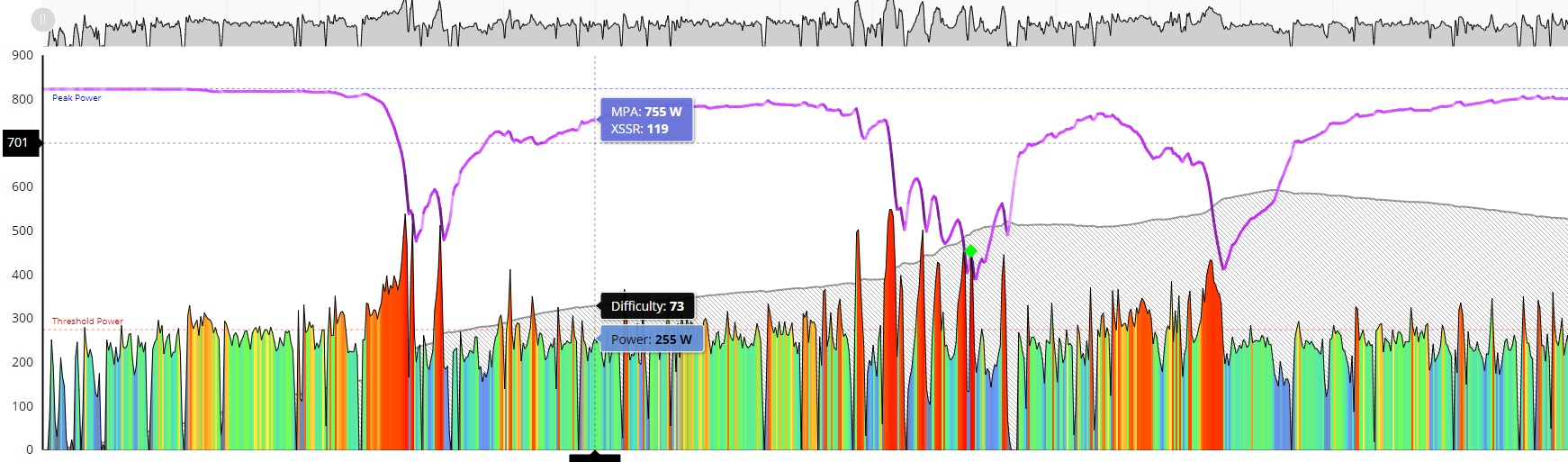
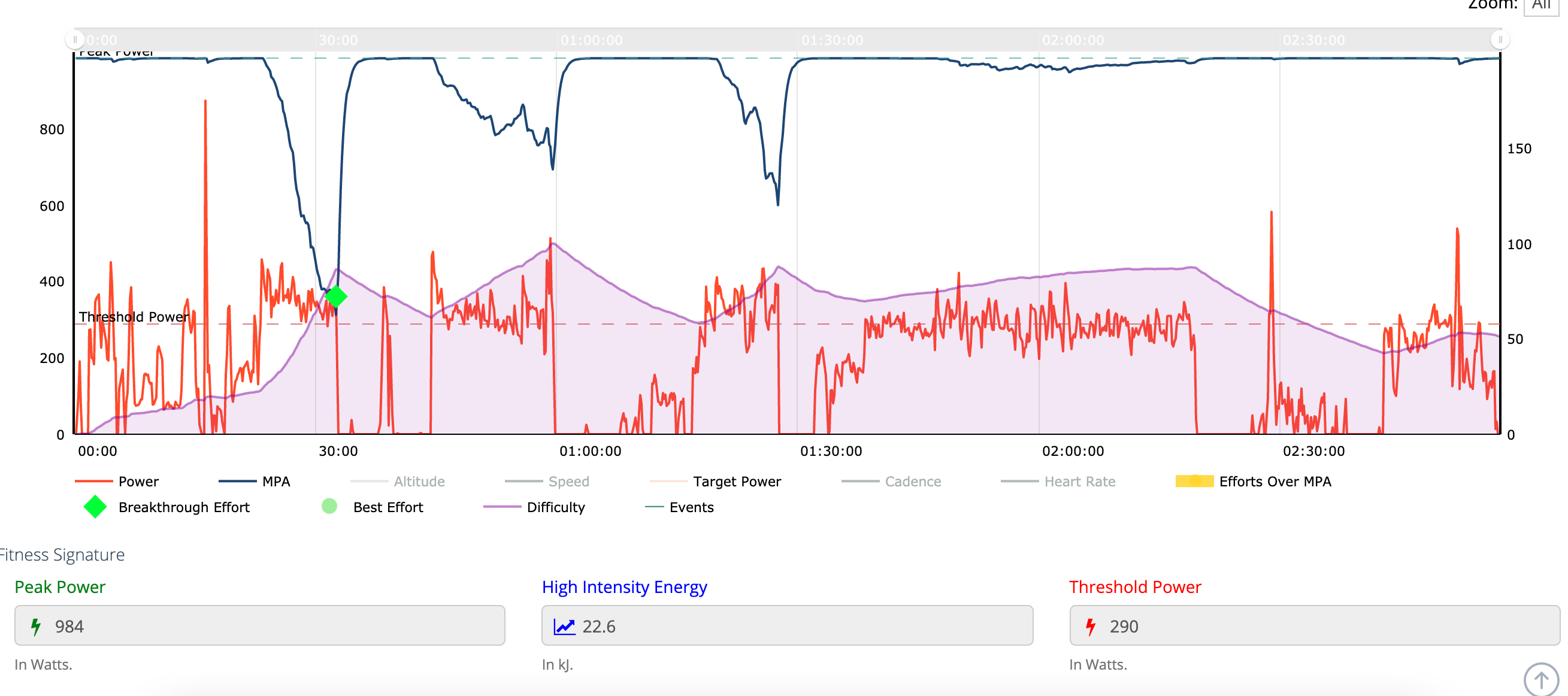
Thanks for the suggestion, I did have a look at Xert but just couldn’t get on with the user interface. I assume thats what the purple line means, the longer and harder you’re working the less able you are to produce an instantaneous max power?
So looking at the same ride on Xert it appears that as it was hill reps and the descents were total rest it assumes I fully recovered between each one… Which I can assure you I wasn’t!!
I guess that’s what the training load/Normalised power score represents for a ride.
Same with me, fully recovered in Xert is not fully recovered personally. But I like the system used, gives good indication. What I do is try to draw down that MPa line to a somewhat doable level (say somewhere 500-600 W) and then try to get above and hold as long as possible. Then take a short rest and give it A try once more. Often second attempt works best. After 2 or 3 hours ride (even if supposed to be fully recovered) I don’t stand a chance for new bt.
I don’t know the answer to the question, but my estimated eFTP is usually within just a couple of points of whatever my Garmin auto-calculates my FTP for me, so whatever it’s doing seems to be pretty much right.
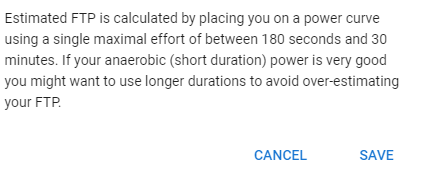
Sure. You need a max effort of long enough duration. This is used to place you one one of many pre-defined power curves modelled from real world data. So if you can do 330w for 12m that will put you on a model curve that has 330w at 12m. The 1h point on that curve is your eFTP. It is essentially a generalisation of the “95% of 20m power” rule of thumb.
First off - Thank You for Intervals.icu It is amazing!
This may be a dumb question, but I’m coming from a background of using Wahoo Systm with their idea of individual 4DP profiles rather than “general power curve”.
If I believe I’m more of a diesel engine on the bike, in other words, in terms of the population I’m better at say a 20 minute effort than a 5 minute effort would I be best served by setting the threshold to something like 900 to ignore all short efforts or does the modelling process allow for this and effectively ignore my “poor” 5 or 6 minute efforts notice my “good” 18 minute effort instead?
Sorry if this is a bit rambling - hopefully the question makes sense!
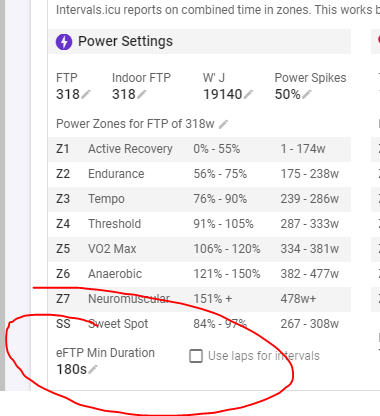
Don’t do this - it will mess a lot of other things up! Rather, go to your /setting page and change the ‘eFTP Min Duration’ value to better reflect your rider phenotype
Thank you for your reply. Sorry for not making it clear, Yes “eFTP Min Duration” was the value I was thinking of changing to say 900 (15 minutes). On reflection, perhaps it’s actually more important for people with very good short term power to set this to a higher number to prevent their eFTP being overestimated?
Anyway, probably what I really need to do is:
Install my recently acquired crank power meter (currently using power readings from Kickr indoors)
Get off the trainer and back to outdoor cycling
Get used to looking at analysis from Intervals for my outdoor rides using default Intervals settings
Realise that David has developed a sophisticated system and I shouldn’t mess with settings before I fully understand what I’m looking at!
Oh, ha! That makes sense. In my haste I read threshold and my mind read FTP… And yes, I agree on the short term power comment and preventing eFTP overestimation.
You are correct that you could change that. However if you are a diesel you might not need to. Your short efforts are not likely to give you a higher eFTP that longer stuff. I am the opposite (best power compared to others is 3 mins) so I have mine set to 5 minutes and I usually do at least 7-8 mins.
Intervals.icu doesn’t attempt to automatically detect “diesels” and so on for eFTP estimation. That would require a well filled in power curve (max efforts for a wide range of durations) and a lot of people don’t have that.
Thank you for the explanation which makes sense. This year will be my first time riding/training outdoors with a power meter so I’m sure I have a lot to learn and things will look very different to the very controlled world of turbo trainer in ERG mode that I’m used to looking at.
I’m hoping that Intervals+TrainerDay will be my tools for the outdoor season and am looking forward to getting to grips with both of them.
As David has mentioned, a well filled power duration curve is important, and also serves as ongoing “field” testing. Many world class sprinters don’t need to worry too much on their 40-70m power, but a TTer does.
So do those max efforts across the range, i.e. 5s, 1m, 3m, 5-6m and the max sustainable efforts for 20m, 30m, 60m and longer. Then train where you are below the curve and maintain the ones you are at/above the curve.



 And yes, I agree on the short term power comment and preventing eFTP overestimation.
 to avoid influence of anaerobic system