I love .icu & David, will remain a supporter forever, no matter what happens on this. I know many improvements just don’t make it to the top of the list, and that’s totally understood and fine.
But… WOWZA… Weight Lifting desperately needs support.
I’m an idiot and only recently learned, from a physiotherapist & sports MD that integrating glute & other posterior strengthening is critical to avoid long-term IT band & other issues. Point: Every cyclist must be doing strength work w their bike work.
David: Please add true WL support. Given how critical it is, .icu should incorporate it into the “fitness world” we have in .icu.
Starting immediately, I’m going to be doing a significant amt of strgth training, and that is going to negatively impact my fatigue & cycling hrs / wk, especially intensity work.
I really would sincerely appreciate it if .icu will help me track & monitor this.
-No field for HR; no HR tracking. Allen, Coggan, and others have concluded irrelevant for lifting, which makes sense; all that matters is weight lifted vs. the athlete’s strength / recent weight training & lifting abilities.
-Load calcs auto from total wgt lifted during that WO, mathematically compared to a custom, athlete - set baseline avg wgt lifted per WO, set in settings. If I usually lift a total of 2000 kgs, and I lift 4000 in a WO, load is doubled. This is super simple, and gives an easy to track metric.
If I suddenly lift double the wgt I lifted last week across three weight lifting WOs, my legs will be twice as tired from lifting, than they were last wk. Simple, easy - peasy.
No complex “Yeah, but how did HR impact it, and how does that relate to how HR impacts during cardiovascular / endurance exercise, how did your time duration impact it vs. if you lifted that total wgt faster, in a shorter time,” etc., etc. All unnecessary noise. Total wgt lifted vs. recent / current avg. total wgt lifted during WOs.
Then plus any cycling load; separate. I can then track total wgt lifted per wk over time, to track growth in my strength.
-Load auto impacts fitness & fatigue; [ this is already setup as custom set-able in settings. ]
-Please get rid of all ‘junk fields’ ; drop the “Distance in kms” setting in below [ the ’ ? ’ field ], drop the watts chart at bottom of below:
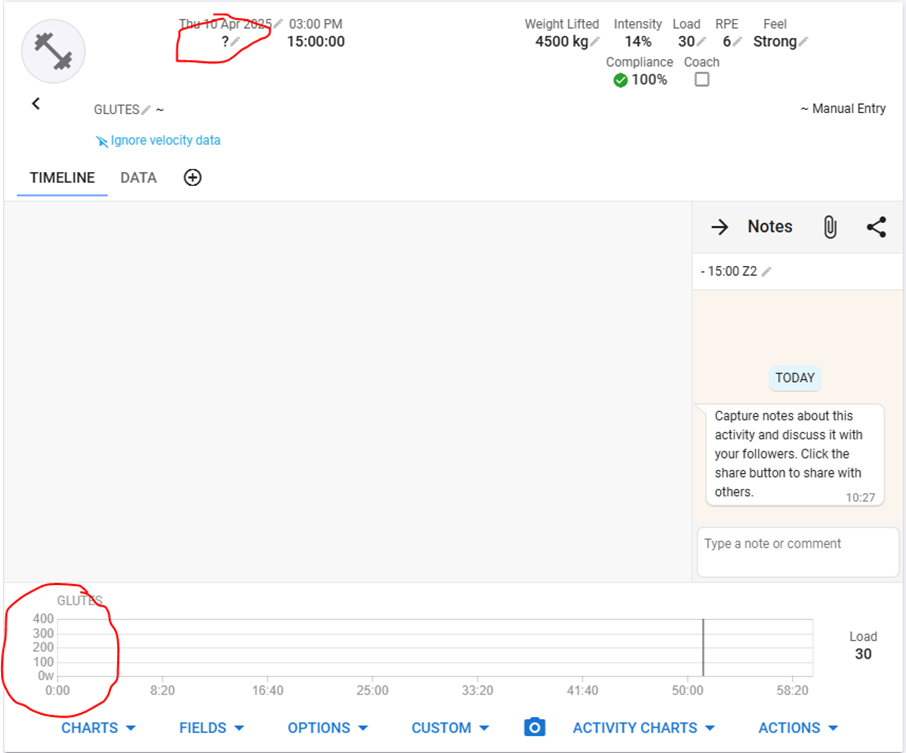
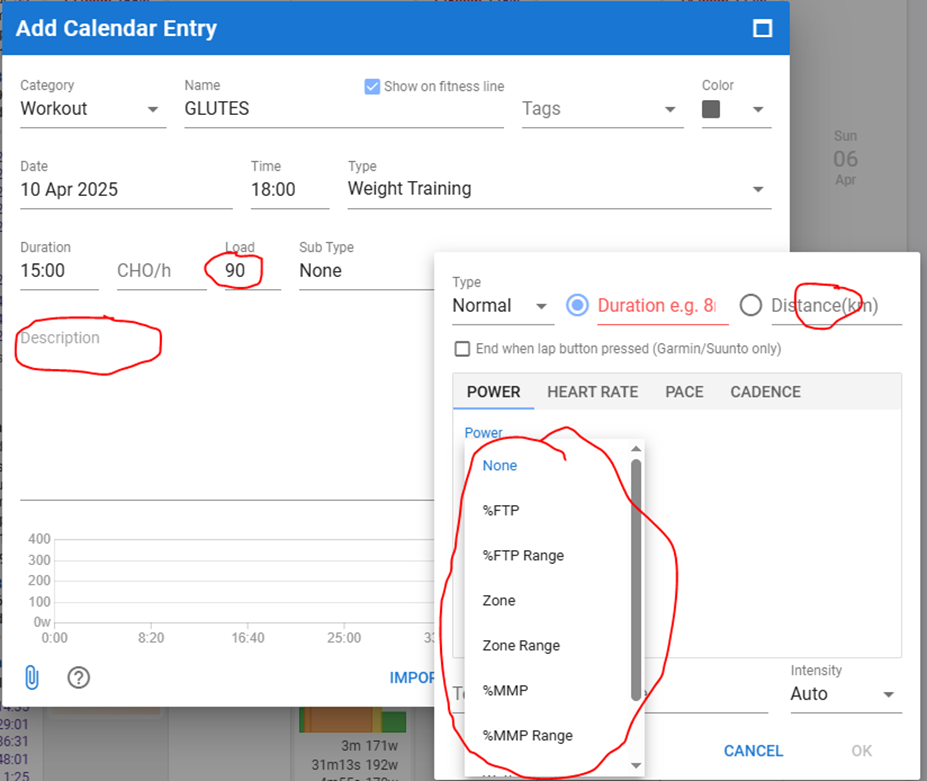
-Please make load in below auto - calc, not entered-by-athlete,
-Please either get rid of steps entry window entirely, or let us just input steps as wgt lifted. Something like:
-SQUAT: 3 X 50 KG
-BULGARIAN SQUAT: 3 X 50 KG
-SINGLE LEG SQUAT: 3 X 60 KG
-Would be amazing if it auto - summed total wgt from this, but no biggie if we have to enter total wgt lifted manually, and above is just txt notes for athlete to follow along WO.
-We shouldn’t see “% FTP”, “Zone Range”, etc., in the entry screens pictured below; not applicable to wgt lifting; zero value.
Sincere ‘Thank You’ for any consideration you can give this.
[ As always; deep dove search before posting. Nothing identical to this req. ]
