I think the TSS ramp is more related to your current TSS level. For example, my last 8 weeks of training looks like this:
| Week No | TSS | CTL | CTL Ramp | ATL | ACWR |
|---|---|---|---|---|---|
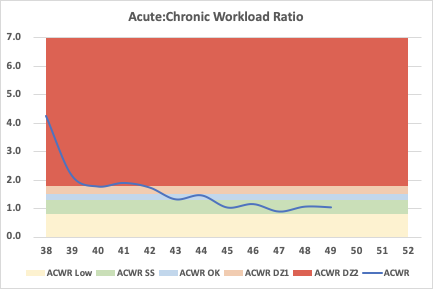
| 2020_38 | 420 | 14 | 10 | 59 | 4.2 |
| 2020_39 | 313 | 21 | 7 | 46 | 2.1 |
| 2020_40 | 390 | 31 | 9 | 54 | 1.8 |
| 2020_41 | 565 | 44 | 13 | 83 | 1.9 |
| 2020_42 | 636 | 55 | 11 | 96 | 1.7 |
| 2020_43 | 700 | 72 | 17 | 94 | 1.3 |
| 2020_44 | 772 | 81 | 8 | 117 | 1.4 |
| 2020_45 | 682 | 89 | 9 | 91 | 1.0 |
| 2020_46 | 744 | 98 | 9 | 111 | 1.1 |
| 2020_47 | 651 | 100 | 2 | 87 | 0.9 |
| 2020_48 | 752 | 102 | 3 | 107 | 1.1 |
According to this page:
A reasonable ramp rate is one that you maintain for a few weeks before taking a break for a few days. While it depends to a great extent on who the athlete is, I’ve found that an increase in CTL of about 5 to 8 points per week is about right for most.
I had the summer off due to some home improvements projects so although it looks like I was ramping substantially in weeks 41 - 43 (and I probably was to some degree), I had built up a base fitness during spring and early summer so was able to cope with this.
Here I am calculating my last 6 weeks exponentially weighted average Chronic Training Load (CTL) and then calculating a weekly CTL Ramp by comparing the current week CTL to the previous week CTL.
Additionally I calculate the last 7 days exponentially weighted average Acute Training Load (ATL) and calculate the Acute:Chronic Workload Ratio (ACWR) by dividing the ATL by the CTL.
This page gives more information all of these terms, but in order to think about TSS per ride I cite this text:
CTL and TSS are related and you can use the scale below to determine the intensity of a workout with respect to your current fitness. In this example, we’ll assume the athlete has a CTL of 50.
Hard Workout – A hard workout will result in a TSS score that is 50%-100% above your current CTL (TSS for a hard workout would be 75 – 100 TSS.)
Moderate Workout – A moderate workout will result in a TSS score that is 25% above your current CTL (TSS for a moderate workout would be 60-70 TSS.)
Easy Workout – An easy workout will result in a TSS score that is 10-25% below your current CTL (TSS for an easy workout would be 35-40 TSS)
As my CTL sits around 100 at present, I imagine that I should double those numbers so a Hard Workout would be 50% - 100% above 100, i.e. 150 - 200 TSS. A Moderate Workout should be 25% above my CTL, i.e. 125 TSS. An Easy Workout should be 10-25% below my CTL, i.e. 75-90 TSS.
I also found some interesting information about the ACWR from this page:
According to research by Dr. Tim Gabbett, the ‘sweets spot’ ratio when the risk of injury is reduced is 0.8-1.3
<1 – Athlete in a well-prepared state
0.8-1.3 – Training ‘sweet spot’ where injury risk is reduced
1.5 – Danger zone. More at risk of injury
1.8 – Danger zone 2. Further increased risk of injury
For my purposes, I have plotted this on a chart so that I am able to understand exactly what my progress is and to ensure I am training at the level that I want to be:
@Gato_Felix: Does this make sense?