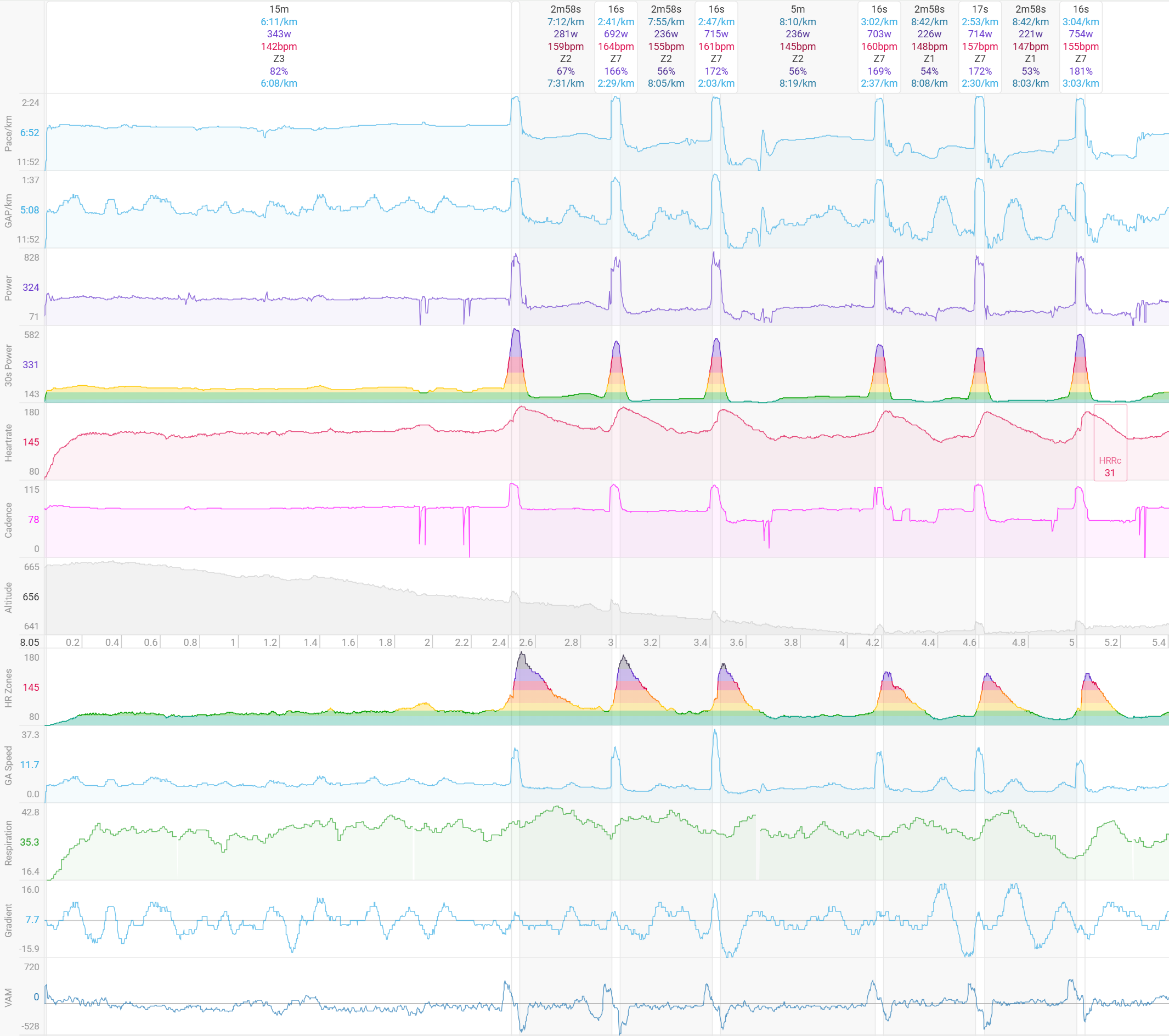
I ran a set of all-out sprint intervals on a flat path (riverside bike path; essentially level—only a few meters of elevation over ~10 km). While reviewing the workout, I noticed something odd in Intervals.icu:
During each sprint, VAM briefly goes positive, up to >300 VAM.
Immediately after the sprint ends, VAM plunges sharply negative (around −500 VAM) for a few seconds.
This pattern repeats for every sprint, even though the terrain is flat.
My understanding is that on flat terrain (in fact - even slightly negative terrain) VAM should stay near zero and not vary with running speed. What could explain these rapid VAM swings on flat ground? Is this due to how VAM is computed (e.g., smoothing window, elevation source/barometric lag, GPS elevation noise), or is there a setting I should check (e.g., elevation correction or smoothing)?
Recorded with Garmin Fenix 8X.
Any insights would be appreciated.
Thanks and greetings from Tyrol,
Andreas
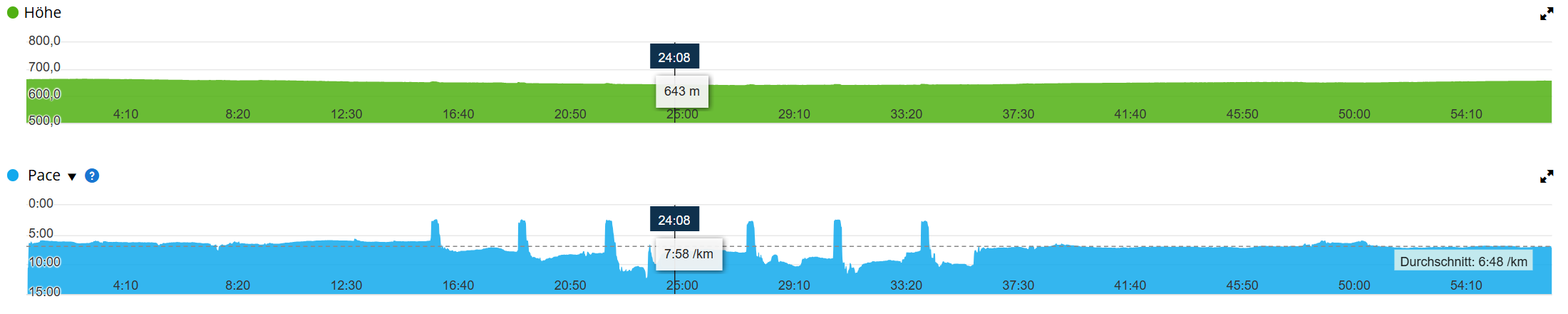
How did you track your activity (device)? Your altitude increases during the sprint, and so the VAM will increase too. First thought is that your device has no barometric sensor.
The altitude graph suggests a gradual barometric shift toward higher pressure. Regarding VAM spikes, my guess its barometric noise.
Fenix 8 is not well-suited for recording short high speed sprints/accelerations.
This workout was recorded with a Garmin Fēnix 8 Pro, which does have a barometric altimeter.
You’d expect a premium Garmin to perform well in these scenarios, right?
So I’m trying to figure out whether this is typical or a sensor-specific problem on my unit.
This is expected, as it’s a technological limitation. Even Stryd, which is much better at this type of tracking, doesn’t perform well for monitoring a 100-meter sprint.
For tracking training over typical running distances (e.g., 400m and up), both the Garmin Fenix 8 and Stryd are excellent tools. But for analyzing the precise mechanics and performance of a short, all-out sprint, dedicated timing systems (like laser or radar guns) and high-speed motion capture are the technologies required for true accuracy.
From Stryd Web site:
Stryd is optimized for distance running although some sprinters do use it.
 At this time, our product will not serve sprinters well.
We are considering augmenting our product to serve sprinters.
Got it — thanks for the detailed explanation. I honestly expected that with today’s sensors/algorithms (multi-GNSS + baro, etc.) this would be captured cleanly even in short all-out sprints. But fair enough — sounds like this is a general limitation rather than something wrong with my Fēnix.
No real issue on my side then; I was mainly trying to figure out whether my watch’s baro might be defective or if this is just how things are for 100 m-style efforts. Thanks again!