Thanks! Didn’t know about that. Seems nice and well done.
The key difference here is privacy.
The new app is Android native, you can run it offline, no login/register required (your data are not shared with anyone), and you manage your own connection to intervals.icu.
You can also manage your local workout library offline.
I don’t have any need for another trainer app because Auuki, BikeTerra (free tier), RideCave and InCyclist are all usable for free and give me enough variance.
For HRV, I would consider, if you let the user decide how the value is send to Intervals. RMSSD, as is, can’t be used for correct CV, you need a log version of HRV. HRV normalized and in log version is what I actually use. But I need quit a bit of workarounds with external tools to get the HRV value from Kubios, calculate the log-normalized value, and send that to Intervals.
So, as far as I understand, you are using an HR chest strap sensor (not opting in the camera measurement the likewise of HRV4training, right? why?), take the raw RMSSD value, take its log (which formula? what do you mean by normalized? against historical data?) and write it manually or put it somewhere and push it to intervals, right?
When it comes to HRV, I’m probably one of the pioneers here on the forum…
I have always used a Polar H10 strap and I’m so used to it after ~6years of daily measurements that it doesnt bother me at all.
I tried another app with ppg measurement through the camera, but my Samsung S20’s camera seems to be not suited for a correct measurement.
Your questions regarding RMSSD/log/normalized, come over as strange for someone busy developing a HRV app.
HRV4T uses 20 x Ln(RMSSD) because that results in a number in between 0 and ~100. Can in some extreme cases be slightly higher then 100. All CV references in literature are based on a natural log value of RMSSD. The multiplier has no effect on CV but the log has a huge impact.
Normalized HRV is RMSSD/MeanRR, both from the same measurement. It takes into account that a higher HRrest automatically reduces RMSSD because there’s less room for variation.
My routine now:
Measure after bathroom visit with Kubios app connected to Polar H10 in a sitting position
Screenshot the Kubios result on my phone and OCR
Copy that OCR’ed text to the Intervals calendar comment
Run an MS Excell template (scheduled task) on my laptop (which is anyway started every day) to get the Intervals comment field. Parse the text to an Excell table and send the parsed results to the Intervals API to populate the defined Wellness fields. The Excell file has VBScript to send curl commands and is mostly automated.
This breaks when Kubios updates the app and changes the text layout
I’m not using HRV4T, but I’m using the same method. RMSSD is the input to the HRV score which is 20 x Ln(RMSSD).
RMSSD, as is, is something that is useful in research, just to make sure that the starting point is the same. Research applies a logarithmic conversion to the RMSSD and works with that. HRV score is different from app to app and thus can’t be compared or mixed for research.
EliteHRV for example also has a HRV score but that is scaled to 10. They simply use 2 x Ln(RMSSD).
In a nutshell:
RMSSD is raw data and any app giving access to that number can cooperate in research
HRV score is for the good apps always a logarithmic conversion of RMSSD but not all apps openly tell you what the exact conversion is. If HRV score makes use of other inputs, like training stress, sleep quantity/quality, etc, it is simply unusable for comparison to others.
I’m a regular reader of Marco Altini blog and content. Been using HRV4training app for a year at some point, and then the Dropbox export stopped working, never been able to get it fixed so I stopped the morning measures. I look on occasion at Garmin nightly HRV stats but with a bit of distance as I know it’s not the best measurement method. The protocol that MedTechCD shared looks quite heavy, I’m surprised there’s no automatic method with all the technology and AI these days. I surely need to read more on HRV and understand the science. If there’s an easer way to get Kubios data into Intervals, I’d be curious to get the data fed into Montis AI agent and see what would be the recommendation there for daily/weekly training advice.
I’ve been using and logging HRV since q3 2018 with EliteHRV and have over 8 years worth of data and trends that correlate very well to injury / illness etc.
a question I like to ask:
what problem are you trying to solve?
Are you aware of alternatives?
Has anyone else already solved the problem?
If yes to Q3, can you outperform the alternatives so new users can justify any payment?
Many users probably get overnight HRV already from a sports watch. I think Intervals.icu should support additional HRV scores from morning checks like Kubios or EliteHRV or your own app, right now I think it supports only 1 rmSSD stream.
Intervals supports 2 by default for both RMSSD and SDNN (thus 4 in total), snapshot and HRV. The latter can be overnight or morning depending on what the user imports. And on top of that, you can create custom fields to support anything you want. I have additional fields for externally calculated 20xLN(RMSSD) and Normalized HRV.
When it comes to supporting outputs from apps, Intervals is very open but nothing can be done if the app is not exposing the results in some way. I have contacted Kubios on several occasions and the free phone app will never have any form of export, not as a file and not through an API. You need to buy the full (expensive) Kubios suite for that. So, I looked for and found an alternative way.
Why do I specifically want to use Kubios? Because it is considered Gold Standard, used in most research and gives the most detailed data. (RMSSD/SDNN/MeanRR/PNS/SNS/Baevski Stress/…)
I agree about Kubios. I have 8 years of data from EliteHRV and started using Kubios more recently. I manually enter all the values on Google Sheets that I manually update.
As an aside, as the Polar h10 supports 2x bluetooth channels I run Kubios and Elite HRV simultaneously. 95% of the time, resting HR and rmSSD is identical BUT if there are any artifacts (rare with h10) the rmSSD can be quite different! So artifacts handling for this new proposal is important and maybe that requires deep knowledge that Kubios has but the starter of this thread may not?
Direct integration with Intervals: when you register a measurement, it autatically uploads to Intervals.icu. / In-app history insights: graph, trend, etc. - the features the HRV4training has on the paid subscription
Yes, found none with the above
Not that I’m aware of
I can’t answer that. Reception of the idea is quite cold now.
This is the level of detail from Kubios and I capture everything on the screenshot onto a Google Sheets document. It would nice to get this detail intevals.icu if you planned to integrate.
Maybe rather than try to reinvent the wheel with HRV reading and handling maybe consider just processing screenshots like below and passing to Intervals.icu?
Regarding cost, if you charge users even £10 then they will expect support - even with things that are not your problem, example their heart rate sensor is already paired and active to another app, but they blame you! Only 30 minutes support is working below minimum wage. So if you do it, just treating it as an open source hobby project is probably better for your sanity!
But I think if you try to compete with free apps like Kubios or EliteHRV in collecting HRV directly, I think this quite a big task to try to do better, especially gold standard apps like Kubios
That’s an outstanding comment @Andy_Drake ! Food for thoughts.
Seems like we all share the same pain opints using 3rd party apps AND intervals.icu.
The latter is oh so powerful and nice, it’s becoming a staple app/repository for many of us, BUT the mainstream apps are lacking any serious connection to it (apart from “Apps that can connect to Intervals.icu”, counting ~200 non-maintream apps as of today). And we’re currently finding intricate ways to push the data from our favourite apps to intervals.
What I’m doing here is to find a way to skip all the manual work it’s currently needed to push data to intervals, save time, no subscription required. The main things for me are HRV data, sleep data (REM, Deep, etc) and nutrition data (kCal, macros, etc.), and I am thinking about tools to do that.
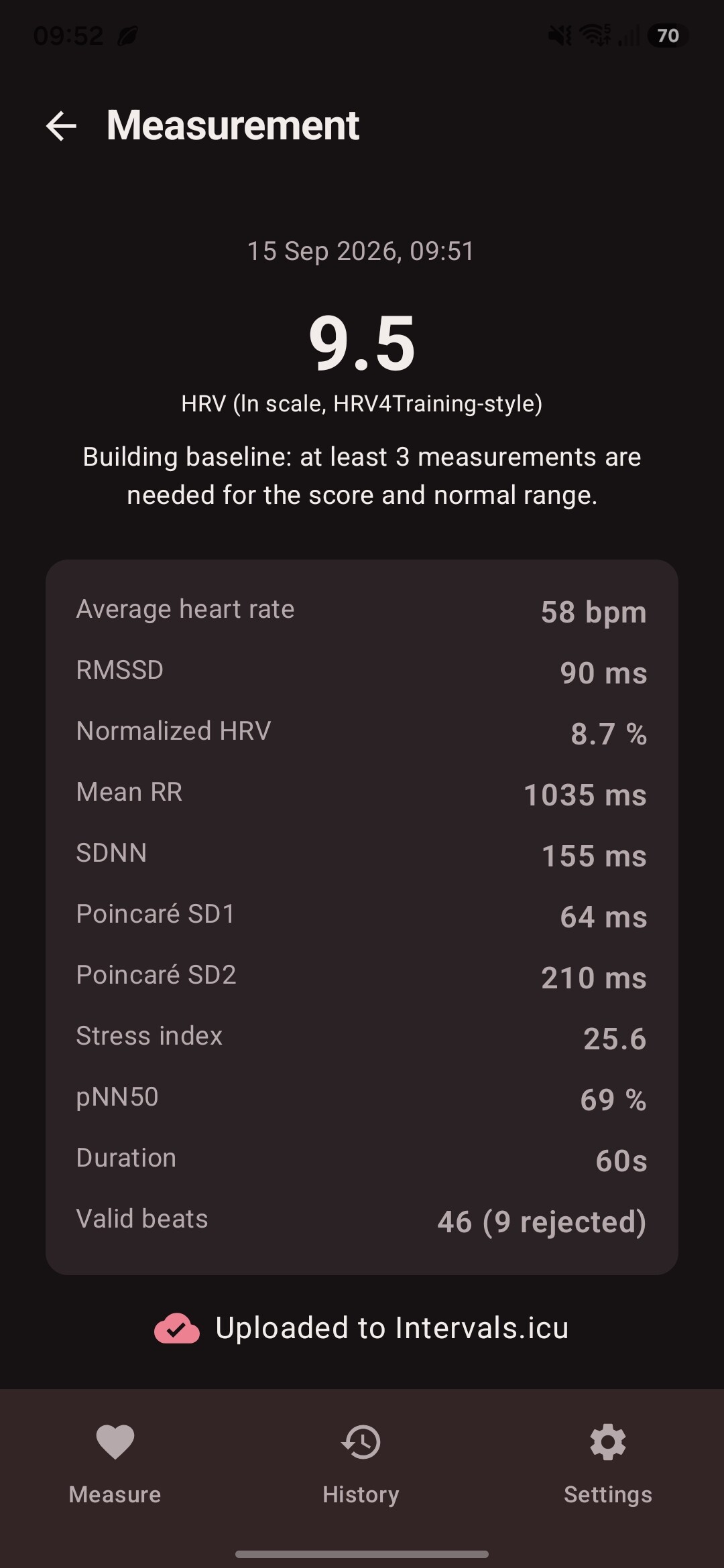
My HRV app is honestly good, took many and many builds to perfect but the result is quite impressive at least (my comparison is HRV4training). Now I’ll take a look at the Kubios data, just to understand how much work that would require…
About the support activity, yes you’re 100% right: some serious business, also the smallest one, needs serious support, no doubt about it, I’m used to it in my day-to-day job ah ah.
That looks as expected. I think a 3 minute window is better than 1 minute. I guess this is configurable.
You have a high level or artefacts - the trick is to try to isolate genuine errors (strap movement etc) and genuine irregular beats which may look like artefacts. This has a major impact on rmSSD which if you are tracking long term trends, is the most important one to follow.
Are you using the Polar SDK? If you do, you can also get credible HRV from the Verity Sense or OH10 bicep straps as well as more options for H9 and H10 users.