As the title states, I really want to optimize my power to weight for an upcoming event in February. The event is 8000 feet of climbing up to about 9000 feet max. I want to do it in 2 hours 20 minutes, beating my time last year by 19 minutes.
Last year, I was a bit lighter, 67-68kg. The problem was, that was very light for me and In order to get down to that weight, I had to sacrifice some training quality. That sort of meant running myself into the ground each day. Currently im about 70-71kg when I wake up. Sometimes a hair under. But I’ve been eating a lot and doing postural work in the gym (back extensions, squats, core work).
I guess my question is, should i say screw it, and keep eating like mad and riding 8k-9000+ kj per week with gym work? Or focus more on trimming my body fat down?
I get that watt/kg are what matters for hill climbs. Trust me. I get it. But on a ~2.5 hour climb, the only way to prepare for it is long hard days of climbing.
What would you do?
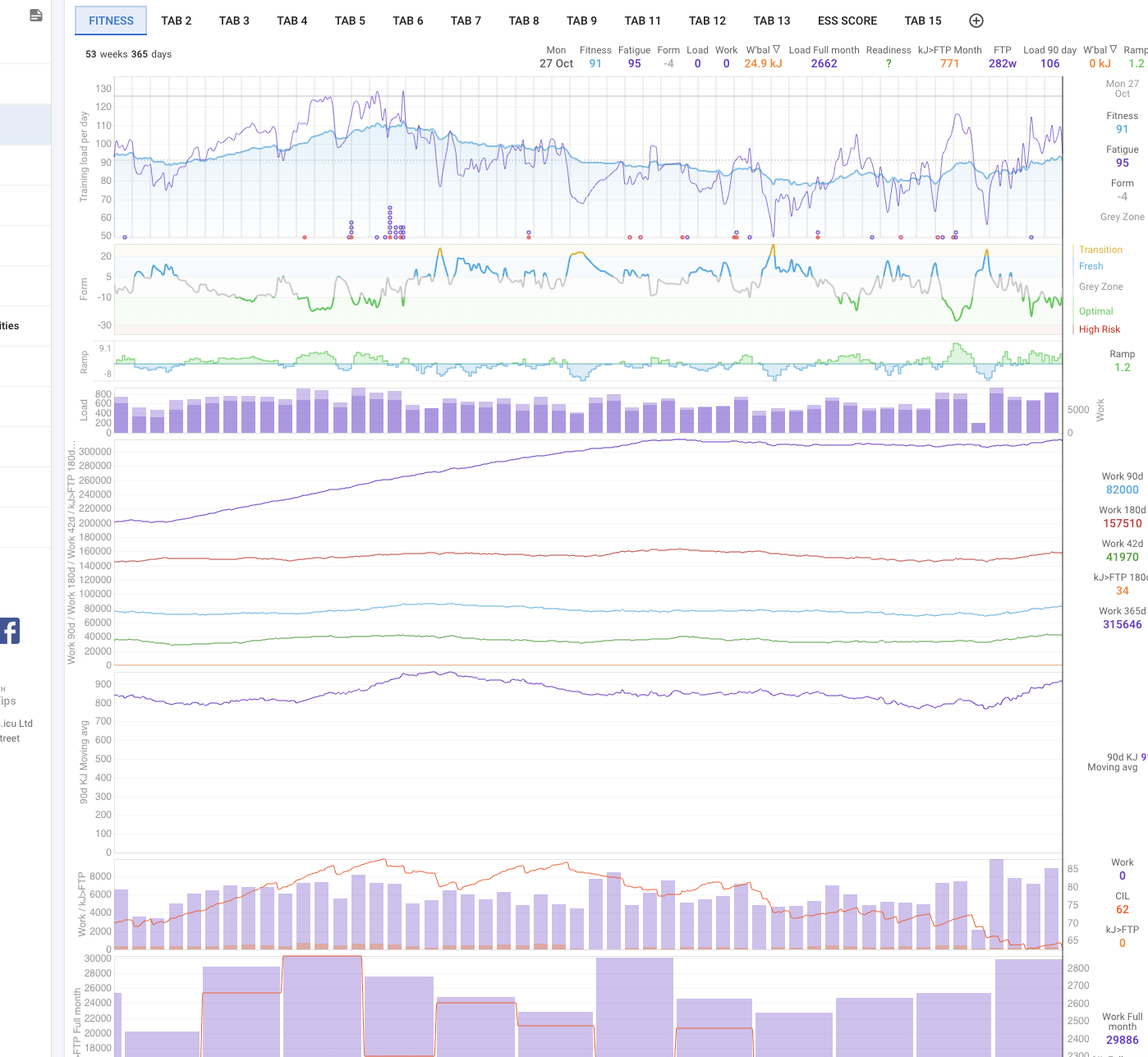
Screenshot of training manager chart here. Not sure if you can compare over time since last february about i changed my FTP from 269 → 281 to more accurately reflect my fitness. AND i’m living at 4800 feet elevation now.
What would you do?
Looking at the data you provide, it seems you are already shaping up very well to put in a great performance in February.
I don’t think I am going to write anything here that you don’t already know, but here is my 2c worth anyway.
w/kg matters for that climb (and any climb) of course, however!
I would say that it isn’t the spot w/kg from your FTP / your current weight that really matters.
It is the w/kg you can sustain for ~2.5 hours on the day, taking into account heat, altitude etc.
If you warm up, then do an all out 20 minute effort, then ride for 60-80 minutes at close to race pace and then do another all out 20 minute effort, what is the power delta between the two 20 minute efforts?
Consider that you have ~3 months to training to reduce that delta, as well as lift overall power.
That is a big chunk of work to do and it needs to be properly fuelled.
As you know, #1 priority is to stay consistent and avoid injuries. Might adding weight loss into the mix increase the risk of derailing the training?
It sounds like you are using the gym work as conditioning to make you faster on that climb for now. No need for any “Arnie” workouts!
TLDR. Don’t ignore weight, but properly fuel the workouts you need to do in order to arrive at the start line in the best shape you can to smash the event.
To answer your question, Likely a delta of about 305w → 255, if i had fueling dialed.
Another issue i have is that the final 40 minutes is like 9% at altitude.
My plan now is to try and ratchet up to 12,000kj per week with a touch of threhsold and vo2 but mostly Z2 until very close to race day and also focus on bulletproofing my core for the steepness.
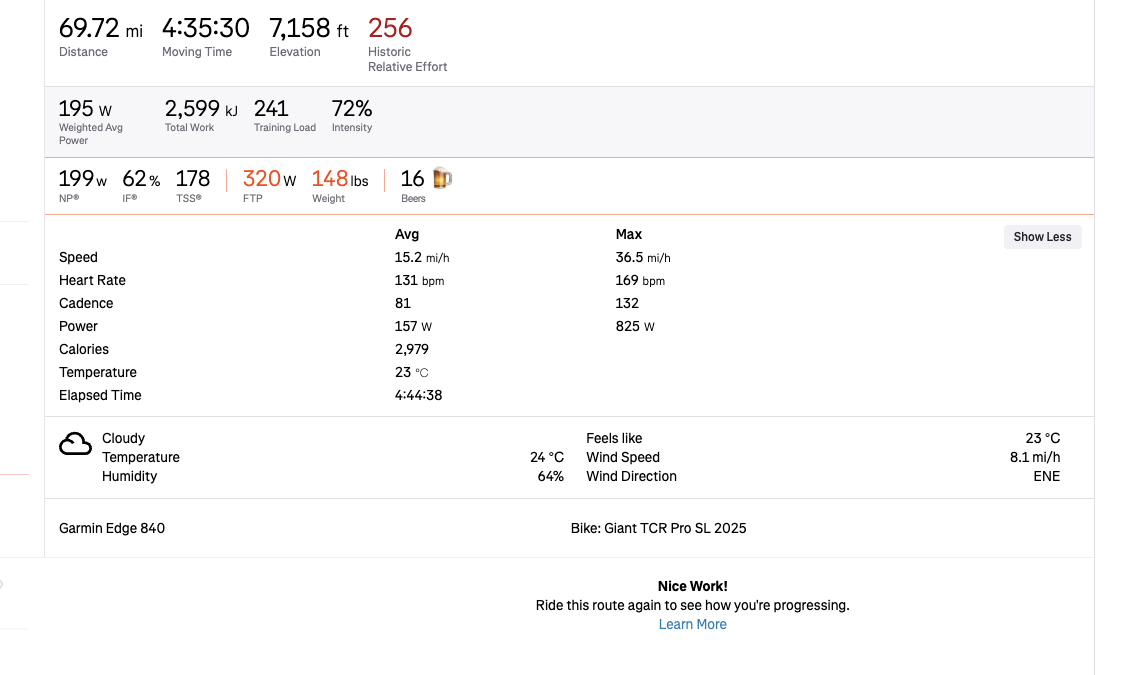
This is my go-to training ride to simulate the event.
1 Like
Don’t know if this helps , but here is my story. After 8 months of surgery, recovery
getting into shape again, I could not lose the 3 kg I have gained.
So I contacted a nutritionist and gave her my training data and a VO2max test that showed how I burned carbs and fat. After 3 months I had slowly lost the 3 kg and had increase my training volume with appr. 70% without any issues what so ever like fatigue. The diet is pretty basic as you probably know , concentrate on carbs and protein (lots of it) but from the right food source. And she insisted that I took creatine as well … 
Seems like a sound plan.
The only thing I would put up for consideration is for you to check your “likely” delta with actual data (by doing it!).
With ~3 months to go, there should be time to fit that (very hard) day in and unless you are very confident that your “likely” is very close to reality, I think there is some value to you in knowing the actual as you refine your training towards the event.
Others (most with more knowledge than me on such things) may well come up with other ideas for you to think about.
I don’t disagree that there’s some value in that and honestly, there may be some value in the training as far as practicing fueling during such a demanding load.
One thing I’ve learned is it’s really friggin hard to go out and ride 2.5-3 hours uninterrupted. My biggest climb here local is only like 2 hours and there still may be a little traffic.
1 Like
Could you do a warm up and the first 20 minute effort on the trainer, then go out and do 60-80 minutes outdoors and come back to do the second 20 minute effort on the trainer?
Also, have you looked at something like bestbikesplit to consider pacing plans for the event?
Unfortunately my trainer is at my other home in a neighboring country. Every “long” route requires substantial high speed downhills. Like i cannot hold 180w-220w without holding the brake. I wish there was some device that allowed me to keep pedaling hard on downhills without smoking my rotors.