I kept wanting to ask when, why and how this is needed?
Finally got a 5 minute interval in.
233 seconds 364 Watts 8/5
300 seconds 352 Watts Today
653 seconds 330 Watts 8/7
High North CP 311 FTP 299 W’ 12.3
I extended the interval to 6 minutes. I definitely was sputtering out as I approached the HN 5 minute estimate of 351 and in death throws for minute 6 at a few Watts higher than the HN estimate of 344 HN estimated the W’ at 12.3kj and 12.2kj respectively the Drop on Intervals.icu was 18.6kj Which was close to the W’ widget on my Garmin. I had some gas for sprint and 2 more 3+ minute efforts in Zone 5 (VO2). I dropped 10kj in the 30 second sprint according to Intervals. The I saw at least 8kj on the widget. But when it is low it comes up fast and I didn’t look right away. I am still not sure what this all means exactly, but it is fun experimenting.
1 Like
So, you don’t HAVE to do three tests, if you’re more experienced and can pace your efforts well, the research suggests two can be sufficient.
Our physiology isn’t precise. Rather than thinking of FTP/CP as a single number think of it as a “phased transition” from sustainable to unsustainable exercise intensity. What a 3rd or even 4th test provides is a realistic range in which your FTP/CP is likely to be. It also can provide you with evidence as to whether to performed the test well or not, a large error suggests one or more of the time trials wasn’t a true maximal effort.
Which 2 tests do you think are more predictive i.e. 3 and 12, 5 and 20 etc
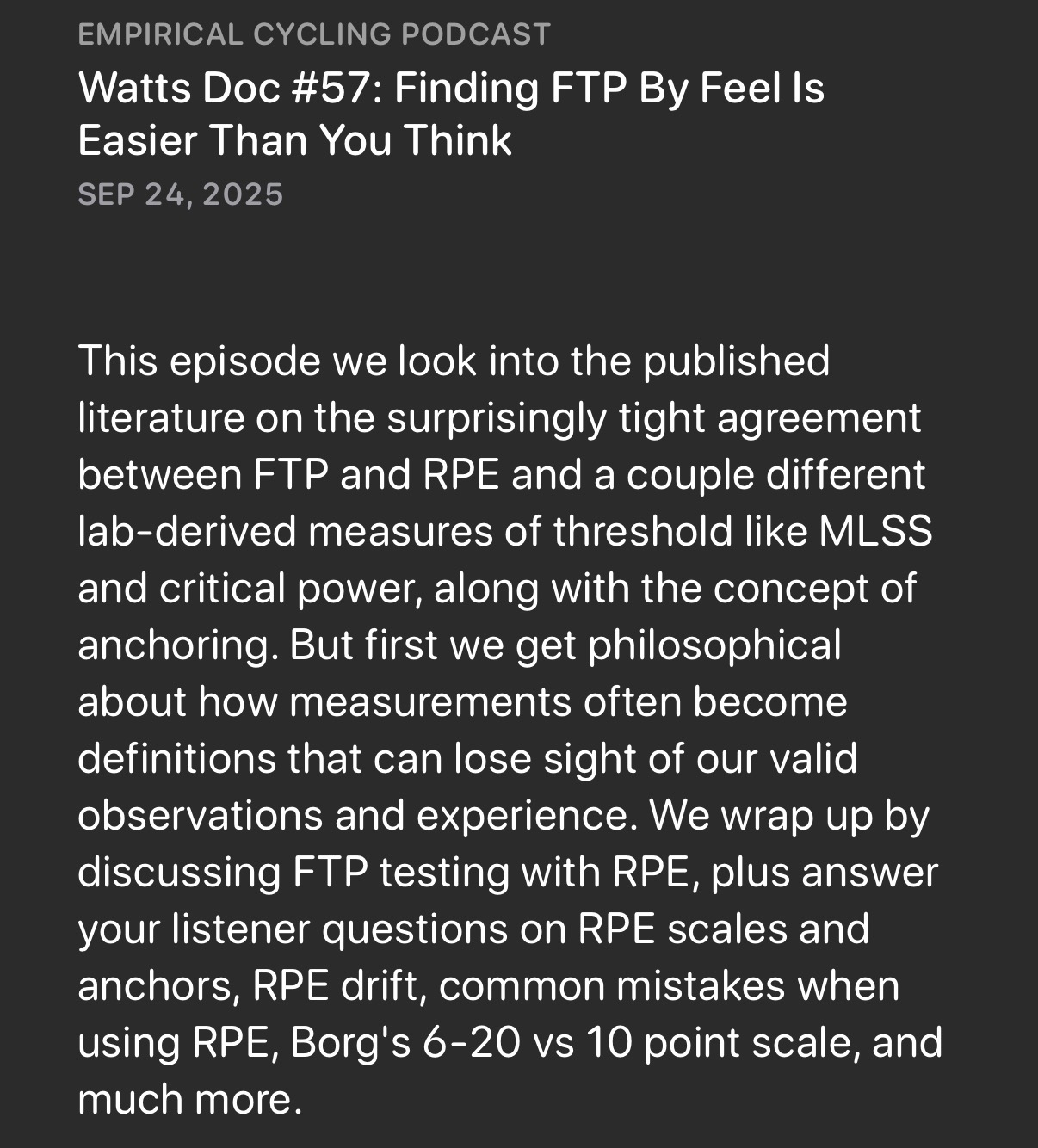
You really need to listen to the first hour, at a minimum, as they discuss models and some interesting studies on riding at threshold based on RPE while also doing lab tests.
1 Like
It doesn’t really matter.
3 & 12 have been used in the cycling literature, but any tests between 3-minutes and up to ~ 15 minutes will be fine. You’ll improve your pacing as you repeat the efforts, which is why for the first few attempts, doing 3 tests will be helpful.
I originally got an HR monitor decades ago and later on a power meter, because I sucked at RPE. LOL. My podcast time is limited for a while.
I’ve done so many FTP tests in the past. So when I do these CP tests now, I go out and do some pretests so I have an Idea how to pace, they do improve but some of that is my FTP or CPs were higher than I expected, doing, no specific training for them. Just riding, sometimes very hard.
did you listen or just talking out loud. Because your next post was about pacing efforts. You know how I figured out FTP by feeling? Going out on the Wednesday flat/windy drop ride and blowing up in 5 minutes, then a couple months later blowing up after 15 minutes, then eventually doing 35-40 minutes to the regroup, and then another 30-40 minutes back. No power meter, no “RPE” - just feeling out when I was about to blow up and backing off, trying to stay on wheels, and finally succeeding at it. In other words, learning how to pace efforts longer than 30 minutes.
No, as I said, my pod cast listening is very limited. I did not listen to it at all. I learned to pace my self on a trainer 20 years ago. I have done 60 minutes at FTP after doing 2 by 20m and 3 by 20m and SST 2 by 30m and then 3 by 30m. Before that I did LTHR tests and plotted it on graph paper and training by HR and Pace on that trainer and later got a Computrainer and repeated that all over again. But I feel we are way off track as my original question was why is there a difference in the Calculated W" from and High North and the recorded drop from Intervals.icu? 14 vs 21kj. Its not a pacing issue, it is a math issue that I am trying to understand.
Probably not a math issue, but different models or a programming issue…
IIRC you also get different FTP/CPs from these…
Do you feed in exactly the same numbers?
Do you know the specific models used?
Did you compute it yourself using one of these?
As a side note, i.icu provides multiple models, plus the original refs (at least, for some). Likely they give you very different values (pairs) already.
PS: Are you really referring to W’’ as in d^2 W / d t^2 ? Missed that before…
Clearly they are likely different implementations of the CP model. And one question I never bothered to investigate is if one of Intervals models
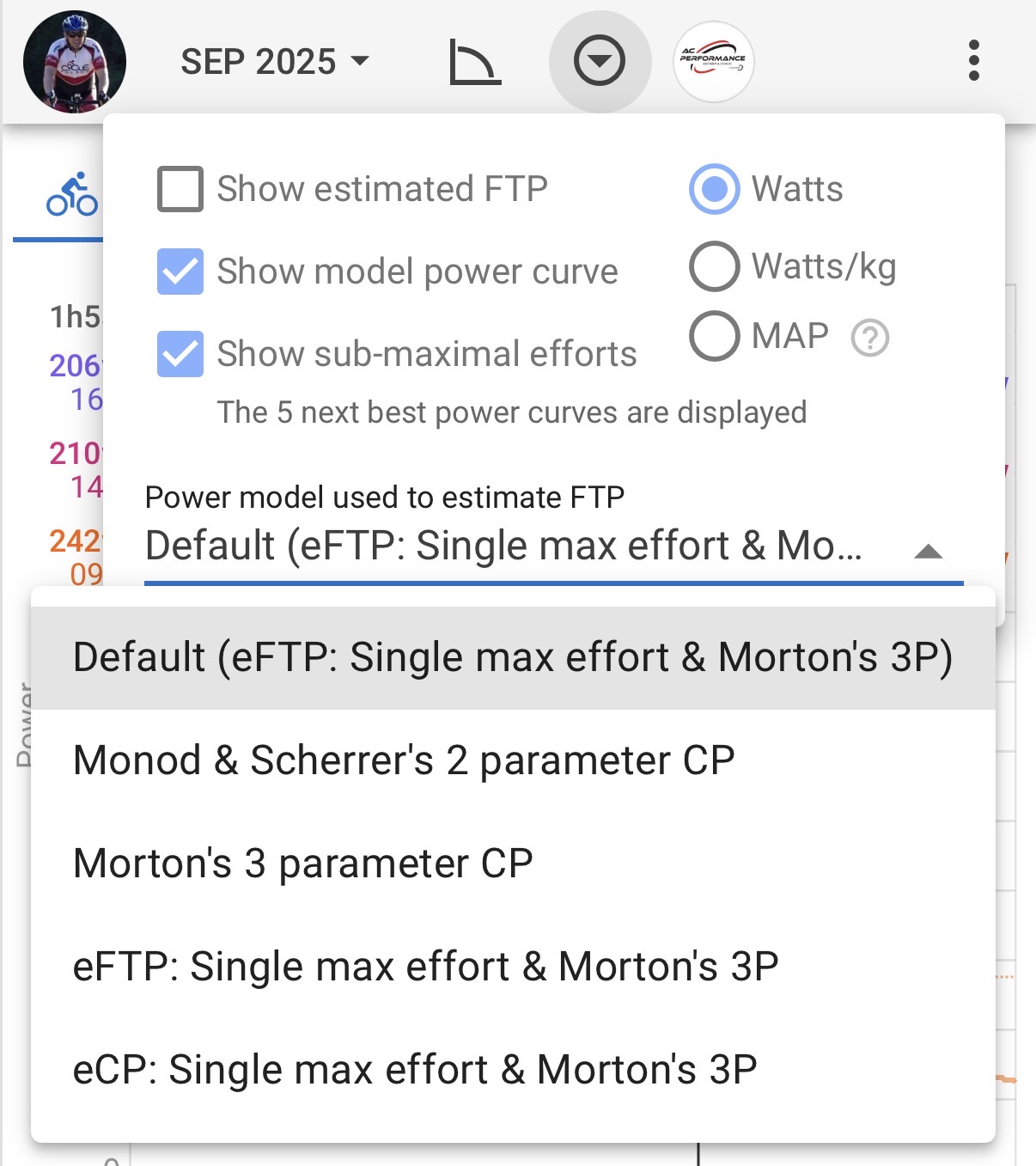
matches HighNorth implementation. My guess is that Morton’s 3P CP should match HighNorth’s calculator. But it’s a guess.
The most important walkaway in my opinion is that any CP model is sensitive to inputs. And that for certain inputs the model may not truly represent the underlying physiology. And then there is stuff like CP model says you can ride say 10W below CP for long long long lengths of time. As discussed on Empirical Cycling podcast. Highly worth a listen, as it also discusses why the WKO performance model is considered superior by some. I primarily use eFTP on Intervals to quickly estimate FTP in the early season before doing any longer threshold efforts (and often have to increase the eFTP Min Duration setting from 180-sec to something a bit longer like 200 or 240).
Models are math.
After a test on 8/5 where I got 992 seconds at 316 Watts Intervals.icu gave eFTP of 296 using the Default Single Max effort and Morton 3P. Highnorth Gave CP 301 FTP 289 Watts.
From the 8/5 efforts HN predicted 313 Watts at 20 minute. On 8/7, I got 314 Watts for 20:17 and Intervals gave and eFTP of 299 Watts for it.
So Highnorth Gave 289 Watts FTP at 14.5kj W’
Interrvals.ICU eFTP 299 at 19.8 eW’ that gave a drop in W’ of 21.3kj for that very same interval.
Now here is the part I am trying to wrap my head around;
If I change my FTP on the activity with that 20 minutes at 314 Watts from 299 to 289 Watts to match Highnorth, then Intervals.icu shows a W’ drop of 32 kj about 150% of the drop at 299 Watt FTP and over double the W’ given by HN
I use 300
I under stand the weakness in the CP model as the duration gets longer. I am not approaching those durations in my tests.
I don’t doubt it. I will search for it at some point.
I started out as a WKO fanboy for the early years, I bought it installed it and used it extensively. I was away for a few years and when I came back, What I thought was a lifetime updated software was deemed end of life. Their new subscription business model, while good for them, left a bad taste in my mouth. So I looked for something else. GC was not intuitive to me, a little cumbersome and resource heavy but had great stuff(I still don’t know what W’ Tau to use). Then I found Intervals.icu and what @david and others do here for free had me subscribe to it faster than anything else that I ever had.
But I am seriously digressing lol. Lets just say I won’t be experiencing WKO or TP any time soon.
Debatable, at least. Here I would think this is “physiological models”. Yes, they should be phrased in the language of math or, in fact, “computer code”, but really, it’s really not math.
The rest of your email is a bit confusing… Maybe setting up a table and making this systematic would help (you), but in first instance my guessing also shows that this is not unreasonable.
I.e., if I assume you wrote
I rode 20 min with AP = 314 W. With an assumed FTP of 299 W this/i.cu gives me a change of W’ of 21.3 kJ. When I, alternatively, assume an FTP of 289 W i.icu gives me a change of W’ of 32 kJ.
This is confusing me.
314 - 299 = 15
314 - 289 = 25
25 / 15 ~= 1.7
32 / 21.3 ~= 1.5
I assume the difference of 1.7 vs. 1.5 comes from modulations of power during the 20 min interval.
Looking above, this is what you should expect. 
Your paraphrasing seems accurate. I did not realize it was as linear at that. Thanks for the math.
So it begs 2 questions, at lest rom me;
Why does Highnorth show 14.5kj for W"?
and
And do you think a 61 year old with than 2 years back on the bike can have a 32 kj W" after taking most of 7 years off?
21.7 kj seems with in the realm though.
For what it’s worth, Intervals.icu shows the variability of that 20 minute 314 Watt interval as 1.
Sorry, I have a low threshold pun intended, for getting this kind of information from podcast. At least from these guys. Made it 7 minutes and that’s with fast forwarding. LOL I’d rather do an 60 minute FTP test on a trainer!